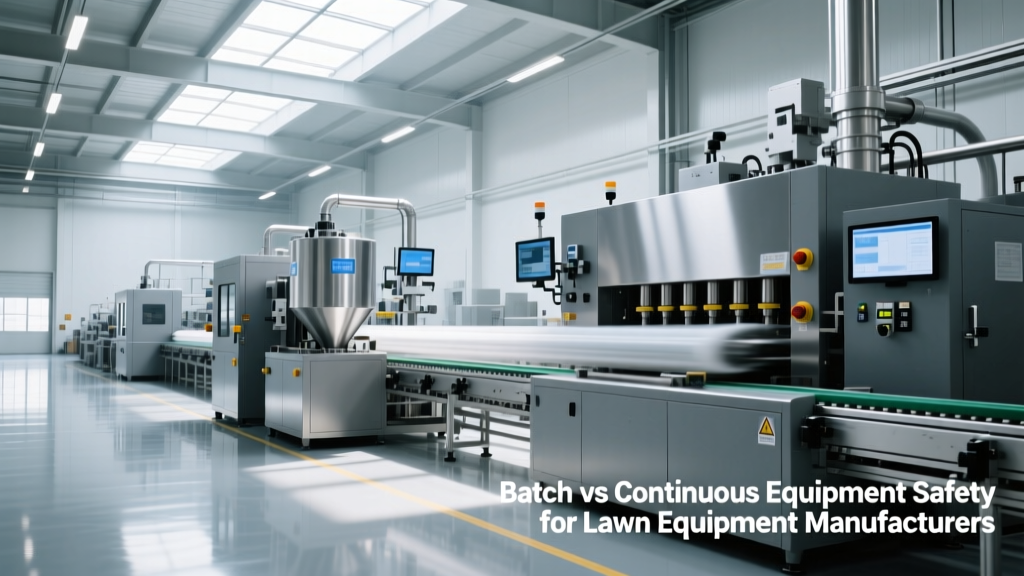
Batch vs Continuous Equipment Safety for Lawn Equipment Manufacturers
Compare batch vs continuous manufacturing safety standards for lawn equipment manufacturers. Explore OSHA compliance, safeguarding, and ANSI guidelines.
The Compliance Divide in Outdoor Power Equipment Production
Lawn equipment manufacturers operate complex, hybrid production floors. Building a commercial zero-turn mower or a residential string trimmer requires both batch processing—such as injection-molding high-density polyethylene (HDPE) grass catchers—and continuous processing, like servo-driven coil feeding for 14-gauge stamped steel mower decks. The safety compliance frameworks governing these two manufacturing paradigms diverge sharply under OSHA regulations and ANSI B11 standards. Misapplying batch safeguarding logic to a continuous roll-forming line, or vice versa, is a primary driver of severe OSHA citations in the outdoor power equipment sector.
OSHA Citation Alert: In 2026, the maximum penalty for a willful machine guarding violation under OSHA's Machine Guarding standards exceeds $165,000 per instance. Lawn equipment plants are frequently cited when continuous stamping lines lack presence-sensing device initiation (PSDI) or when batch molding machines bypass interlocked gate switches.Batch Manufacturing Equipment: Safeguarding the Start-Stop Cycle
Batch equipment in lawn equipment manufacturing is defined by distinct, cyclical operations. High-tonnage injection molding machines producing ABS plastic snowblower chutes and batch powder-coating ovens for tractor chassis operate on a start-dwell-stop-reset sequence. The primary hazard is crushing or shearing during the active stroke or clamp phase.
Critical Compliance Checkpoints for Batch Systems
Under ISO 12100:2010 and ANSI B11.19, batch machinery relies heavily on physical barriers and interlocked access doors. For a 1,500-ton injection molding machine producing mower housings, compliance requires:
- Interlocking Architecture: Utilization of RFID-coded safety switches (e.g., Schmersal AZM400) on all operator-side gates to prevent defeat by simple mechanical overrides.
- Performance Level (PL): Safety circuits must achieve a minimum of PL d, Category 3 under ISO 13849-1, ensuring that a single fault in the gate switch does not lead to a loss of the safety function.
- Escape Release Mechanisms: Inside the mold area, mechanical escape releases must be installed so maintenance technicians clearing a jammed HDPE sprue are not trapped if the machine cycles unexpectedly.
Continuous Manufacturing Systems: Managing Unstoppable Kinetic Energy
Continuous systems, such as roll-forming lines that extrude aluminum profiles for trimmer shafts or progressive die stamping lines fed by continuous coil stock, present fundamentally different hazards. The material is in constant motion, and the kinetic energy of the machinery cannot be halted instantaneously. Safeguarding here shifts from physical barriers to calculated safety distances and presence-sensing devices.
When stamping steel mower blades on a continuous servo-press, operators often interact with the material feed zone. Compliance under OSHA 1910.217 (Mechanical Power Presses) requires strict adherence to safety distance formulas when using light curtains (e.g., SICK deTec4 Core).
The Safety Distance Formula (ANSI B11.19):
S = K x T + C
Where S is the safety distance, K is the hand speed constant (63 inches/second), T is the total stopping time of the continuous press, and C is the penetration depth factor. If a continuous stamping press takes 250ms to stop, the light curtain must be positioned at least 22 inches away from the pinch point. Placing the curtain 12 inches away to save floor space is a guaranteed OSHA willful violation.
Comparative Safeguarding Matrix: Batch vs. Continuous
Plant safety managers must deploy distinct hardware and logic architectures depending on the equipment type. The following matrix outlines the engineering requirements for typical lawn equipment manufacturing cells.
| Parameter | Batch Equipment (e.g., Injection Molding) | Continuous Equipment (e.g., Coil Feed Stamping) |
|---|---|---|
| Primary Hazard | Cyclic crushing, thermal burns, trapped material | Continuous drawing-in, kinetic shearing, coil whip |
| Primary Safeguard | Interlocked physical gates, mechanical blocking | Type 4 Light curtains, safety laser scanners, fixed barriers |
| Stopping Mechanism | Immediate clutch/brake disengagement at top-dead-center | Controlled dynamic braking, calculated coast-down time |
| Safety PLC Standard | ISO 13849-1 (PL d, Cat 3) | IEC 62061 (SIL 3) due to high kinetic energy |
| Muting Requirements | Rarely applicable; gates must fully close | Frequent; automated material entry requires muting lamps/sensors |
Navigating the Transition Zones: Where Batch Meets Continuous
The highest risk for catastrophic injury and subsequent regulatory fines occurs in transition zones. In a modern mower assembly plant, a continuous roll-forming line might produce steel deck skirts that are immediately transferred via conveyor into a batch robotic welding cell.
These handoff areas often fall into a compliance gray zone. If the continuous line pushes material into the batch cell while the robotic welder is active, safeguarding must account for both the drawing-in hazard of the conveyor and the optical/arc hazard of the welding cell. Compliance requires muting sequences governed by a unified safety PLC, such as the Allen-Bradley GuardLogix 5580. The PLC must verify that the material profile breaking the light curtain matches the exact dimensional signature of the mower deck skirt, preventing an operator from reaching through the curtain alongside the material.
Real-World Cost Implications of Non-Compliance
Upgrading legacy transition zones requires capital expenditure, but the cost of non-compliance is exponentially higher. Consider a mid-sized lawn equipment manufacturer operating a 1990s-era continuous stamping line feeding a batch assembly table:
- Legacy Setup: Mechanical pull-back restraints (frequently bypassed by operators to increase cycle speed).
- OSHA Intervention: Following a near-miss report, OSHA inspects and issues two willful citations for bypassed safeguards and lack of PSDI.
- Financial Impact: $330,000 in immediate fines, plus mandatory third-party safety audits costing $45,000.
- Proactive Upgrade Cost: Retrofitting the line with SICK microScan3 safety laser scanners and a GuardLogix controller costs approximately $65,000 to $85,000, yielding a positive ROI within six months purely on risk mitigation and reduced downtime.
Strategic Safety Auditing Framework for Production Upgrades
For plant engineers and EHS directors in the outdoor power equipment sector, executing a compliant transition from legacy machinery to modern, integrated safety networks requires a structured approach.
- Map the Kinetic Energy Profiles: Do not apply uniform safety standards across the floor. Calculate the exact stopping times (in milliseconds) for every continuous servo-press and the clamping forces for every batch injection molder. Document these in a centralized ISO 12100 risk assessment matrix.
- Audit Interlock Defeat Vulnerabilities: Inspect all batch equipment gates. If an operator can defeat a magnetic safety switch with a spare piece of steel or a zip-tie, the system is non-compliant. Upgrade to RFID-coded, uniquely coded actuators (e.g., Euchner CTM series) that cannot be bypassed.
- Validate Muting Logic on Continuous Feeds: On continuous coil feeds and roll-formers, test the muting sequences. Ensure that muting is only active for the exact duration required for the raw material to pass the hazard point, and that the system defaults to a safe-stop state if the muting sensors are obscured by dust or metal shavings.
- Implement Safety Network Diagnostics: Transition from hardwired safety relays to networked safety protocols like CIP Safety over EtherNet/IP. This allows the central SCADA system to log every time a batch gate is opened or a continuous light curtain is broken, providing EHS teams with predictive data on operator behavior and potential compliance drift before an accident occurs.