Equipment Selection for a Medical Equipment Manufacturing Company
Learn how a medical equipment manufacturing company evaluates contract manufacturing equipment for operator trainability, HMI usability, and FDA compliance.
The Hidden Cost of Poor Equipment Trainability in Medical Device Production
When a medical equipment manufacturing company scales production through contract manufacturing, capital expenditure discussions typically center on spindle speeds, cycle times, and micron-level tolerances. However, from an operator training and best practices perspective, the true bottleneck in 2026 is human-machine interaction. The industry is currently facing a severe shortage of skilled CNC machinists and injection molding technicians. Consequently, selecting production equipment that requires 120 hours of supervised training to operate safely in an ISO Class 7 cleanroom is a massive financial liability.
Evaluating contract manufacturing equipment strictly through the lens of operator trainability, ergonomic safety, and regulatory compliance is no longer optional. A machine that is difficult to operate leads to higher scrap rates in expensive medical-grade materials like PEEK (Polyether ether ketone) or Titanium Ti-6Al-4V ELI. With fully burdened medical device operators costing between $45 and $60 per hour in 2026, a steep learning curve directly inflates the Cost of Poor Quality (COPQ). This guide outlines the exact criteria training managers and production leads must use when selecting new manufacturing platforms.
⚠️ Regulatory Warning: FDA 483 ObservationsA significant percentage of FDA Form 483 observations in medical device manufacturing stem from inadequate operator training and failure to follow validated Standard Operating Procedures (SOPs). If the equipment's Human-Machine Interface (HMI) is counterintuitive, operators will develop undocumented 'workarounds,' directly violating your validated manufacturing process and triggering regulatory action.
The Cognitive Load & HMI Audit
The Human-Machine Interface (HMI) is the primary bridge between your operator and the manufacturing process. When auditing a new machine, training managers must evaluate the cognitive load required to execute standard tasks. We look specifically at alarm management, navigation depth, and conversational programming capabilities.
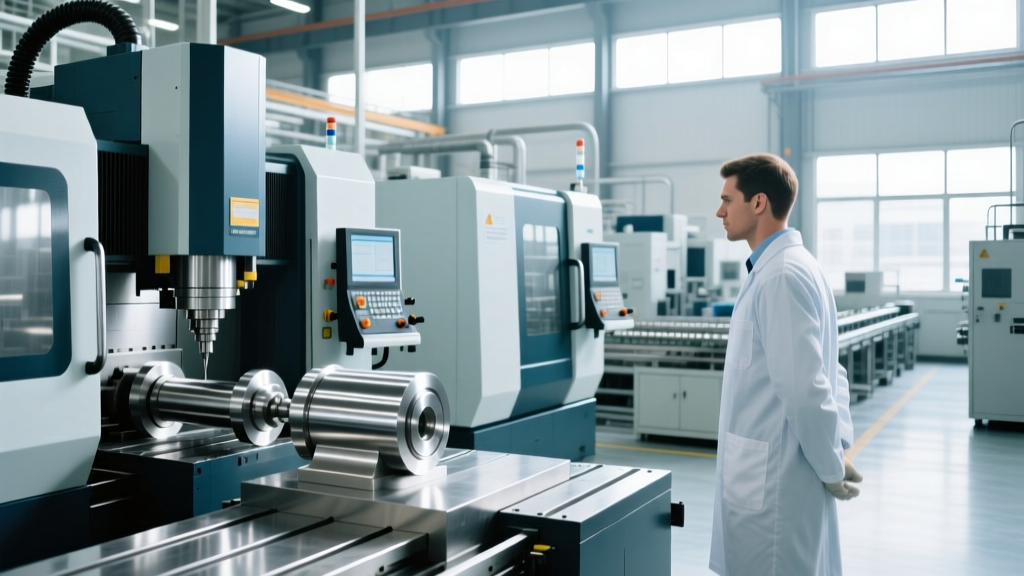
For CNC machining centers used in orthopedic implant production, the control system dictates training time. The Fanuc 0i-F Plus control, utilizing the Manual Guide i conversational programming interface, allows novice operators to set up standard milling operations without deep CAM software knowledge. In contrast, older or highly customized HMIs that require navigating through four to five sub-menus to adjust a simple coolant flow rate induce 'alarm fatigue' and increase setup errors.
For medical-grade injection molding, platforms like the Arburg Allrounder 370 A feature the arburgXworld interface, which provides digital twin integration and step-by-step guided setup wizards on a 15-inch multi-touch display. These guided wizards reduce initial mold-setup training time by up to 40% compared to traditional parameter-entry screens.
Trainability Matrix: Comparing Top Medical Manufacturing Platforms
Below is a comparison matrix evaluating leading equipment models based on operator trainability, error-proofing (Poka-Yoke), and cleanroom readiness. This framework should be adapted for your specific capital equipment RFQs.
| Machine Platform | Primary Application | HMI / Control System | Avg. Novice Training Time | Built-in Poka-Yoke Features | ISO Class 7 Ready? |
|---|---|---|---|---|---|
| Brother Speedio S140X2 | Titanium/PEEK Implant Milling | Brother CNC-C00 (Customized) | 60 - 80 Hours | Tool life management, load monitoring, collision prevention | Yes (with enclosed coolant/HEPA) |
| Haas DT-1 | Surgical Instrument Prototyping | Haas Next Gen Control | 40 - 60 Hours | Visual probing, intuitive tool offsets, wireless MPG | No (Requires aftermarket enclosure) |
| Arburg Allrounder 370 A | Medical Consumables (Syringes, Vials) | arburgXworld (Selogica/aXworld) | 80 - 100 Hours | Fill-level monitoring, virtual molding setup wizards | Yes (Electric drive, no hydraulic leaks) |
| Engel e-mac 180 | Diagnostic Device Housings | Engel iQ 4.0 Control | 90 - 110 Hours | iQ weight control, automated viscosity compensation | Yes (Fully electric, cleanroom rated) |
Cleanroom Ergonomics and Physical Operator Interaction
Operating machinery inside an ISO Class 7 or ISO Class 8 cleanroom fundamentally alters human ergonomics. Operators wearing Tyvek suits, double-layered nitrile gloves, and face shields experience reduced tactile feedback, restricted peripheral vision, and limited mobility. Equipment selection must account for these physical barriers.
According to guidelines published by the Occupational Safety and Health Administration (OSHA), repetitive motion and awkward postures are leading causes of musculoskeletal disorders. In a cleanroom, these risks are amplified. When evaluating equipment, measure the following physical interaction points:
- Loading Heights: Material loading and part extraction zones must fall within the 'green zone' of 34 to 48 inches from the floor. Bending to load raw PEEK billets into a low-profile chuck while wearing a restrictive cleanroom suit accelerates fatigue and increases the likelihood of dropping and contaminating expensive medical-grade stock.
- Tactile vs. Capacitive Controls: Capacitive touchscreens are highly unreliable when operators are wearing thick cleanroom gloves. Prioritize machines with physical, heavy-duty push buttons for critical functions (Cycle Start, Feed Hold, E-Stop) and resistive or glove-compatible touchscreens for the HMI.
- Visual Contrast: Status indicator towers (Andon lights) must be high-intensity and positioned above the operator's sightline to be visible over the top of cleanroom hoods.
FDA 21 CFR Part 11 & Electronic Training Records
For any medical equipment manufacturing company producing Class II or Class III devices, the equipment's software must comply with FDA 21 CFR Part 11 regarding electronic records and signatures. This heavily impacts operator training and access control.
If a machine controller allows multiple operators to log in under a shared 'Admin' or 'Setup' password, it is fundamentally non-compliant for medical device production. The equipment must support individualized, secure logins (preferably via RFID badge tap or biometric scan) that tie every parameter change, setup adjustment, and production run to a specific, trained operator. Furthermore, the machine's software must natively support audit trails that cannot be altered or deleted by the operator, ensuring that training managers can verify exactly who ran the machine and whether their training certifications were current at the time of production.
'Usability engineering is not just about making a device easy to use for the patient; it extends to the manufacturing equipment used to produce it. Applying the principles of IEC 62366-1 to the factory floor reduces use errors during assembly and machining, directly safeguarding the final patient.' — Adapted from Human Factors Engineering principles in medical device manufacturing.
The 'Day in the Life' Operator Validation Protocol
Before signing a purchase order for any new contract manufacturing equipment, training managers must mandate a physical validation test. Relying on OEM brochures or a 30-minute sales demonstration is insufficient. Implement this 4-step validation protocol on the showroom floor or during a site visit to an existing user.
Step 1: The Novice Shadow Test (4 Hours)
Assign a mid-level operator (someone with 1-2 years of experience, not a master machinist or senior technician) to run the machine for four consecutive hours. The OEM applications engineer is only allowed to intervene if a safety hazard occurs. Track the number of times the operator hesitates, navigates to the wrong menu, or requires a prompt to clear a standard alarm. If the novice operator cannot clear a 'door open' or 'low coolant' alarm within 30 seconds using only the HMI prompts, the machine fails the trainability audit.
Step 2: The Error-Recovery Drill
Intentionally induce a common fault—such as a tool breakage detection trigger or a temperature deviation in the molding barrel. Measure the exact time and number of steps required for the operator to diagnose the issue, safely clear the fault, and resume production. Machines that require a full system reboot or a call to OEM support for minor, recoverable faults will devastate your OEE (Overall Equipment Effectiveness) metrics.
Step 3: The Changeover Time Trial (SMED)
Medical contract manufacturing relies on high-mix, low-volume production runs. Perform a Single-Minute Exchange of Die (SMED) test. Time how long it takes the operator to swap from a left-knee tibial tray fixture to a right-knee fixture. Evaluate the physical weight of the fixturing, the location of the zero-point clamping systems, and whether the HMI automatically loads the correct offset parameters via RFID tool tags.
Step 4: The Cleaning and Bioburden Validation
Finally, assess the machine's physical geometry for cleanability. Medical equipment manufacturing demands rigorous bioburden control. Look for sloped surfaces that prevent dust accumulation, sealed cable conduits, and the absence of exposed threads or blind holes where biological contaminants or cleaning solvents can pool. If a machine requires an operator to use a toothbrush to clean out a chip conveyor crevice, it is not suited for a regulated medical production environment.
Final Decision Framework for Equipment Buyers
Selecting the right machinery is a balance of mechanical capability and human usability. By prioritizing HMI cognitive load, cleanroom ergonomics, and native FDA Part 11 compliance, a medical equipment manufacturing company can drastically reduce onboarding time, minimize scrap, and ensure a bulletproof regulatory posture. Always let the end-user—the operator on the floor—have the final veto power during the equipment selection process.