Automation Costs for Medical Imaging Equipment Manufacturers (2026)
A 2026 CapEx guide for medical imaging equipment manufacturers detailing automated line integration costs, FDA validation fees, and ROI models.
The CapEx Reality: Hardware vs. Integration in Imaging Lines
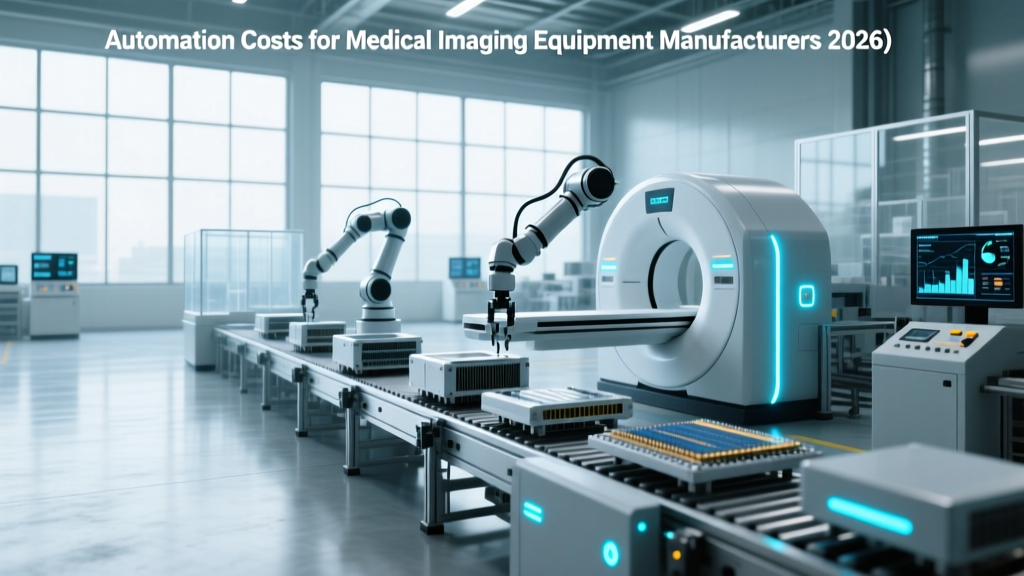
When medical imaging equipment manufacturers plan production line upgrades, the initial focus often lands on robot arm price tags. However, the capital expenditure (CapEx) for automated integration in the medical device sector operates on a completely different multiplier than automotive or consumer electronics. Imaging systems require low-volume, high-mix production environments with extreme precision tolerances, often inside ISO Class 7 or Class 8 cleanrooms.
Consider the assembly of a CT scanner gantry. This process involves mounting heavy, precision-balanced slip rings and X-ray tubes. A standard heavy-payload robot like the KUKA KR QUANTEC series might cost $110,000 to $140,000 for the base manipulator. But the actual cost to integrate that robot into a functional, validated production cell—including custom end-of-arm tooling (EOAT), safety PLCs, cleanroom-rated protective suits, and vision-guided robotics (VGR)—frequently pushes the single-cell cost past $450,000.
| Automated Cell Type | Primary Application | Base Hardware Cost | Fully Integrated Cost (2026) |
|---|---|---|---|
| Heavy-Payload Gantry Assembly | CT Scanner Slip Ring & Tube Mounting | $120,000 - $150,000 | $450,000 - $620,000 |
| Precision Fluid Dispensing | MRI Gradient Coil Potting & Sealing | $85,000 (e.g., Nordson EFD) | $280,000 - $350,000 |
| Cobot Inspection Cells | Ultrasound Piezoelectric Crystal Alignment | $45,000 (e.g., UR20) | $165,000 - $210,000 |
| Automated Optical Inspection (AOI) | CT Detector Board PCB Verification | $180,000 (e.g., Keyence 3D) | $310,000 - $400,000 |
The 42% Integration Premium and EOAT Engineering
The most frequent budget overrun in automated production line equipment integration stems from End-of-Arm Tooling (EOAT) and custom fixturing. Medical imaging components are notoriously fragile and geometrically complex. For example, an X-ray tube's beryllium window is highly sensitive to micro-scratches and pressure points. Standard pneumatic grippers will destroy the component.
Manufacturers must budget for custom-engineered vacuum grippers equipped with ATI Industrial Automation force-torque sensors to ensure contact pressure remains below 2 Newtons during pick-and-place operations. Engineering these bespoke EOAT solutions, complete with cleanroom-compatible materials (like PEEK and anodized aluminum to prevent particulate shedding), typically adds $60,000 to $95,000 per robot.
Integrator Selection Note: Do not award integration contracts based solely on the lowest hardware bid. In 2026, the bottleneck is controls engineering. Ensure your systems integrator has dedicated staff for FDA-compliant SCADA architecture, not just standard industrial PLC programming.
FDA 21 CFR Part 820 and the Validation Tax
Unlike automotive manufacturing, where a process is validated once and monitored via statistical process control (SPC), medical device manufacturing requires rigorous Installation, Operational, and Performance Qualification (IQ/OQ/PQ). Under FDA 21 CFR Part 820, any automated process that cannot be fully verified by subsequent inspection and testing must be validated with a high degree of assurance.
If an automated dispenser applies thermal interface material (TIM) to an IGBT module inside an MRI power supply, and that TIM application cannot be 100% non-destructively verified post-cure, the dispensing process must be validated. Budgeting for this 'Validation Tax' is critical:
- IQ (Installation Qualification): $8,000 - $12,000 per cell (verifying calibration, utilities, and software version control).
- OQ (Operational Qualification): $15,000 - $25,000 per cell (testing process windows, high/low parameter limits, and alarm states).
- PQ (Performance Qualification): $25,000 - $45,000 per cell (running consecutive production lots to prove statistical capability, Cpk > 1.33).
Many manufacturers budget for hardware IQ/OQ/PQ but forget to budget for Automated Manufacturing System (AMS) software validation. If your integrated line uses a custom Python script or a proprietary C# application to log torque data from a screwdriving spindle to your MES (Manufacturing Execution System), that software must undergo independent validation under FDA General Principles of Software Validation. Allocate an additional $20,000 to $35,000 per custom software module.
Operational Savings: Scrap Reduction in High-Stakes Assembly
To justify the $2M+ CapEx of an integrated imaging line, financial models must look beyond direct labor reduction. In medical imaging, the cost of scrap and rework vastly outweighs hourly labor savings. Consider the manufacturing of X-ray tubes, which require a high-vacuum environment to function. A single microscopic leak in the brazed joints of the tube housing results in catastrophic arcing during testing, destroying a component valued at $30,000 to $60,000.
Integrating automated helium mass spectrometer leak testing directly into the assembly line—using robotic arms to move the tubes between vacuum chambers and sniffing probes—reduces false-pass rates. According to internal industry benchmarks, automated leak-testing integration reduces tube scrap rates by 18% to 24%. When a single scrapped X-ray tube costs $45,000 in raw materials and lost cleanroom time, preventing just 40 scrapped units a year yields $1.8M in recovered margins, paying for the integration in under 14 months.
Strategic Budgeting Framework for 2026 Expansions
Medical imaging equipment manufacturers should avoid 'big bang' automation overhauls. The most financially sound approach utilizes a phased integration framework aligned with ISO 13485:2016 risk management protocols.
- Phase 1: Automate the Bottleneck and the Hazard (Months 1-6)
Target processes that limit throughput or expose workers to hazards. For MRI manufacturers, this means automating the winding and tensioning of superconducting niobium-titanium wire, a process where human fatigue leads to tension variances and subsequent quench failures. Budget: $800,000. - Phase 2: Integrate Automated Metrology (Months 7-12)
Instead of moving parts to a CMM (Coordinate Measuring Machine) lab, integrate inline 3D laser profiling (e.g., Keyence LJ-X series) directly onto the assembly line to verify CT detector array alignments in real-time. This eliminates WIP (Work in Process) queuing. Budget: $350,000. - Phase 3: Close the Loop with MES Integration (Months 13-18)
Connect the automated cells to the central MES for complete electronic device history record (eDHR) automation. This eliminates manual batch record paperwork, reducing QA release times from 14 days to 48 hours. Budget: $250,000 for software integration and validation.
By structuring CapEx around risk reduction and scrap prevention rather than simple headcount reduction, manufacturers can build a resilient, compliant production infrastructure. For deeper technical frameworks on smart manufacturing interoperability, the NIST Smart Manufacturing division provides excellent open-source reference architectures for integrating legacy imaging assembly equipment with modern IIoT sensors.