Candy Manufacturing Equipment Safety: Batch vs Continuous Lines
Compare batch and continuous candy manufacturing equipment through the lens of FDA, EHEDG, and OSHA safety compliance. Make the right capital investment.
The Regulatory Divergence: Sanitary Design and Food Safety
When evaluating candy manufacturing equipment, the choice between batch and continuous processing architectures extends far beyond throughput rates. From a compliance perspective, these two methodologies trigger entirely different regulatory frameworks regarding sanitary design, chemical handling, and pathogen mitigation. Hard candy, gummies, and caramels require distinct thermal and moisture profiles, which directly dictate the safety architecture of the production line.
Regulatory Baseline: All confectionery processing systems must comply with FDA 21 CFR Part 110 (Current Good Manufacturing Practice). However, continuous lines are increasingly audited against EHEDG (European Hygienic Engineering & Design Group) guidelines for automated Clean-In-Place (CIP) validation, whereas batch systems are heavily scrutinized for manual Clean-Out-of-Place (COP) cross-contamination risks.Batch Systems: COP and Manual Intervention Risks
Batch vacuum cookers, such as the Chocotech Sucroliner, rely on discrete processing cycles. Once a batch of hard candy mass reaches 145°C–160°C (293°F–320°F) and achieves the target 1-2% moisture content, the vessel is vented and the mass is manually or semi-automatically dumped onto cooling tables. From a food safety standpoint, batch equipment requires COP procedures. Operators must manually disassemble valves, scrapers, and discharge chutes to clean residual sugar and flavorings. This manual intervention introduces a high risk of Listeria or Salmonella cross-contamination if sanitation SOPs are not strictly followed. Compliance requires rigorous ATP swab testing after every washdown, increasing labor costs and chemical exposure.
Continuous Systems: CIP Automation and Chemical Safety
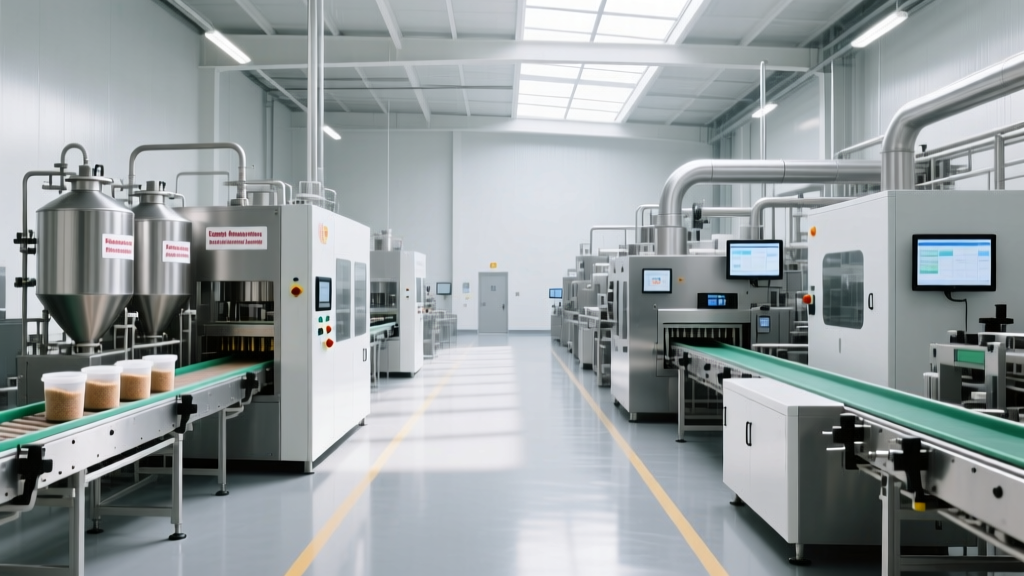
Continuous thin-film cookers, like the Hänsel Processing Vacumat or Microfilm systems, operate in a closed-loop environment. The sugar syrup is pumped continuously through a heated tube, flash-evaporated in a vacuum chamber, and extruded directly onto a continuous cooling belt. Because the product path is enclosed, continuous candy manufacturing equipment utilizes automated CIP systems. While this eliminates manual COP contamination risks, it introduces strict chemical compliance hazards. CIP systems utilize 1.5% to 2.0% sodium hydroxide (NaOH) at 60°C–70°C. If CIP interlocks fail or conductivity sensors drift out of calibration, caustic residues can contaminate the candy mass, leading to catastrophic product recalls and severe consumer injury.
Operator Safety: Thermal Burns vs. Mechanical Nip Points
OSHA enforcement in confectionery plants heavily targets thermal burns and mechanical amputations. The physical state of the candy mass dictates which hazard dominates the factory floor.
| Hazard Category | Batch Equipment Profile | Continuous Equipment Profile |
|---|---|---|
| Thermal Exposure | High. Manual dumping of 150°C mass creates splash zones and radiant heat exposure. | Low. Mass is enclosed until it reaches the cooling belt, dropping below 80°C. |
| Mechanical Nip Points | Moderate. Limited to batch mixer paddles and discharge augers. | Severe. Continuous sizing rollers, extruders, and guillotine cutters create dozens of in-running nip points. |
| Ergonomic Strain | High. Manual scraping, lifting of flavor/color micro-ingredients, and table pulling. | Low. Automated dosing and continuous conveying eliminate heavy lifting. |
| Primary OSHA Focus | PPE compliance (thermal aprons, face shields) and burn first-aid stations. | Machine guarding (OSHA 1910.212) and light curtain validation. |
Continuous lines require extensive guarding. A standard continuous candy forming line includes a continuous rope sizer, a multi-roller sizing station, and a rotary die former. Every roller interface is a potential amputation hazard. Compliance mandates the installation of Type 4 safety light curtains and zero-speed monitoring VFDs that halt the line within milliseconds if an operator breaches the perimeter. Batch lines, conversely, require heavy investment in thermal PPE and localized exhaust ventilation to manage the volatile organic compounds (VOCs) released when liquid flavors are manually injected into the hot candy mass.
Lockout/Tagout (LOTO) Complexity and Energy Isolation
The most frequently cited OSHA violation in food manufacturing is inadequate energy control procedures under OSHA 1910.147. The complexity of LOTO procedures scales exponentially with the automation level of the equipment.
- Batch LOTO Profile: A standard batch vacuum cooker has 4 to 6 primary energy isolation points: the main electrical disconnect, the steam inlet valve, the cooling water valve, the vacuum pump, and the compressed air supply for pneumatic discharge valves. Creating a machine-specific LOTO procedure is straightforward, and annual operator training is easily managed.
- Continuous LOTO Profile: A continuous cooking and forming line spanning 40 meters may contain over 50 individual energy isolation points. This includes multiple variable frequency drives (VFDs), high-pressure steam lines, thermal oil heating circuits, CIP chemical dosing pumps, and localized pneumatic actuators. Compliance requires complex Group LOTO procedures, often necessitating a designated LOTO coordinator and multi-lock hasps. Failure to isolate stored energy in a continuous line's thermal oil system can result in fatal burns during maintenance.
Dust Explosion Hazards: Starch Moguls vs. Starchless Extrusion
When manufacturing gummies or jellies, the choice between traditional starch-mogul lines and modern starchless continuous depositors introduces a massive divergence in combustible dust compliance (NFPA 652).
'Batch starch-mogul lines require the continuous drying, sifting, and recycling of corn starch. This generates massive volumes of suspended combustible dust. Facilities must invest heavily in NFPA-compliant dust collection systems, explosion venting, and intrinsically safe electrical enclosures to prevent catastrophic deflagration.'
Continuous starchless depositors, such as those manufactured by Winkler & Dunnebier (W&D) or Makat, eliminate the starch handling process entirely. The gummy mass is deposited directly into precision-machined PTFE or silicone molds. From a safety compliance perspective, starchless continuous equipment removes the combustible dust hazard from the equation, drastically reducing the facility's insurance premiums and eliminating the need for ATEX-rated electrical components in the depositor zone.
Capital Expenditure and Compliance ROI Matrix
When projecting the 2026 capital expenditure for candy manufacturing equipment, safety and compliance costs must be factored into the total cost of ownership (TCO), not just the initial equipment purchase price.
Financial & Compliance Breakdown
Batch Vacuum Cooking Line:
- Base Equipment Cost: $180,000 – $350,000
- Sanitation & COP Infrastructure: $40,000
- Thermal PPE & Burn Mitigation: $15,000 annually
- Workers' Compensation Risk Profile: High (repetitive strain and thermal burns)
Continuous Thin-Film Cooking & Forming Line:
- Base Equipment Cost: $1,200,000 – $2,500,000+
- CIP System & Chemical Dosing Interlocks: $120,000
- OSHA Machine Guarding & Light Curtains: $85,000
- Workers' Compensation Risk Profile: Low (highly automated, enclosed thermal zones)
Decision Framework: Which System Fits Your Compliance Profile?
Selecting between batch and continuous candy manufacturing equipment requires aligning your production goals with your facility's risk tolerance and compliance maturity.
- Choose Batch Equipment If: Your facility produces highly customized, small-run artisanal candies with frequent recipe changes. You must have a mature, well-documented COP sanitation program and a workforce trained in strict thermal PPE protocols. Batch systems offer lower upfront capital costs but demand rigorous, daily manual compliance efforts to satisfy FDA auditors.
- Choose Continuous Equipment If: You are producing high-volume, standardized SKUs (e.g., standard hard candies, continuous gummy ropes). Continuous systems are mandatory if your corporate safety mandate prioritizes the elimination of manual thermal handling and combustible dust hazards. While the upfront capital and machine guarding costs are substantial, the automated CIP validation and reduced LOTO frequency provide a superior long-term compliance ROI and significantly lower the risk of OSHA citations.
Ultimately, safety compliance in confectionery processing is not an afterthought; it is engineered into the metallurgy, the automation logic, and the physical footprint of the machinery. By mapping your specific product portfolio against the distinct OSHA and FDA profiles of batch versus continuous systems, you can engineer a production floor that protects both your operators and your brand integrity.