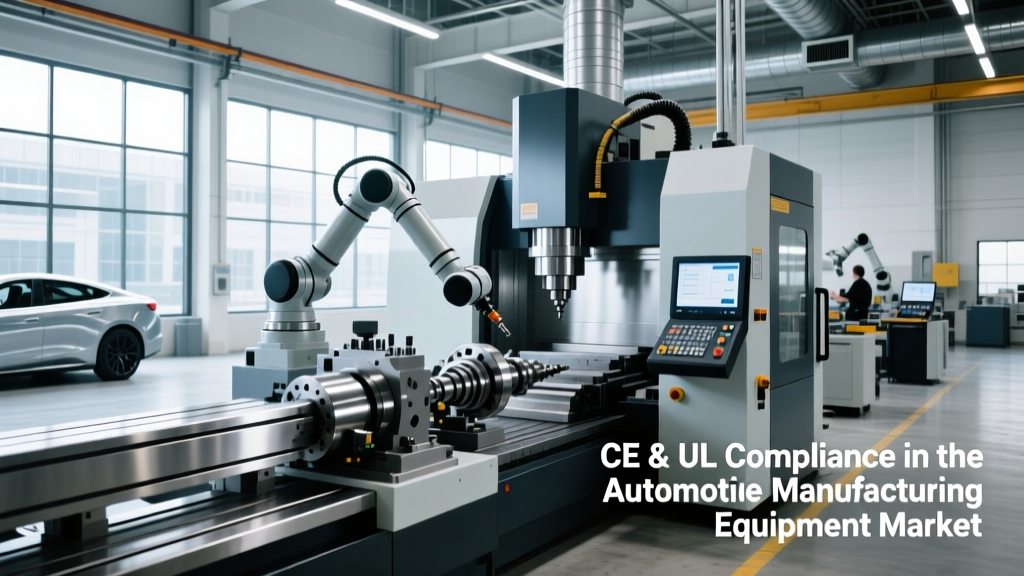
CE & UL Compliance in the Automotive Manufacturing Equipment Market
Navigate CE, UL, and CSA compliance for the automotive manufacturing equipment market. Explore EV assembly case studies, certification costs, and regulations.
The automotive manufacturing equipment market operates on razor-thin margins where a single hour of unplanned downtime at a major assembly plant can cost upwards of $1.2 million. When Tier 1 suppliers and integrators deploy custom robotic welding cells, stamping presses, or EV battery module assembly lines, the electrical and mechanical safety certifications—specifically CE, UL, and CSA marks—are not mere bureaucratic checkboxes. They are the legal and operational prerequisites for powering on the equipment. Failing to secure the correct marks before equipment arrives at the OEM facility results in immediate lockout/tagout (LOTO) orders, halting production launches and triggering severe contractual penalties.
Financial Risk Matrix: Unplanned downtime in a high-volume auto plant averages $20,000 per minute. A rejected UL field evaluation on a custom assembly cell delays launch by 3-6 weeks, triggering OEM penalty clauses that frequently exceed $500,000 per incident.Decoding the Marks: Regional Mandates in Auto Production
Global automotive OEMs require equipment to meet the localized safety standards of the specific plant receiving the machinery. A robotic cell built in Michigan for a German automaker must satisfy European directives, while the exact same cell deployed in Tennessee must satisfy North American electrical codes. Understanding the jurisdictional boundaries of these marks is the first step in compliance engineering.
| Mark | Primary Jurisdiction | Core Industrial Standard | Automotive Application Focus |
|---|---|---|---|
| CE | European Union / EEA | EN ISO 12100 / EN 60204-1 | Full machine lifecycle, AI safety components, and ergonomic risk assessment. |
| UL | United States | UL 508A / NFPA 79 | Industrial control panel wiring, component spacing, and Short Circuit Current Rating (SCCR). |
| CSA | Canada | CSA C22.2 No. 14 / No. 301 | Harmonized with UL but mandates specific French/English labeling and distinct grounding protocols. |
Case Study: EV Battery Tray Assembly Line Integration
To illustrate the practical friction of compliance, consider a mid-western integrator tasked with building a 40-station automated battery tray line. The contract stipulates that half the line ships to a Volkswagen plant in Chattanooga, Tennessee (US), and the other half to a Stellantis facility in Slovakia (EU). The mechanical design is identical, but the electrical and safety architectures must diverge significantly to meet local mandates.
The North American Hurdle: UL 508A and SCCR Calculations
For the US-bound equipment, the integrator must comply with NFPA 79 Electrical Standard for Industrial Machinery and UL 508A for the industrial control panels. The most common failure point during an OSHA Nationally Recognized Testing Laboratory (NRTL) program field inspection is the Short Circuit Current Rating (SCCR). If the battery tray line utilizes 480V 3-phase power, the available fault current at the plant transformer might be 65kA. If the integrator installs a motor starter with a 5kA rating and fails to apply the UL 508A Supplement SB methodology to calculate the combined panel SCCR, the UL inspector will red-tag the panel on-site. The panel cannot be energized until the undersized components are replaced, causing weeks of delay.
The European Mandate: CE and the New Machinery Regulation
For the Slovakia-bound line, the CE mark is mandatory. However, integrators in 2026 are navigating the critical transition from the legacy Machinery Directive (2006/42/EC) to the new Regulation (EU) 2023/1230. This new regulation explicitly addresses "substantial modification" and AI-driven safety systems. Because the EV battery tray line utilizes machine-vision optical inspection systems with AI-driven defect recognition that directly interact with the safety PLC to reject faulty welds, these AI components now fall under strict conformity assessment requirements. The integrator cannot self-certify this specific AI-safety loop; they must engage a Notified Body to review the technical file, adding significant lead time to the project.
Warning for Brownfield Auto Plants: Under the new EU Machinery Regulation, retrofitting an older stamping press with a new AI-driven predictive maintenance sensor suite that alters or bypasses any part of the safety control loop constitutes a "substantial modification." This forces the plant to re-certify the entire machine under the new CE framework, a costly oversight frequently missed by plant engineers.Financial & Timeline Realities for Tier 1 Suppliers
Budgeting for compliance requires precise forecasting. The costs below reflect current market rates for industrial automation integrators serving the automotive sector:
- UL 508A Panel Shop Certification: $8,000 - $12,000 annual fee, plus mandatory quarterly audits by the NRTL. This allows the shop to apply the UL label directly before shipping.
- On-site UL Field Evaluation (FEL):strong> $3,500 - $5,500 per panel (plus inspector travel expenses). Used when buying from non-certified panel builders or modifying panels on the auto plant floor.
- CE Technical File Compilation: $15,000 - $25,000 per complex multi-robot cell when utilizing an external compliance consultant to draft the risk assessment (EN ISO 12100) and circuit validation.
- Notified Body Lead Time (CE): 12-16 weeks for high-risk Annex IV machinery, such as automated forging presses or complex laser-welding enclosures with automated part-loading.
Decision Framework: Pre-Certification vs. Field Evaluation
Integrators must decide whether to build panels in-house under a pre-certified UL 508A program or rely on third-party Field Evaluations once the equipment is installed at the automotive OEM. Use this framework to allocate resources:
Scenario A: Pre-Certify
Use When: Building high-volume, repeatable cells (e.g., standard 6-axis FANUC or Yaskawa welding robots) or producing equipment for multiple global OEMs.
Action: Invest in UL 508A panel shop certification. The upfront cost is amortized across dozens of panels, and equipment ships with the label applied, eliminating on-site inspection delays.
Scenario B: Field Evaluation
Use When: Deploying one-off, massive multi-million dollar transfer lines or heavily modifying existing equipment directly on the plant floor.
Action: Rely on a UL Field Evaluation Label (FEL). It is cost-prohibitive to certify a one-off 200-panel transfer line under a shop program. Schedule the FEL inspector for the exact week of mechanical commissioning.
Navigating Robotics Safety Standards (ISO 10218 & RIA 15.06)
Beyond the electrical panels, the robotic work cells themselves must comply with specific safety architectures. In North America, ANSI/RIA R15.06 governs robot safety, while Europe relies on EN ISO 10218-1/2. Both standards heavily dictate the configuration of the Safety PLCs (e.g., Rockwell GuardLogix 5580 or Siemens SIMATIC S7-1500F).
For a high-speed automotive stamping line where operators frequently enter the cell for die changes, the safety system must be designed to Category 4, Performance Level e (PLe) under ISO 13849-1. This requires dual-channel architecture with cross-monitoring and safe torque off (STO) functionality on the servo drives via PROFIsafe or CIP Safety protocols. If an integrator attempts to save costs by utilizing a standard PLC with hardwired safety relays for a Category 4 application, the system will fail the validation phase of the CE technical file or the OSHA-compliant risk assessment, requiring a complete teardown and rewiring of the safety loop.
Ultimately, success in the automotive manufacturing equipment market requires treating compliance not as a post-build administrative task, but as a foundational engineering parameter. Integrators that embed SCCR calculations, AI-safety regulatory shifts, and dual-channel safety architectures into their initial CAD designs consistently achieve on-time, penalty-free production launches.