Medical Equipment Manufacturing Industry Growth Projections 2025-2030: Automation Integration
Align automated production line integration with medical equipment manufacturing industry growth projections 2025-2030 using this equipment selection guide.
Scaling MedTech Production: The 2026 Automation Imperative
The medical equipment manufacturing industry growth projections 2025-2030 indicate a compound annual growth rate (CAGR) hovering around 6.5%, pushing the global market past the $750 billion mark by the end of the decade. However, this expansion is highly fragmented. The highest margin growth is concentrated in high-mix, low-to-medium volume (HMLV) segments: continuous glucose monitors (CGMs), smart inhalers, point-of-care IVD (in vitro diagnostic) cartridges, and minimally invasive surgical robotics. For plant engineers and operations directors, scaling production to meet these 2030 demands using legacy manual assembly or fixed hard-automation is a mathematical impossibility. Manual lines cannot maintain the required ISO Class 7/8 cleanroom particulate limits, and fixed automation lacks the flexibility to handle rapid SKU proliferation.
2026 Market Reality Check: According to current industry consensus data, MedTech manufacturers transitioning from manual to flexible automated assembly cells are seeing a 34% reduction in cost-of-poor-quality (COPQ) and a 40% increase in overall equipment effectiveness (OEE) within the first 12 months of deployment.This guide provides a technical blueprint for selecting and integrating automated production line equipment specifically engineered for the stringent regulatory and operational demands of modern medical device manufacturing.
Core Automation Hardware for ISO 13485-Compliant Lines
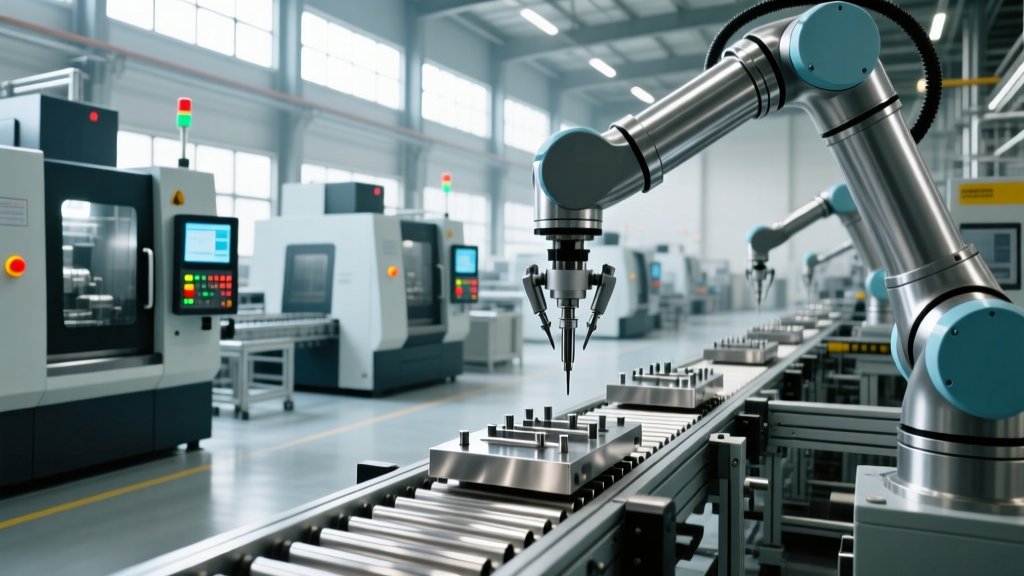
Standard industrial robotics are insufficient for medical device assembly. Equipment must meet strict outgassing, particulate, and cleanability standards. When designing an automated assembly cell for Class II or Class III medical devices, the selection between 6-axis articulated arms and SCARA robots dictates your line's throughput and footprint.
Cleanroom Robotics: Stäubli vs. Epson
For high-precision tasks like inserting micro-fluidic channels or assembling delicate sensor arrays, the choice of manipulator is critical. Below is a technical comparison of two industry-standard cleanroom robots deployed in 2026 MedTech lines.
| Specification | Stäubli TX2cr-90 (6-Axis) | Epson LS3-401S (SCARA) |
|---|---|---|
| Cleanroom Class | ISO Class 4 | ISO Class 3 |
| IP Rating | IP66 (Fully washdown) | IP20 (Standard cleanroom) |
| Payload / Reach | 5 kg / 920 mm | 3 kg / 400 mm |
| Repeatability | ±0.05 mm | ±0.01 mm |
| Approx. Base Cost (2026) | $52,000 - $58,000 | $16,000 - $19,000 |
| Best Application | Complex 3D assembly, washdown zones | High-speed pick-and-place, flat PCBs |
Integration Insight: Never use standard pneumatic grippers in an ISO Class 7 environment. The exhaust air introduces oil aerosols and particulates. Specify electric grippers with bellows seals, such as the Schunk EGP-40 (approx. $3,200 per unit), which feature brushless DC motors and zero particulate emission.
Machine Vision: 100% Inline Inspection Requirements
The FDA mandates rigorous quality controls for critical dimensions on life-sustaining devices. Sampling-based inspection (e.g., AQL 1.0) is rapidly being replaced by 100% inline machine vision to mitigate recall risks.
For inspecting medical-grade polycarbonates and transparent micro-fluidics, standard contrast vision fails due to specular reflection. The Cognex In-Sight 2800 series (approx. $9,500 - $12,000 per unit) utilizes edge-learning AI to classify cosmetic defects versus critical functional defects (like micro-cracks in fluid paths) without requiring thousands of training images. When integrating these systems, ensure the vision controller communicates directly with the PLC via PROFINET or EtherNet/IP to trigger automatic reject mechanisms within the 200ms cycle time limit typical of high-speed IVD cartridge lines.
Software & Traceability: The Hidden Integration Bottleneck
Hardware selection is only 40% of the integration battle. The remaining 60% lies in software architecture, specifically achieving compliance with FDA 21 CFR Part 11 regarding electronic records and signatures. If your automated line cannot cryptographically sign off on process parameters and maintain an immutable audit trail, it will not pass validation.
Audit Trap: Storing batch recipe data locally on the HMI (Human Machine Interface) is a direct violation of data integrity principles. All recipe management, user access logs, and alarm histories must be centralized in a validated Manufacturing Execution System (MES) or Historian database with automated, time-stamped backups.Implementing OPC UA over TSN
To achieve deterministic data transfer between the cell PLC (e.g., Siemens S7-1500 or Rockwell ControlLogix) and the MES, modern integrators are deploying OPC UA over Time-Sensitive Networking (TSN). This ensures that critical process data—such as the exact torque profile applied by a servo-screwdriver during a surgical tool assembly—is transmitted with microsecond latency and guaranteed delivery, fulfilling the strict traceability requirements of ISO 13485:2016.
Capital Expenditure (CapEx) Breakdown: Automated Assembly Cell
Budgeting for medical automation requires accounting for extensive documentation and validation phases, which inflate integration costs compared to standard consumer goods manufacturing. Below is a realistic CapEx breakdown for a single, fully validated automated assembly cell producing a Class II diagnostic device in 2026.
- Robotics & End-of-Arm Tooling (EOAT): $65,000 (Includes 1x Stäubli TX2cr, Schunk electric grippers, custom 316L stainless steel EOAT)
- Machine Vision & Lighting: $18,000 (2x Cognex In-Sight cameras, custom polarized domes)
- Conveyance & Base Tooling: $85,000 (Bosch Rexroth TS5 pallet system, precision machined nests)
- Controls & Electrical Enclosure: $42,000 (PLC, safety controllers, NEMA 4X enclosure)
- Systems Integration & Programming: $110,000 (Mechanical design, PLC/HMI programming, robot teaching)
- Validation (IQ/OQ/PQ) & Documentation: $65,000 (Creation of execution protocols, traceability matrix, final report)
- Total Estimated CapEx: $385,000
The Validation Gauntlet: IQ, OQ, and PQ
Unlike automotive or consumer electronics, medical equipment manufacturing requires formalized equipment qualification. Integration is not complete until the following three phases are executed and signed off by Quality Assurance:
- Installation Qualification (IQ): Verifying that the equipment is installed according to the manufacturer's specifications, including calibrated torque wrenches on all frame bolts, verified electrical grounding, and confirmed cleanroom HEPA filter certifications.
- Operational Qualification (OQ): Testing the equipment at the extreme edges of its operating window (e.g., running the line at +10% and -10% voltage, testing safety light curtain response times, verifying pneumatic pressure drops).
- Performance Qualification (PQ): Running the line with actual production materials at nominal speeds across three consecutive shifts to prove statistical process capability (Cpk > 1.33 for critical dimensions).
For deeper frameworks on establishing smart, interconnected manufacturing lines that support these validation protocols, refer to the guidelines provided by the NIST Smart Connected Manufacturing program, which offers robust architectures for data lineage and equipment interoperability.
Strategic Alignment with 2030 Volumes
The medical equipment manufacturing industry growth projections 2025-2030 heavily favor manufacturers who adopt modular automation. By utilizing standardized pallet systems and quick-change EOAT, a single $385,000 cell can be reconfigured in under 4 hours to accommodate a new product SKU. This flexibility is the ultimate hedge against market volatility, ensuring that your capital investments remain productive and compliant well into the next decade.