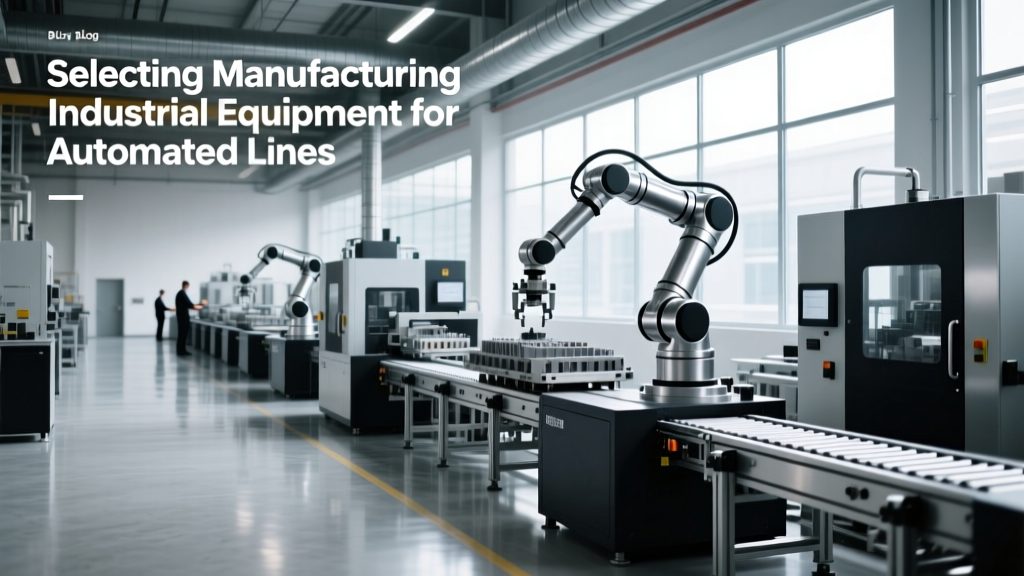
Selecting Manufacturing Industrial Equipment for Automated Lines
Learn how to select and integrate manufacturing industrial equipment into automated production lines with our 2026 buyer's guide and cost frameworks.
The Integration Bottleneck: Why Automation Projects Stall
When factory operations upgrade their floor, the primary point of failure is rarely the individual machines themselves. Instead, it is the integration layer. Selecting manufacturing industrial equipment for automated production lines requires moving beyond standalone spec sheets and evaluating how each asset communicates, handles edge-case faults, and synchronizes with upstream and downstream nodes. In 2026, the baseline expectation for new equipment is native OPC UA support and sub-millisecond deterministic networking. If a vendor cannot provide an OPC UA companion specification or a pre-configured function block library for your target PLC, you are purchasing a liability, not an asset.
⚠️ Integration Trap: Buying manufacturing industrial equipment from multiple OEMs without mandating a unified data model will result in weeks of custom middleware coding. Always require vendors to map their equipment states to the ISA-95 standard hierarchy before signing the purchase order.Specifying Core Manufacturing Industrial Equipment
Building a cohesive line means matching the physical throughput and digital handshake capabilities of three core equipment categories: conveyance, robotics, and vision inspection.
Precision Conveyance and Material Handling
For high-speed automated assembly, standard roller conveyors introduce unacceptable micro-vibrations. The current industry benchmark for precision indexing is the Dorner 3200 Series Precision Move. Engineered with a Kevlar-reinforced timing belt, it supports belt speeds up to 200 feet per minute with a positional repeatability of ±0.02 inches. When specifying this equipment, ensure you select the integrated 24V DC motor options with built-in EtherCAT drives, which eliminates the need for external VFDs and reduces cabinet footprint by 30%. Expect to budget approximately $9,200 to $11,500 per 12-foot section, including the drive and tail assemblies.
Robotic End-of-Line Palletizing
While 6-axis articulated arms remain common, collaborative robots (cobots) with high-payload capacities are dominating 2026 integration projects due to their reduced safety fencing requirements. The Universal Robots UR20 offers a 20 kg (44 lbs) payload and a 1,750 mm reach, making it ideal for end-of-line case packing and palletizing. Crucially, the UR20 natively supports PROFINET and EtherNet/IP via its polyscope interface, allowing direct handshake with Siemens or Rockwell PLCs without secondary gateway hardware. Base pricing for the UR20 arm sits around $38,500, but you must factor in an additional $4,500 to $7,000 for a Schunk LGP-40 pneumatic gripper and custom 3D-printed TPU finger pads for corrugated box handling.
Machine Vision and Defect Detection
Automated lines require vision systems that can process edge-AI inference locally to avoid network latency. The Cognex In-Sight 2800 is a leading choice, featuring a 2.3 MP sensor and an IP67-rated housing suitable for washdown environments. It handles complex optical character recognition (OCR) and defect detection at line speeds exceeding 400 parts per minute. When integrating, utilize the Cognex native EtherNet/IP driver to push pass/fail data directly into the master PLC's shift registers. Unit cost is approximately $6,800, excluding the specialized ring light ($850) required to eliminate specular reflections on metallic parts.
Network Protocol Decision Matrix
The physical equipment is only as effective as the network backbone connecting it. Selecting the wrong industrial protocol for your specific manufacturing industrial equipment will result in jitter, dropped packets, and safety relay trips. Use this framework to align your protocol choice with your application's physical demands.
| Protocol | Cycle Time | Topology | Best Application Scenario |
|---|---|---|---|
| EtherCAT | < 100 µs | Ring / Line | High-speed motion control (e.g., Beckhoff servos, flying shear cutters) |
| PROFINET IRT | 250 µs - 1 ms | Star / Line | Siemens-based automotive assembly and synchronized multi-axis gantries |
| EtherNet/IP CIP | 1 ms - 5 ms | Star | Rockwell/Allen-Bradley packaging systems and discrete part tracking |
| OPC UA (TCP) | 10 ms - 100 ms | Client/Server | Supervisory data collection, MES integration, and non-real-time telemetry |
The OPC UA Handshake: Avoiding State-Machine Deadlocks
The most common failure mode in automated line integration is a state-machine deadlock between two pieces of manufacturing industrial equipment. For example, an automated case erector signals 'Box Ready', but the downstream robotic palletizer is waiting for a 'Clamp Secure' signal from the infeed conveyor. If the PLC logic lacks robust watchdog timers, the line halts indefinitely without throwing a specific HMI alarm.
'When integrating multi-vendor equipment, mandate a standardized heartbeat signal. Every machine must toggle a specific boolean bit every 500 milliseconds. If the master PLC detects a stagnant heartbeat for 1.5 seconds, it immediately triggers a controlled line-stop sequence rather than waiting for a catastrophic mechanical fault.' — Lead Controls Engineer, Tier-1 Automotive Supplier
To prevent these deadlocks, require all OEMs to implement the OPC UA PackML (ISA-TR88) state model. This ensures that terms like 'Starting', 'Execute', 'Held', and 'Aborted' mean the exact same thing across a filler, a capper, and a labeler, regardless of who manufactured them.
2026 Integration Budget Framework
Capital expenditure (CAPEX) for the physical machinery is only the beginning. A realistic budget for integrating manufacturing industrial equipment must account for safety hardware, PLC programming, and middleware configuration. Below is a realistic cost breakdown for integrating a standard 3-machine automated packaging cell in 2026.
| Line Item | Estimated Cost (USD) | Technical Notes |
|---|---|---|
| Base Machinery (Conveyor, Cobot, Vision) | $54,500 - $62,000 | Includes UR20, Dorner 3200, Cognex 2800 |
| Safety Fencing & Interlocks (Troax ST30) | $4,800 - $7,200 | ~$45/sq ft including RFID guard locking switches |
| Safety PLC & PROFIsafe Modules | $3,500 - $5,000 | Sick Flexi Soft gateway + safe I/O blocks |
| Systems Integration & PLC Programming | $18,000 - $28,000 | 120-160 hours at $150-$175/hr engineering rate |
| FAT/SAT & Commissioning Travel | $4,000 - $6,500 | On-site debug, OEE baseline tuning, operator training |
| Total Estimated Cell Cost | $84,800 - $108,700 | Excludes facility prep (drop-downs, air lines) |
Safety Guardrails and Compliance
Integrating automated equipment fundamentally alters the risk profile of your factory floor. According to the OSHA Robotics Safety Guidelines, the employer is ultimately responsible for ensuring that integrated systems meet ANSI/RIA R15.06 standards. Relying solely on the OEM's built-in collision detection is insufficient for high-inertia payloads.
For a UR20 handling 20kg cases, you must implement a dual-channel safety architecture. This involves hardwiring area laser scanners (such as the SICK microScan3) into a dedicated safety relay or PROFIsafe network. When a human breaches the yellow warning zone, the PLC commands the robot to reduce speed to 250 mm/s. If the red stop zone is breached, the safety controller instantly drops the STO (Safe Torque Off) signal to the servo drives, cutting power to the motors while keeping the brakes engaged to prevent the payload from dropping.
Vendor RFQ Evaluation Checklist
Before issuing a final purchase order for manufacturing industrial equipment, run the vendor's proposal through this strict technical checklist to ensure seamless integration:
- Native Protocol Support: Does the equipment support your facility's primary protocol (e.g., PROFINET, EtherNet/IP) natively, or does it require a $2,500 third-party gateway (like an Anybus) to translate Modbus TCP?
- CAD & Kinematic Models: Has the vendor provided accurate 3D STEP files and digital twin kinematic models for offline programming in software like Visual Components or RoboDK?
- I/O Map Transparency: Is the complete input/output map, including fault codes and reset sequences, documented in English prior to delivery?
- Spare Parts Consignment: Will the vendor include a critical spares kit (belts, sensors, servo cables) with the initial shipment to prevent Day-1 downtime?
- Remote Access Architecture: Does the HMI support secure, zero-trust remote access (e.g., via Tosibox or Secomea) for OEM troubleshooting without exposing your OT network to the public internet?
Selecting the right manufacturing industrial equipment is an exercise in systems engineering. By prioritizing standardized data models, deterministic networking, and rigorous safety architectures over isolated machine speed, you ensure your automated production line delivers sustained OEE and long-term operational resilience.