Storeroom Integrated Material Handling Equipment Installations: Lift Aids
Compare ergonomic lift assist devices for storeroom integrated material handling equipment installations. Analyze costs, spatial constraints, and ROI.
The Spatial Paradox of MRO Storeroom Ergonomics
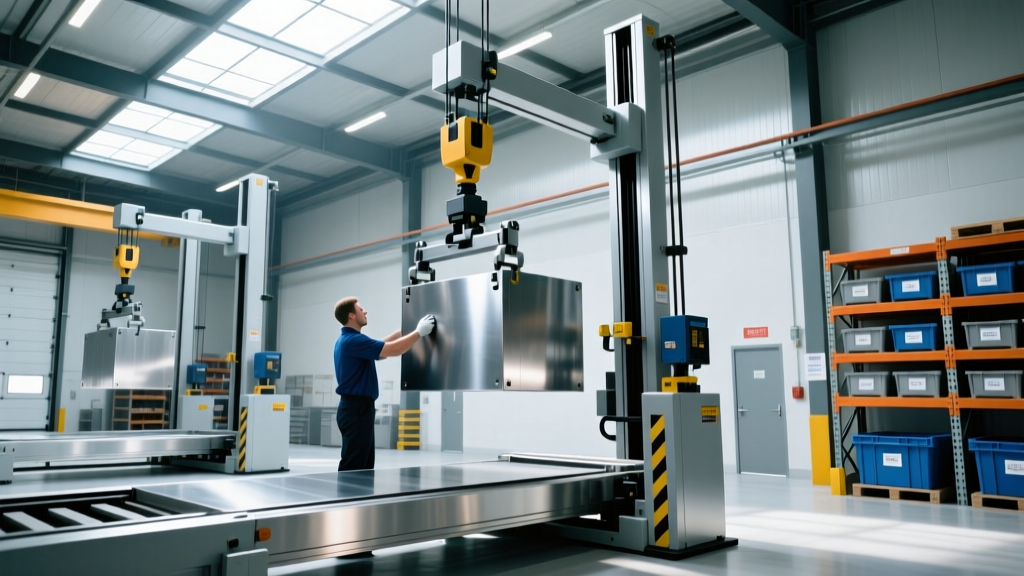
Maintenance, Repair, and Operations (MRO) storerooms present a unique engineering paradox: they require the heavy-duty lifting capacity of a manufacturing floor, but are confined within the tight spatial envelopes of a retail stockroom. When planning storeroom integrated material handling equipment installations, facility managers cannot simply drop in standard 2-ton bridge cranes or massive hydraulic gantries. The focus must shift to precision ergonomic lift assist devices that mitigate musculoskeletal disorder (MSD) risks without cannibalizing valuable rack-space or violating narrow-aisle clearance requirements.
According to the Occupational Safety and Health Administration (OSHA), ergonomic injuries in warehousing and storage consistently account for some of the highest rates of lost workdays in general industry. Selecting the correct lift assist technology requires a rigorous comparison of servo-driven hoists, vacuum tube lifters, and articulating jib systems against your specific SKU weight profiles and spatial constraints.
Constraint Matrix: Storeroom Lift Assist Technologies
Before evaluating specific brands, map your facility's physical limitations. The following matrix defines the baseline installation requirements for the three primary ergonomic lift categories in confined storerooms.
| Technology Type | Min. Aisle Width | Overhead Clearance Req. | Power / Utility Source | Max Effective Duty Cycle |
|---|---|---|---|---|
| Intelligent Servo Hoists | 8 feet | 10 feet (under hook) | 230V/1Ph or 460V/3Ph | High (Continuous picking) |
| Vacuum Tube Lifters | 6 feet | 9 feet (tube storage) | 80 PSI Dry Compressed Air | Medium (Heat buildup limits) |
| Articulating Jib Cranes | 4 feet (mast mount) | 8.5 feet (boom clearance) | Manual / Pneumatic Hoist | Low-Medium (Spot lifting) |
Servo-Driven Intelligent Hoists vs. Pneumatic Balancers
For storerooms handling high-mix, high-weight components (e.g., electric motors, gearboxes, and pump assemblies ranging from 50 to 350 lbs), the debate centers on intelligent servo hoists versus traditional pneumatic air balancers.
Intelligent Servo Hoists (e.g., Gorbel G-Force)
Servo-driven systems utilize load cells and high-speed processors to detect operator intent. When an operator applies less than one pound of upward or downward force to the end-effector, the servo motor instantly matches the speed and direction.
- Pros: Unmatched precision for loading delicate parts into CNC machines or tight shelving bays. 'Float mode' allows operators to maneuver 200 lb loads with minimal physical exertion. Immune to ambient temperature changes.
- Cons: High capital expenditure. A fully integrated 350 lb capacity Gorbel G-Force system with a customized end-of-arm tool (EOAT) typically ranges from $18,000 to $26,000 installed in 2026. Requires clean, stable electrical power.
Pneumatic Air Balancers (e.g., Ingersoll Rand Zimmerman)
Air balancers use regulated compressed air to achieve neutral buoyancy. They are mechanically simpler but rely heavily on consistent air pressure.
- Pros: Lower initial cost ($10,000 to $14,000 installed). Intrinsically safe for environments with combustible dust or flammable solvents, which is sometimes relevant in specialized chemical MRO storerooms.
- Cons: Highly susceptible to 'droop' if the facility's compressed air system experiences pressure drops when heavy machinery cycles on elsewhere in the plant. Requires 3 to 5 lbs of actuation force, increasing operator fatigue over a 10-hour shift compared to servo systems.
Vacuum Tube Lifters: The High-Frequency Carton Solution
If your storeroom primarily handles corrugated packaging, sealed drums, or non-porous replacement parts (like HVAC units or sealed bearings), vacuum tube lifters like the Schmalz JumboErgo are the industry standard. These systems use a continuous vacuum generator to lift the load, while the flexible lifting tube itself acts as the hoist mechanism—expanding and contracting as the operator pulls down or pushes up on the ergonomic handle.
⚠️ Critical Installation Warning: Vacuum lifters require exceptionally clean, dry compressed air. If your plant's air supply contains oil aerosols or excessive moisture, the vacuum generator's internal filters will clog within weeks, leading to catastrophic load drops. You must install a dedicated FRL (Filter, Regulator, Lubricator) unit with a coalescing filter rated to 0.01 microns directly upstream of the vacuum lifter. Furthermore, ensure the air supply line uses a minimum 1/2-inch ID hose; using a standard 3/8-inch quick-connect will starve the vacuum pump during the initial lift phase, causing dangerous load slippage.Vacuum lifters excel in speed. An experienced operator can pick, move, and release a 50 lb box in under 4 seconds. However, they fail entirely on porous surfaces, heavily recycled corrugated cardboard with air leaks, or parts with uneven topographies unless heavily customized (and expensive) foam-grip suction cups are utilized.
Articulating Jib Cranes vs. Scissor Lift Tables
When overhead clearance is severely restricted by HVAC ducting or fire suppression piping, or when the primary task involves feeding heavy parts onto a workbench rather than moving them down an aisle, the choice shifts to ground-level or low-profile aids.
Articulating Jib Cranes (AJCs)
Unlike standard cantilever jibs that create a 'dead zone' close to the mast, articulating jibs (like the Gorbel AJC series) feature a two-arm design that allows the hoist to reach in close to the mast and around obstacles.
Best Application: Reaching into deep, multi-tiered shelving units to extract heavy, awkwardly shaped castings.
Limitation: Span deflection. In a storeroom environment, do not exceed a 16-foot span for a 500 lb capacity articulating jib without upgrading to a heavy-duty mast, or the secondary arm will sag, destroying the ergonomic benefit.
Hydraulic & Pneumatic Scissor Lift Tables
For static picking stations where operators are breaking down pallets of heavy MRO supplies (e.g., bags of fasteners, welding rods, or lubricants), scissor lift tables keep the work at the 'golden zone' (between knuckle and shoulder height).
The 2026 Upgrade: Traditional hydraulic tables require pit installation or ramp access, which ruins storeroom flexibility. Modern pneumatic air-bag lift tables (e.g., Pentalift Pneu-Lift) require no pit, operate on standard shop air, and can be moved with a pallet jack when the storeroom layout is reconfigured. Expect to pay between $4,500 and $7,500 per unit.
Decision Framework: Selecting Your Storeroom Lift Assist
If/Then Routing Guide for Equipment Selection
- IF loads are highly variable in shape, weight (up to 350 lbs), and require precise placement into tight machine housings → THEN specify an Intelligent Servo Hoist on an enclosed track bridge crane.
- IF loads are uniform, non-porous boxes or drums (under 185 lbs) with high pick-rates → THEN specify a Vacuum Tube Lifter mounted to a floor-supported jib.
- IF the primary injury risk is lower-back strain from repetitive bending to floor-level pallets → THEN specify Pneumatic Scissor Lift Tables at all break-down stations.
- IF the storeroom lacks both electrical drops and clean compressed air → THEN specify Mechanical Wire-Rope Hoists on Articulating Jibs (Manual operation, lowest throughput but zero utility requirements).
Calculating ROI and Safety Compliance
The financial justification for ergonomic lift assists in storerooms extends far beyond simple throughput metrics. The National Institute for Occupational Safety and Health (NIOSH) emphasizes that engineering controls—such as mechanical lift assists—are vastly superior to administrative controls (like job rotation) for preventing MSDs.
Consider the hidden costs of manual handling in an MRO storeroom: a single lower-back injury resulting from a technician manually wrestling a 90 lb replacement valve off a top-tier shelf can trigger workers' compensation claims exceeding $40,000, alongside indirect costs of temporary labor and lost maintenance uptime. When a $22,000 servo-driven hoist installation prevents even one such incident, the ROI is realized in the first year. Furthermore, modern intelligent hoists feature built-in load-cell data logging, allowing facility managers to track exact lift weights and cycle counts via API integrations into their CMMS (Computerized Maintenance Management System), providing verifiable data for continuous ergonomic improvement and OSHA compliance audits.