Smart Material Handling Equipment for Semiconductor Cleanrooms in 2026
Explore 2026 innovations in cleanroom material handling equipment for semiconductor fabs, including AMHS, OHT systems, and ISO-class compliant AGVs.
Automated Material Handling Systems (AMHS) represent the central nervous system of a modern 300mm semiconductor fabrication facility. As transistor architectures shrink to sub-2nm nodes, the tolerance for particulate contamination approaches absolute zero. In this environment, cleanroom material handling equipment must perform high-speed logistics while strictly adhering to ISO 14644-1 Class 1 through Class 3 particulate limits. A single micro-abrasion from a legacy transport wheel can generate thousands of 0.5 µm particles, potentially ruining a wafer lot valued at over $2 million.
The 2026 landscape of semiconductor fab logistics has shifted away from mechanical friction toward magnetic levitation, AI-driven acoustic monitoring, and digital twin synchronization. This guide details the technical specifications, integration protocols, and contamination-control metrics defining next-generation material handling equipment in advanced semiconductor manufacturing.
The Shift to Frictionless Maglev OHT Systems
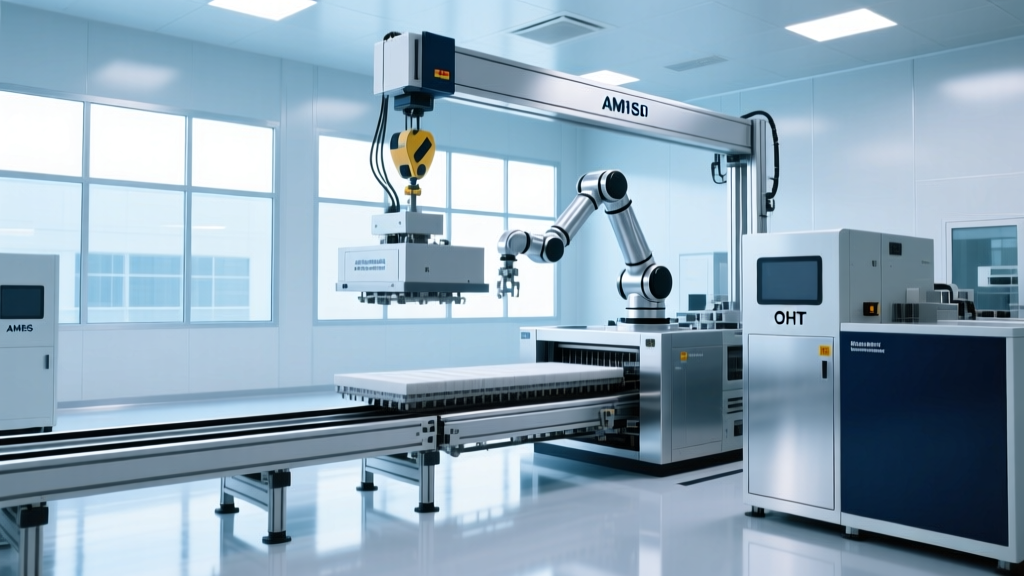
Overhead Hoist Transport (OHT) systems are the primary arteries of a fab, moving Front Opening Unified Pods (FOUPs) between process tools and stockers. Legacy OHT vehicles rely on polyurethane or rubber drive wheels gripping an aluminum track. While effective, the mechanical friction inherently sheds micro-particles and requires aggressive HEPA/ULPA fan filter units (FFUs) to sweep contaminants away from the wafer bays below.
In 2026, leading manufacturers like Murata Machinery (Muratec) and Daifuku have standardized Linear Synchronous Motor (LSM) magnetic levitation tracks for ISO Class 1 and Class 2 environments. By utilizing electromagnetic propulsion, the OHT vehicle floats millimeters above the guideway, entirely eliminating wheel-to-track friction.
⚠️ CRITICAL WARNING: Legacy Belt DegradationIf your fab still operates Gen-3 OHT systems with Kevlar-reinforced polyurethane hoist belts, be aware that ambient cleanroom ozone and UV exposure from inspection tools cause micro-cracking at the 18-month mark. These micro-fractures shed 0.3 µm particles directly over open Equipment Front End Modules (EFEMs). Transitioning to stainless-steel flat-belt hoists or direct-drive maglev winches is mandatory for sub-3nm yield protection.
Predictive Maintenance via Acoustic Emission Sensors
Next-generation material handling equipment no longer relies on calendar-based preventative maintenance. Modern OHT hoist motor housings now integrate piezoelectric acoustic emission (AE) sensors. These sensors continuously monitor the 30 kHz to 50 kHz frequency range, detecting the specific acoustic signature of bearing micro-fractures or belt delamination weeks before a physical failure occurs. By feeding this telemetry into the fab's central Manufacturing Execution System (MES), engineers can route vehicles with degrading components to maintenance spurs without disrupting primary interbay transport loops.
ISO 14644-1 Compliance and Particle Thresholds
Selecting cleanroom transport vehicles requires strict alignment with ISO 14644-1 cleanroom classifications. The standard dictates the maximum allowable concentration of airborne particles per cubic meter. Material handling equipment must be certified to generate fewer particles than the ambient limit of the specific fab zone it operates within.
| ISO Class | Max Particles/m³ (≥0.1 µm) | Max Particles/m³ (≥0.2 µm) | Required AMHS Technology (2026) |
|---|---|---|---|
| ISO Class 1 | 10 | 2 | Maglev OHT, Direct-Drive Hoists |
| ISO Class 2 | 100 | 24 | Sealed-Bearing OHT, PTFE-coated AGVs |
| ISO Class 3 | 1,000 | 237 | Standard Cleanroom AGVs, Roller Conveyors |
| ISO Class 4 | 10,000 | 2,370 | Automated Guided Carts, Standard Hoists |
Ground-Level Logistics: AGVs and the LiDAR Problem
While OHT systems manage interbay transport, ground-level Automated Guided Vehicles (AGVs) handle intrabay movements, reticle transport, and chemical delivery. A major technological pivot in 2026 involves the navigation systems used in ISO Class 2 and Class 3 environments.
Standard warehouse AGVs rely on LiDAR and optical cameras for SLAM (Simultaneous Localization and Mapping). However, in a semiconductor fab, LiDAR laser emissions can inadvertently expose photoresist-coated wafers if a pod seal is compromised, and the cooling fans required for LiDAR units disrupt the strict laminar airflow patterns mandated by fab HVAC designs. Furthermore, the physical rotation of LiDAR domes generates micro-vibrations and particle shedding.
To resolve this, modern cleanroom material handling equipment utilizes embedded RFID floor tags combined with ultra-wideband (UWB) beacons and magnetic tape guidance. This solid-state navigation approach eliminates moving sensor parts, maintains laminar airflow, and guarantees zero optical interference with lithography processes. Vehicles like the KUKA KMR iiwa (adapted for cleanrooms) utilize sealed, particle-free magnetic encoders to achieve ±2mm docking accuracy at EFEM load ports without emitting airborne contaminants.
Comparison Matrix: Legacy vs. 2026 Next-Gen AMHS
Upgrading a fabrication facility's transport infrastructure requires a rigorous cost-benefit analysis. Below is a technical comparison between legacy Gen-3 systems and the current Gen-5 maglev ecosystems.
| Specification | Gen-3 Legacy OHT (Pre-2022) | Gen-5 Maglev AMHS (2026) |
|---|---|---|
| Propulsion | Rotary Servo + Polyurethane Wheels | Linear Synchronous Motor (LSM) |
| Max Travel Speed | 2.0 m/s | 3.5 m/s (with active sway control) |
| Particle Generation | ~500 particles/min (≥0.3 µm) | <10 particles/min (≥0.1 µm) |
| Handoff Protocol | SEMI E84 (Optical IR) | SEMI E84 + Wireless 5G Telemetry |
| Estimated CapEx (Per Bay) | $1.2M - $1.8M | $2.5M - $3.5M |
Integration Checklist for Fab Engineers
Deploying advanced material handling equipment requires strict adherence to SEMI international standards to ensure interoperability between the AMHS, the MES, and the process tools. Before commissioning a new transport fleet, engineering teams must verify the following parameters:
- SEMI E84 Handoff Validation: Ensure the active optical infrared sensors on the OHT hoist and the EFEM load port are perfectly aligned. A misalignment of just 1.5mm can cause repeated handoff timeouts, stalling the entire bay.
- Vibration Dampening Limits: During the hoist lowering phase, Z-axis vibration must not exceed 0.05G. Excessive vibration can cause wafer slippage inside the FOUP cassette slots, leading to cross-slotted wafers and catastrophic tool damage.
- Outgassing Certifications: All polymers, lubricants, and cable jackets used on the AGVs and OHTs must pass strict ASTM E595 outgassing testing. Total Mass Loss (TML) must be <1.0% and Collected Volatile Condensable Materials (CVCM) must be <0.10% to prevent chemical fogging on lithography lenses.
- Digital Twin Synchronization: Verify that the vehicle's onboard edge-computing module updates the fab's digital twin at a minimum of 60Hz. This latency is critical for AI routing algorithms to prevent traffic deadlocks at high-volume intersection nodes.
The Economics of Yield Protection
While the initial capital expenditure for Gen-5 maglev AMHS and solid-state AGVs represents a 40% premium over legacy mechanical systems, the return on investment is realized through yield preservation. In a high-volume 300mm fab producing advanced logic chips, a single contamination event caused by mechanical shedding can scrap a lot worth $2.5 million. By eliminating friction-based particle generation and implementing acoustic predictive maintenance, semiconductor manufacturers effectively insure their most valuable assets, proving that next-generation material handling equipment is not merely a logistical tool, but a critical component of the manufacturing process itself.