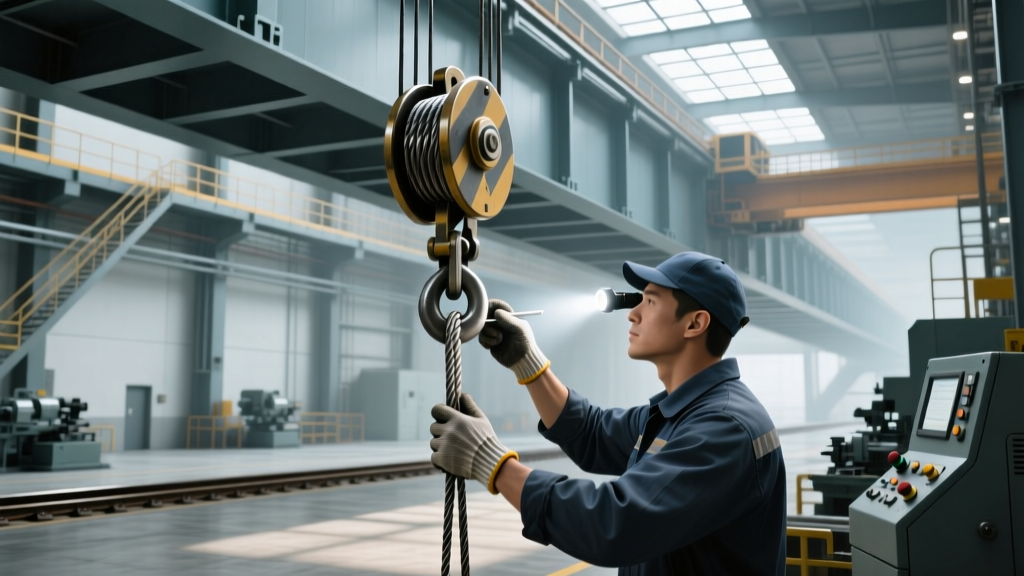
Bridge Crane Material Handling Equipment Maintenance: Operator Guide
Master bridge crane material handling equipment maintenance with this operator training guide. Learn daily inspections, load testing, and wear metrics.
The Frontline Defense: Operator-Led Crane Reliability
In heavy manufacturing, steel service centers, and precast concrete facilities, overhead bridge cranes are the undisputed backbone of production. While certified millwrights and structural engineers handle annual teardowns and runway alignments, the most critical layer of material handling equipment maintenance occurs during the first 15 minutes of an operator's shift. Unplanned downtime for a 50-ton top-running bridge crane can cost a facility between $2,500 and $8,000 per hour in halted production and delayed logistics.
Transitioning from a reactive repair model to a proactive, operator-driven maintenance culture requires precise, configuration-specific knowledge. This guide details the exact diagnostic protocols, ASME B30.2 discard criteria, and sensory inspection techniques required to maintain top-running and underhung bridge crane systems in 2026.
⚠️ OSHA Compliance Warning: Under OSHA 1910.179, the employer must designate a competent person to perform daily visual inspections. Failing to document pre-shift brake and limit switch tests exposes the facility to severe citations, especially following a near-miss or load-drop incident.Daily Pre-Shift Inspection Protocols (The 15-Minute Standard)
Effective material handling equipment maintenance begins before the first load is lifted. Operators must execute a systematic, no-load functional test of all three axes (bridge, trolley, and hoist). Do not rely solely on visual checks; dynamic testing reveals hidden mechanical faults.
Step-by-Step Dynamic Testing Sequence
- Upper Limit Switch Verification: Run the empty hook block to the upper limit. The primary limit switch must cut power to the hoist motor before the block contacts the drum or upper structure. Manually reset and verify the secondary (backup) limit switch engages if the primary fails.
- Brake Slip Test: Hoist a test load equivalent to 25% of the crane's rated capacity. Raise the load two feet, stop, and observe the drum. Any visible drift or 'creep' exceeding 0.5 inches per minute indicates worn brake linings or contaminated friction surfaces.
- Acoustic Baseline Check: Traverse the bridge and trolley at full speed. Listen for rhythmic clicking (indicating flat spots on forged wheels) or high-pitched squealing (indicating dry wheel bearings or misaligned runway rails causing side-thrust).
Configuration-Specific Maintenance Nuances
Bridge cranes are not a monolith. The physical architecture of the crane dictates entirely different maintenance focus areas. Operators must understand whether they are piloting a top-running or underhung system to know where to look for premature wear.
| Feature | Top-Running Bridge Cranes (CMAA Class C-F) | Underhung Bridge Cranes (CMAA Class A-B) |
|---|---|---|
| Load Path | Wheels ride on top of the runway rail. | Wheels ride on the bottom flange of the I-beam. |
| Primary Wear Point | Rail head spalling, wheel flange wear, rail clip loosening. | Bottom flange taper wear, flange edge cracking. |
| Operator Inspection Focus | Check for 'shiny' marks on the side of the runway rail (evidence of skewing and side-thrust). | Inspect the lower flange for a 'lip' or rolled edge caused by overloading. |
| Electrical Delivery | Typically enclosed conductor bars (Vahle/Wampfler). | Typically festoon systems (flat cable on C-track). |
Wire Rope and Hook Block: Exact Discard Criteria
The hoist assembly is the most highly stressed component in any material handling equipment maintenance program. Operators must be trained to identify micro-failures in rigging hardware before they propagate into catastrophic drops. According to ASME B30 standards, the following metrics mandate immediate removal from service:
- Wire Rope (6x19 or 6x36 Classification): Discard if there are six randomly distributed broken wires in one rope lay, or three broken wires in one strand in one lay. Additionally, discard if the nominal rope diameter is reduced by more than 1/64th of an inch for ropes up to 3/4 inch in diameter due to core failure or outer wire abrasion.
- Hook Throat Expansion: Using calipers, measure the hook throat opening. If the throat opening has increased by more than 5% of its original manufactured dimension, the hook has undergone plastic deformation and must be scrapped. Never attempt to weld or heat-treat a deformed hook.
- Hook Twist: If the hook is twisted more than 10 degrees from its original vertical plane, discard immediately.
- Sheave Grooves: Run a fingernail along the bottom of the sheave groove. If the wire rope does not sit flush and you feel a 'step' or ridge, the sheave groove is worn and will crush the wire rope, accelerating fatigue.
If the hoist wire rope is not spooling tightly and evenly on the drum (causing cross-winding and crushing), operators should notify maintenance to perform a chalk test. A chalk line drawn across the drum flanges will reveal if the fleet angle exceeds the recommended 1.5 degrees for smooth drums or 2 degrees for grooved drums.
Electrical Systems: Festoons, Conductor Bars, and IoT Telemetry
Modern bridge cranes are as much electrical systems as they are mechanical ones. The method of power delivery to the moving bridge and trolley requires specific operator oversight.
Festoon Cable Systems (Common on Underhung Cranes)
Operators must visually track the C-track festoon system during bridge travel. Look for cables that are sagging below the trolley carriers or showing signs of jacket abrasion. A common failure mode is the tangling of flat cables due to broken carrier wheels, which can sever the control voltage lines and result in a loss of directional control.
Enclosed Conductor Bars
For top-running cranes utilizing enclosed conductor bars, operators cannot see the internal copper rails. However, they can inspect the collector boxes. Look for excessive black copper dust around the collector shoes, which indicates severe electrical arcing. If the carbon or copper-graphite shoes are worn down to the wear indicator line (usually 2mm from the backing plate), they must be replaced to prevent the steel shoe holder from scoring the copper rail.
Integrating IoT Telemetry Dashboards
In 2026, advanced material handling equipment maintenance relies heavily on digital integration. Systems like Konecranes TRUCONNECT or Demag StatusControl provide operators with an HMI (Human-Machine Interface) tablet or cab display. Operators must be trained to monitor:
- Thermal Overload Warnings: Hoist motors equipped with thermal sensors will display a yellow warning when approaching duty cycle limits (e.g., exceeding CMAA Class C duty limits). Operators must pause operations to allow forced-air cooling rather than overriding the alarm.
- Brake Cycle Counts: Digital telemetry tracks the exact number of brake engagements. Once the system flags 100,000 cycles, maintenance must perform a physical teardown, regardless of apparent performance.
"The most expensive component on a bridge crane isn't the gearbox or the motor; it's the runway structure. An operator who ignores wheel squeal and continues to force a skewed crane down the runway will cause thousands of dollars in structural fatigue to the building's support columns long before the crane itself fails."
— Senior Millwright & CMAA Certified Inspector
Operator Action Matrix: Defect Severity and Response
To eliminate ambiguity on the shop floor, facilities must implement a standardized response matrix. Operators should use this framework to determine the immediate action required when an anomaly is detected during material handling equipment maintenance checks.
| Detected Anomaly | Severity Level | Required Operator Action |
|---|---|---|
| Frayed wire rope (1-2 broken wires) | Yellow (Monitor) | Log in CMMS. Continue operation but avoid shock-loading. Maintenance to replace within 7 days. |
| Hoist brake drift (> 0.5 in/min) | Red (Critical) | Immediately lower load to floor. Lockout/Tagout (LOTO) the main disconnect. Ground crane until brake is adjusted. |
| Bridge travel skewing / wheel flange binding | Red (Critical) | Stop travel. Do not 'jog' the bridge to force it past the binding point. Call maintenance for rail/wheel alignment check. |
| Pendant control button sticking | Red (Critical) | Cease use immediately. A sticking contactor can cause unintended autonomous movement of the load. |
| Faded/illegible load chart or warning decals | Green (Admin) | Submit work order for decal replacement. Safe to operate in the interim if operator knows rated capacity. |
Empowering the Operator
True operational excellence in overhead lifting requires treating the crane operator as the primary sensor in the maintenance loop. By equipping personnel with exact dimensional discard criteria, an understanding of CMAA structural classifications, and direct integration with digital CMMS platforms, facilities can drastically reduce the mean-time-between-failures (MTBF) for their most critical lifting assets.