Conveyor Belts for Bulk Material Handling Equipment: Case Studies
Explore real-world case studies on selecting conveyor belt types for bulk material handling equipment based on specific material properties and abrasion levels.
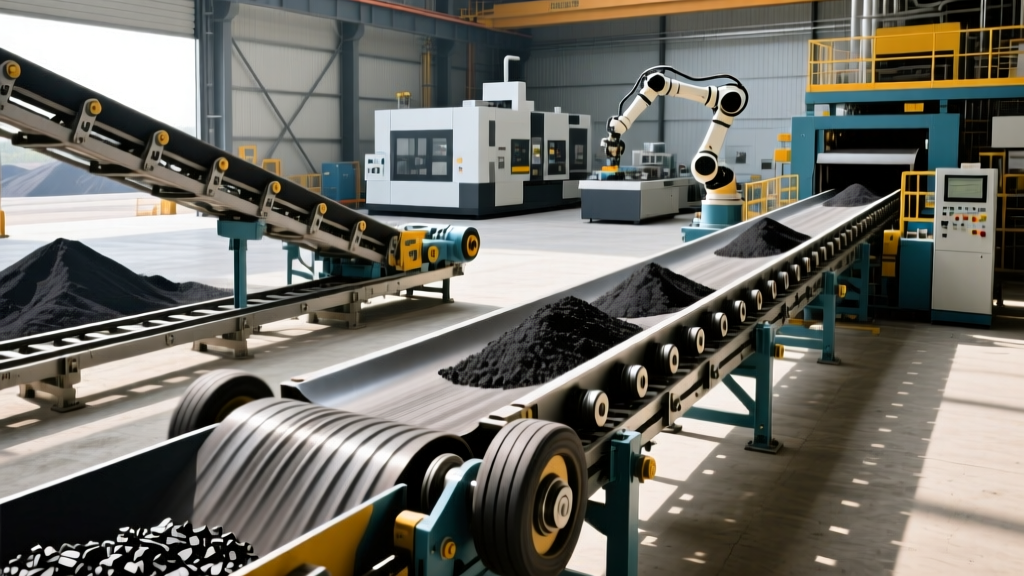
Selecting the correct conveyor belt for bulk material handling equipment is not a generic exercise; it is a precise engineering calculation dictated by material density, lump size, moisture content, and temperature. A mismatch between the belt carcass, cover compound, and the material profile results in catastrophic failure modes ranging from longitudinal ripping to cover delamination. According to the Conveyor Equipment Manufacturers Association (CEMA), improper belting selection accounts for over 35% of unplanned downtime in bulk transfer systems. This guide analyzes three distinct industrial applications to demonstrate how material properties dictate belt specification in heavy-duty bulk material handling equipment.
Financial Impact of Belt Mistracking & Spillage: Replacing a 1,000-meter ST2500 steel cord belt costs between $135,000 and $160,000 in materials alone, excluding crane rentals and lost production revenue. Specifying the correct cover grade initially prevents premature wear that leads to edge fraying and subsequent mistracking.Case Study 1: Copper Ore Transport (High Impact & Severe Abrasion)
Material Profile & Failure Mode
In open-pit copper mining, primary crushed ore presents a severe challenge for bulk material handling equipment. The material features a high bulk density (3.2 to 4.5 tonnes/m³) and sharp, angular lump sizes up to 300mm. When dropped from a 2-meter chute onto the conveyor, the kinetic impact generates immense localized shear forces. Standard fabric (EP) belts suffer from ply separation and carcass puncture under these conditions. Furthermore, the high silica content in the gangue rock acts as a grinding agent, rapidly stripping standard rubber covers.
The Engineering Solution
Mining operations mitigate this by upgrading to steel cord carcass belts, specifically the ST2000 or ST2500 grades, which provide a breaking strength of 2,000 to 2,500 N/mm. The ISO 15236-1 standards dictate rigorous testing for steel cord adhesion, ensuring the rubber penetrates the galvanized steel cables to prevent moisture ingress and internal corrosion. For the cover compound, engineers specify a DIN X or DIN W (super abrasion-resistant) grade. These covers utilize specialized carbon black compounding to achieve a minimum tensile strength of 18 MPa and a maximum volume loss of 120mm³ in DIN abrasion tests. A typical configuration uses an 8mm top cover to absorb impact and a 4mm bottom cover to protect against idler friction, pricing out at approximately $145 per linear meter.
Case Study 2: Cement Clinker Processing (Extreme Heat & Fines)
Material Profile & Failure Mode
Transferring cement clinker from the rotary kiln cooler to the grinding mill involves handling fine, highly abrasive nodules at temperatures frequently exceeding 150°C, with spikes up to 200°C. Standard natural rubber (SBR) or styrene-butadiene covers undergo thermal degradation, hardening, and cracking when exposed to these temperatures. Once the cover cracks, the hot clinker fines embed into the carcass, burning through the nylon/polyester plies and destroying the belt's structural integrity from the inside out.
The Engineering Solution
Plant engineers specify heat-resistant belts utilizing EPDM (Ethylene Propylene Diene Monomer) rubber compounds, classified as T2 or T3 grades. T3 grade EPDM covers can withstand continuous material temperatures up to 200°C and peak temperatures of 220°C without losing elasticity. The carcass is typically an EP (polyester warp, nylon weft) fabric, such as EP315/3, chosen because steel cord belts can suffer from rubber-to-steel adhesion failure under sustained thermal cycling unless heavily over-engineered. To protect the belt at the loading zone, bulk material handling equipment in these circuits must incorporate water-cooled impact idlers and high-temp ceramic lagging on the drive pulleys to prevent belt slip, which generates additional frictional heat.
Belt Cover Grade Matrix for Bulk Material Handling Equipment
| Cover Grade | Target Material Property | DIN / ISO Standard | Est. Cost (USD/m) |
|---|---|---|---|
| DIN Y (Standard) | General bulk, low abrasion (e.g., grain, coal) | DIN 22102-Y | $35 - $50 |
| DIN X (High Abrasion) | Sharp, heavy aggregates, crushed rock | DIN 22102-X | $55 - $75 |
| DIN W (Super Abrasion) | High-silica ores, copper, iron ore lump | DIN 22102-W | $80 - $110 |
| T3 (EPDM Heat Resistant) | Cement clinker, hot sinter, coke (up to 200°C) | ISO 4195 | $90 - $130 |
| FRAS (Fire Resistant) | Underground coal, volatile powders | ISO 340 | $70 - $95 |
Case Study 3: Wet Frac Sand & Aggregates (Sticky, Moisture-Laden)
Material Profile & Failure Mode
Handling wet frac sand or washed aggregates introduces a completely different failure vector: material carryback and belt rollback. With moisture contents between 8% and 12%, these materials become highly cohesive. On standard smooth-top belts, wet sand adheres to the rubber surface, bypassing primary scrapers and accumulating on the return idlers. This buildup causes severe belt mistracking and idler seizure. Furthermore, when conveying wet sand up inclines greater than 15 degrees, the material's loss of internal friction causes it to slide backward down the belt, creating massive spillage at the tail pulley.
The Engineering Solution
To resolve rollback, bulk material handling equipment in this sector utilizes profiled or chevron belts. A 15mm or 25mm high 'V' profile molded directly into the top cover creates physical pockets that trap the wet sand, allowing inclines of up to 28 degrees without material slip. To combat carryback, the return side requires a low-friction bottom cover, often coated with UHMWPE (Ultra-High-Molecular-Weight Polyethylene) or utilizing specialized low-rolling-resistance (LRR) rubber compounds. Additionally, engineers must install multi-stage cleaning systems: a primary tungsten carbide blade scraper, followed by a secondary urethane blade, and a tertiary brush cleaner. According to research published by the Southern African Institute of Mining and Metallurgy, optimizing scraper tension and blade geometry on sticky materials reduces carryback by up to 85%, significantly extending idler life.
4-Step Selection Framework for Plant Engineers
When specifying belts for new bulk material handling equipment or replacing failed belts, follow this sequential framework to ensure operational longevity:
- Calculate the Peak Impact Force: Determine the maximum lump size and drop height at the loading zone. If the impact energy exceeds 250 Joules, a standard fabric belt will fail. Upgrade to a steel cord carcass or install a reinforced impact bed with slider bars before the belt transitions to idlers.
- Analyze the Chemical & Thermal Environment: Test the material for hydrocarbon content (which degrades standard SBR rubber, requiring Nitrile covers) and continuous operating temperature. If temperatures exceed 80°C, transition immediately to EPDM heat-resistant compounds.
- Evaluate Moisture and Cohesion: Conduct a shear box test on the bulk material at its maximum expected moisture content. If cohesion is high, specify molded chevron profiles and upgrade the belt cleaning architecture to include air-knife or water-spray assist systems.
- Specify Cover Asymmetry: Do not default to symmetrical covers (e.g., 6mm top / 6mm bottom). The bottom cover only experiences friction from idlers, not material impact. Reducing the bottom cover to 3mm or 4mm reduces the overall belt weight, lowering the required drive motor horsepower and reducing continuous energy consumption by 3% to 5% over the system's lifecycle.
Precision in belt selection transforms the conveyor from a frequent maintenance liability into a highly reliable component of bulk material handling equipment. By aligning the carcass strength and cover chemistry directly with the physical and chemical realities of the material, facilities eliminate chronic spillage, reduce drive energy costs, and extend belt lifecycle from 24 months to over 72 months in severe applications.