Battery vs Propane Material Handling Equipment Machine Safety
Compare battery and propane material handling equipment machine safety standards, OSHA compliance, NFPA codes, and facility ventilation requirements.
The Regulatory Baseline: OSHA 1910.178 and NFPA 505
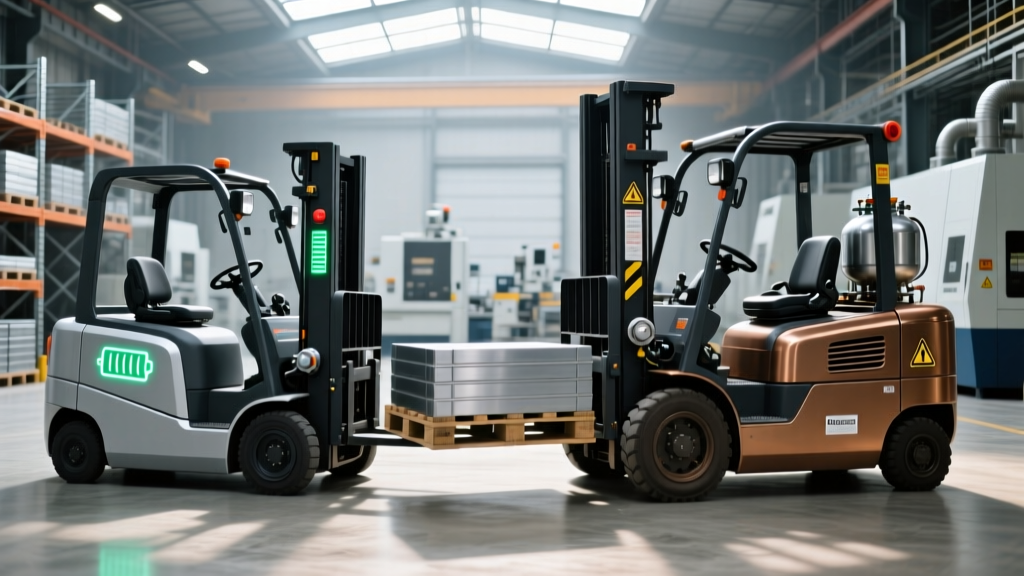
Facility safety managers face a distinct regulatory divergence when specifying power sources for powered industrial trucks. The deployment of any material handling equipment machine is governed primarily by OSHA 1910.178 (Powered Industrial Trucks) and the NFPA 505 Fire Safety Standard. However, the compliance burden shifts dramatically depending on whether the fleet utilizes internal combustion (LPG/Propane) or electric (Lead-Acid/Lithium-Ion) architectures.
Propane systems trigger stringent indoor air quality and combustible fuel storage mandates, while battery-electric systems invoke chemical handling, hydrogen off-gassing, and thermal runaway protocols. Misclassifying the operational environment or ignoring power-source-specific OSHA sub-paragraphs remains a leading cause of six-figure citations during targeted warehouse inspections.
Propane (LPG) Machines: Combustion, Storage, and Air Quality
When an internal combustion material handling equipment machine operates indoors, carbon monoxide (CO) and nitrogen dioxide (NO2) emissions become the primary compliance targets. OSHA mandates an 8-hour Time-Weighted Average (TWA) limit of 50 parts per million (ppm) for CO. Modern LPG forklifts, such as the Toyota 8FGU25, utilize three-way catalytic converters to reduce emissions, but these systems degrade rapidly if the engine runs rich or if maintenance intervals exceed 500 hours.
ANSI/ITSDF B56.1 Tank Inspection and Mounting Protocols
Propane cylinders (typically 33.5-lb or 43-lb DOT specifications) must undergo hydrostatic testing every 5 or 12 years, depending on the cylinder's manufacturing stamp. Beyond the tank itself, the physical mounting of the cylinder on the forklift is a frequent OSHA citation trigger under NFPA 58 (Liquefied Petroleum Gas Code).
- Locator Pin Alignment: Forklift cylinders are designed for liquid withdrawal. The cylinder must be mounted horizontally with the locator pin properly engaged in the cylinder collar. This ensures the pressure relief valve remains in the vapor space (typically the 8 o'clock position), preventing liquid propane from venting directly if the valve opens.
- Hose and Fitting Audits: Hoses must be inspected for dry rot, abrasion, and blistering. Any hose lacking a visible manufacturer date stamp or exceeding a 5-year service life must be replaced.
- Storage Distance: Empty and full cylinders must be stored in designated cages at least 20 feet away from building egress points and ignition sources.
Refueling a propane forklift inside a warehouse or near dock doors is a direct violation of NFPA 505. Cylinders must only be exchanged in designated, well-ventilated outdoor areas. Facilities caught refueling indoors face immediate 'Serious' violations, with penalties exceeding $16,000 per incident.
Battery-Powered Machines: Chemical and Thermal Hazards
Electric forklifts eliminate tailpipe emissions, making them mandatory for food-grade, pharmaceutical, and cold-storage environments. However, the compliance focus shifts to the charging infrastructure and battery chemistry.
Lead-Acid: Hydrogen Off-Gassing and Acid Spill Protocols
During the final 20% of the charge cycle, lead-acid batteries electrolyze water, releasing hydrogen and oxygen gas. Hydrogen is highly combustible and becomes explosive at a 4% Lower Explosive Limit (LEL). OSHA 1910.178(g) requires:
- Ventilation: Charging areas must have mechanical ventilation sufficient to maintain hydrogen concentrations below 1% LEL (typically requiring 1 to 2 CFM per square foot of floor space, depending on the number of chargers).
- Emergency Eyewash: A plumbed or self-contained ANSI Z358.1-compliant eyewash station must be located within a 10-second walk (approximately 25 feet) of the battery changing area.
- Spill Containment: Acid spill kits containing sodium bicarbonate (baking soda) or commercial neutralizers must be present, and the floor must be coated with acid-resistant epoxy.
Lithium-Ion: Thermal Runaway and NFPA 855
Lithium-ion (Li-ion) systems, like those integrated into the Crown FC5200 series, do not off-gas hydrogen and require zero watering. However, they introduce thermal runaway risks. If a Li-ion cell is punctured, overcharged, or subjected to extreme ambient heat, it can enter an uncontrollable exothermic reaction. While OSHA is still adapting specific Li-ion forklift codes, safety officers must reference NFPA 855 (Standard for the Installation of Stationary Energy Storage Systems) as the prevailing framework for high-density battery storage and charging.
Key Li-ion compliance requirements include integrated Battery Management Systems (BMS) that automatically sever the circuit if cell temperatures exceed 60°C (140°F), and maintaining a minimum 3-foot clearance between charging units to prevent cascading thermal events.
Power Source Compliance Matrix
The following matrix outlines the core operational and compliance differences between the three dominant power architectures in modern fleets.
| Compliance Factor | Propane (LPG) | Lead-Acid Electric | Lithium-Ion Electric |
|---|---|---|---|
| Primary OSHA Standard | 1910.178(p) / NFPA 58 | 1910.178(g) | 1910.178(g) / NFPA 855 |
| Indoor Air Quality | Requires CO monitors (50ppm TWA) | Zero emissions | Zero emissions |
| Ventilation Mandate | General dilution ventilation | Hydrogen extraction (<1% LEL) | Standard HVAC (thermal mgmt) |
| Emergency Equipment | Fire extinguisher (Class B/C) | Eyewash station, Acid spill kit | Class D or Li-ion specific extinguisher |
| Refuel/Recharge Zone | Outdoors only, 20ft from egress | Designated indoor acid-resistant zone | Designated indoor zone, 3ft spacing |
Facility Zoning and Power Source Selection
Selecting the correct material handling equipment machine requires mapping your facility's zoning against the regulatory overhead of each power type.
When to Mandate Electric (Li-Ion or Lead-Acid)
- Food & Beverage / Pharmaceutical: Propane is strictly prohibited due to contamination risks from particulate emissions and potential fluid leaks. Li-ion is preferred over lead-acid to eliminate the risk of sulfuric acid aerosolizing into the environment.
- Cold Storage (-10°F to 34°F): Propane engines suffer from severe vaporization issues in sub-zero environments, leading to stalling and rich fuel mixtures. Li-ion batteries with integrated heating elements maintain consistent voltage and eliminate the need for operators to handle freezing battery casings.
When to Permit Propane (LPG)
- Heavy Outdoor Lumber & Steel Yards: Propane forklifts (e.g., Hyster S50FT) provide superior torque and continuous runtime for heavy, outdoor loads where charging infrastructure is impractical to install.
- Multi-Shift Cross-Docking with High Ramp Grades: If a facility lacks the electrical capacity (often requiring 480V, 3-phase drops) to support a fleet of fast chargers, propane eliminates the need for massive utility upgrades, provided the dock doors offer sufficient natural ventilation to keep CO levels compliant.
Frequently Asked Compliance Questions
Can we convert an older propane forklift to electric to avoid emissions testing?
While aftermarket conversion kits exist, OSHA and ANSI/ITSDF B56.1 require that any modification altering the forklift's capacity, stability, or power source must be approved in writing by the original equipment manufacturer (OEM). Operating an unapproved converted machine voids the safety certification and results in automatic citations during an audit.
Do lithium-ion forklifts require special fire suppression systems?
Standard wet-pipe sprinkler systems are generally sufficient for Li-ion forklift charging areas, provided the density meets NFPA 13 requirements. However, if the facility stores spare Li-ion batteries in high-density racks, specialized early suppression fast response (ESFR) sprinklers or localized thermal detection systems may be mandated by the local Authority Having Jurisdiction (AHJ).