Mill-Duty Material Handling Equipment: Dock Leveler Alternatives
Compare standard dock levelers with heavy-duty alternatives for mill-duty material handling equipment. Find specs, pricing, and failure modes for loading bays.
The Dynamic Load Problem in Mill-Duty Loading Bays
Specifying loading bay equipment for heavy manufacturing, steel mills, and foundries requires a fundamental shift in how engineers calculate load capacities. Standard commercial dock levelers are typically rated for 60,000 to 80,000 lbs of static capacity. However, when integrating mill-duty material handling equipment into a facility's logistics flow, static ratings are virtually meaningless.
In a steel service center or heavy fabrication plant, a forklift or heavy-duty automated guided vehicle (AGV) might transport a single steel coil weighing 40,000 lbs. When that vehicle hits the dock leveler lip at 8 mph, the dynamic impact multiplier can reach 3x to 4x the static load. A standard 80,000 lb leveler will instantly yield, causing the lip to buckle, the hydraulic cylinder to blow its seals, or the main hinge pin to shear. According to OSHA's material handling guidelines, structural failure at the loading dock interface remains a primary vector for catastrophic forklift accidents and product damage.
To mitigate these risks, facility planners must look beyond catalog-spec levelers and evaluate true mill-duty alternatives designed for extreme dynamic forces, abrasive environments, and continuous 24/7 shift cycles.
Comparison Matrix: Standard Heavy-Duty vs. True Mill-Duty Levelers
The table below illustrates the critical engineering differences between standard heavy-duty commercial levelers and equipment specifically built for mill-duty applications as of 2026.
| Specification | Standard Heavy-Duty (Commercial) | True Mill-Duty (Industrial/Metals) |
|---|---|---|
| Deck Steel Grade | A36 Carbon Steel (36,000 psi yield) | A514 / T-1 Alloy Steel (100,000+ psi yield) |
| Lip Thickness | 0.75" to 1.0" | 1.5" to 2.0" (often with hardened wear plates) |
| Dynamic Load Rating | 60,000 - 80,000 lbs | 120,000 - 160,000+ lbs |
| Hinge Pin Design | Standard 1" solid steel pin | Heavy-duty 2" alloy pin with continuous weld hinges |
| Hydraulic Pressure | 2,500 - 3,000 PSI | 4,000 - 5,000 PSI with oversized bore cylinders |
| Estimated Installed Cost | $5,500 - $8,500 | $18,000 - $38,000+ |
Alternative 1: Custom Structural Pit Levelers with Coil Troughs
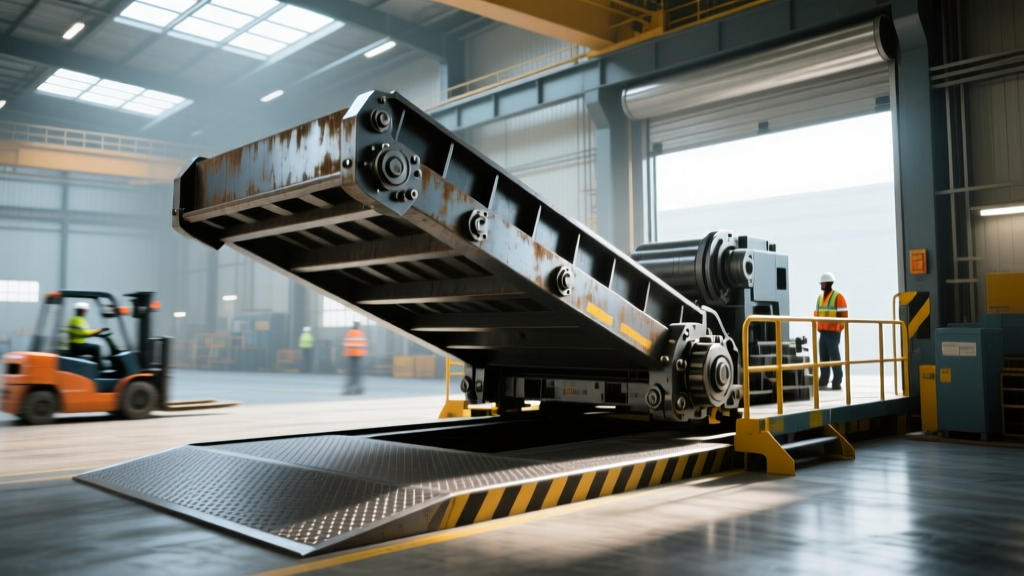
For facilities moving large metal coils, standard flat-deck levelers present a severe rolling hazard. The primary alternative is a custom structural pit leveler integrated with a flush-mount coil trough or cradle.
Engineering Specifics and Failure Prevention
These units feature a depressed section in the deck (the trough) lined with high-density polyurethane or replaceable hardwood timbers. When a forklift sets a 50,000 lb coil onto the leveler, the coil rests securely in the trough rather than balancing on the crown of the deck. This lowers the center of gravity and prevents the coil from breaking its banding and rolling off the edge during the transition from the building floor to the truck bed.
Procurement Tip: When sourcing mill-duty coil trough levelers, specify a dual-cylinder hydraulic system. Single-cylinder systems operating at 5,000 PSI to lift a combined deck-and-coil weight of 90,000 lbs will experience accelerated seal degradation. Dual cylinders distribute the load, allowing for lower operating pressures and doubling the mean time between seal replacements.Alternative 2: Edge-of-Dock (EOD) Levelers with Heavy-Duty Bumpers
When excavating a full pit is structurally impossible—such as in retrofitted foundries with shallow foundations or post-tensioned concrete slabs—facilities must rely on Edge-of-Dock (EOD) levelers. However, standard EOD units are entirely unsuited for mill-duty material handling equipment.
Upgrading the EOD for Mill Environments
To adapt an EOD leveler for heavy manufacturing, engineers must specify units with extended 24-inch to 30-inch lips (compared to the standard 16-inch) and reinforced approach angles. The critical failure point in heavy-duty EOD applications is the anchor system. Standard wedge anchors will pull out of the concrete under the repetitive dynamic braking forces of a 30,000 lb capacity forklift.
- Anchoring Requirement: Use chemical epoxy anchors (e.g., Hilti HIT-RE 500 V4) embedded minimum 12 inches into high-PSI concrete, or weld the EOD frame directly to an embedded steel curb angle.
- Bumper Integration: Pair the EOD with steel-face laminated dock bumpers rated for 150,000 lbs of impact force to prevent the truck from pushing the EOD unit off the foundation during loading.
Alternative 3: Grade-Level Drive-In Ramps and Door Seals
For the heaviest mill-duty equipment—such as multi-axle heavy haulers transporting large castings or heavy machinery—dock levelers are abandoned entirely in favor of grade-level drive-in bays.
A drive-in bay eliminates the transition plate altogether. The truck backs into a specialized heavy-duty dock shelter that seals around the trailer's exterior. The forklift or heavy-duty straddle carrier drives directly from the facility floor into the trailer bed. This requires the trailer bed to be perfectly flush with the facility floor, which is managed using specialized heavy-duty truck restraints and hydraulic trailer jacks to prevent 'landing gear collapse'—a common failure mode when 80,000 lbs of material is driven into the nose of a trailer.
Safety Warning: Grade-level drive-in bays require rigorous ventilation engineering. Heavy-duty diesel forklifts operating inside enclosed trailer beds create lethal concentrations of carbon monoxide and nitrogen dioxide. Always integrate localized exhaust ventilation (LEV) systems directly into the dock shelter header, as recommended by occupational health and safety guidelines for loading docks.
Decision Framework: Selecting the Right Bay Equipment
Choosing the correct loading bay interface for mill-duty material handling equipment requires a systematic evaluation of your specific load profiles and facility constraints. Use the following framework to guide your capital expenditure decisions:
Step 1: Calculate True Dynamic Load
Multiply the maximum static weight of your heaviest payload plus the forklift by an impact factor of 3.5. If the result exceeds 120,000 lbs, standard pit levelers are disqualified. You must specify A514 steel structural pit levelers or transition to a grade-level drive-in bay.
Step 2: Evaluate Payload Geometry
If your primary payloads are cylindrical (steel coils, large pipes, wire spools), flat-deck levelers are a critical safety liability. Mandate the inclusion of integrated coil troughs or specialized V-block deck attachments to secure the load during the dock-to-truck transition.
Step 3: Assess Foundation Constraints
If pit excavation is restricted, evaluate the structural integrity of your existing slab. If the slab cannot support chemical anchoring for a heavy-duty EOD leveler, you must invest in an exterior steel ramp system paired with a grade-level dock seal, bypassing the building's foundation entirely.
Step 4: Factor in Environmental Degradation
Mill environments often feature abrasive particulate (slag, scale, grinding dust) and extreme temperature fluctuations. Specify hydraulic power units with high-capacity desiccant breathers to prevent scale dust from contaminating the hydraulic fluid, and choose deck hinges with sealed, greaseable bushings rather than standard open-pin designs to prevent abrasive binding.