AGVs vs AMRs: Updating Your List of Material Handling Equipment
Compare AGVs and AMRs to update your list of material handling equipment. Explore 2026 pricing, payload specs, and hidden infrastructure costs.
The Technological Divide in Warehouse Automation
When facility managers audit their comprehensive list of material handling equipment, the distinction between Automated Guided Vehicles (AGVs) and Autonomous Mobile Robots (AMRs) dictates both capital expenditure and operational flexibility. While both automate horizontal transport, their underlying navigation architectures, infrastructure requirements, and failure modes are fundamentally different. Selecting the wrong platform for a specific SKU velocity profile results in stranded assets and bottlenecked throughput.
According to the Material Handling Industry (MHI), AGVs rely on deterministic, fixed-path navigation, whereas AMRs utilize dynamic, sensor-driven routing. This distinction is not merely semantic; it alters facility design, IT network requirements, and long-term maintenance schedules.
Core Definitions
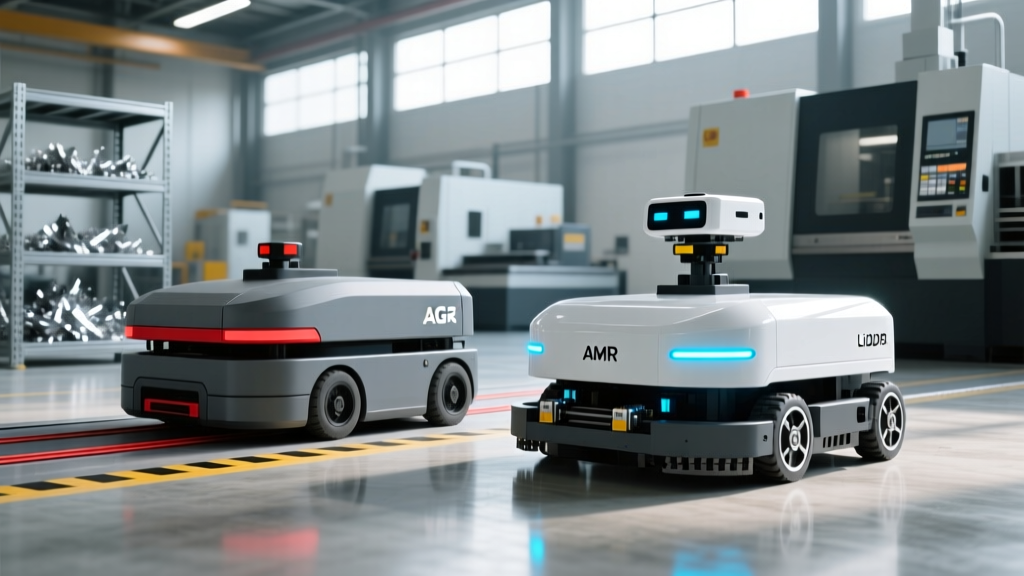
AGV (Automated Guided Vehicle): Follows predefined paths using magnetic tape, induction wires, or painted lines with QR codes. Stops immediately when an obstacle blocks the path.
AMR (Autonomous Mobile Robot): Navigates dynamically using LiDAR, vSLAM (visual Simultaneous Localization and Mapping), and 3D cameras. Recalculates routes in real-time to bypass obstacles.
2026 Comparison Matrix: AGV vs. AMR vs. Manual Fleet
The following matrix breaks down the operational realities of integrating these systems into a mid-sized distribution center (100,000 - 250,000 sq ft).
| Feature | Wire/Tape AGV | LiDAR/vSLAM AMR | Manual Forklift |
|---|---|---|---|
| Base Unit Cost | $45,000 - $85,000 | $60,000 - $120,000 | $25,000 - $40,000 |
| Infrastructure Cost | High ($15k+ for tape/wire) | Low (Digital mapping only) | None |
| Route Change Time | Days (Physical re-taping) | Minutes (Software update) | Instant |
| Obstacle Handling | Stops and waits | Reroutes dynamically | Human judgment |
| Floor Flatness Req. | Strict (FF 50 / FL 35) | Moderate (FF 35 / FL 25) | Low |
When Traditional AGVs Still Win
Despite the industry hype surrounding AMRs, traditional AGVs remain the superior choice for specific high-throughput, low-variability workflows. If your operation involves moving uniform pallets from a fixed depalletizing cell to a fixed stretch-wrapper, an AGV provides a higher return on investment.
Heavy Payloads and Towing
AGVs excel in heavy-duty applications. The KUKA KMP 1500P, for example, utilizes omni-directional mecanum wheels to transport payloads up to 1,500 kg with millimeter-level docking precision. Because AGVs do not carry the computational overhead of real-time 3D spatial mapping, more of the chassis volume and battery capacity (typically 48V LiFePO4 banks) can be dedicated to drive motors and towing capacity.
Predictable Maintenance Cycles
AGV navigation systems—specifically magnetic tape and optical line followers—are technologically mature. When a magnetic tape sensor fails, the diagnostic process is straightforward. Maintenance teams can replace a damaged section of 3M magnetic tape in minutes without needing a robotics engineer to recalibrate a LiDAR point cloud.
Warning on Floor Flatness: AGVs operating at high speeds (>1.5 m/s) with elevated loads require strict adherence to ASTM E1155 floor flatness standards. A floor with an FF (Floor Flatness) number below 50 will cause excessive vibration, triggering the AGV's safety PLC to initiate an emergency stop to prevent load shedding.
The AMR Alternative: Flexibility at a Premium
Autonomous Mobile Robots are engineered for dynamic environments where racking layouts change seasonally, and human workers frequently cross transport aisles. AMRs utilize vSLAM and 2D/3D LiDAR (such as the SICK microScan3 or Hokuyo UST series) to build a continuous digital twin of the facility.
Dynamic Obstacle Avoidance
Unlike AGVs, which halt when a pallet is left in the aisle, an AMR like the MiR1000 (1,000 kg payload capacity) will instantly recalculate its path using the facility's digital map. This capability is critical in mixed-traffic warehouses where OSHA regulations regarding powered industrial trucks mandate strict separation or advanced safety protocols for human-robot interaction.
The Hidden IT Infrastructure Cost
What AMR vendors often understate is the IT infrastructure required to support a fleet. A fleet of 20 AMRs communicating simultaneously with a central fleet management server requires a robust Wi-Fi 6 (802.11ax) network. If network latency exceeds 50ms, or if the warehouse suffers from Wi-Fi dead zones caused by high-density metal racking, AMRs will default to a safe-stop mode, crippling throughput. Upgrading a 150,000 sq ft facility to enterprise-grade Wi-Fi 6 with seamless roaming access points can add $30,000 to $60,000 to the initial project CapEx.
Failure Modes and Edge Cases
Understanding how these systems fail in the real world is crucial for updating your list of material handling equipment accurately.
- AGV Tape Degradation: In facilities with heavy foot traffic or manual forklift cross-traffic, magnetic tape degrades rapidly. Scuff marks and tire residue interfere with optical line sensors, requiring weekly floor scrubbing and monthly tape replacement.
- AMR LiDAR Blinding: High-bay LED lighting with specific flicker frequencies, or highly reflective shrink wrap on pallets, can create 'ghost' obstacles in an AMR's LiDAR point cloud. This causes the robot to brake unnecessarily or refuse to enter an aisle.
- Battery Opportunity Charging: Both systems rely on opportunity charging. However, if the charging contacts (usually copper or beryllium alloy pads) become oxidized due to warehouse humidity, the robot will fail to charge during its 5-minute idle cycles, leading to mid-shift battery depletion.
Procurement Decision Framework
Use the following logic tree to determine which technology belongs in your facility upgrade plan.
If/Then Selection Matrix
- Does your route change more than once a month?
Yes → Select AMR. The cost of re-taping AGV routes will destroy ROI.
No → Proceed to step 2. - Is the payload consistently over 1,200 kg with high-center-of-gravity stacking?
Yes → Select Heavy-Duty AGV. Deterministic paths prevent the micro-adjustments that cause AMRs to drop elevated loads.
No → Proceed to step 3. - Is the warehouse environment highly dynamic with mixed human/forklift traffic?
Yes → Select AMR. Dynamic rerouting prevents the 'deadlock' scenarios common with AGVs in crowded aisles.
No → Select AGV for maximum cost-efficiency.
Integrating Automation into Your Fleet Strategy
Updating your list of material handling equipment is not a binary choice between full automation and manual labor. The most efficient 2026 warehouse deployments utilize a hybrid approach. Manual reach trucks handle complex, non-standard pallet extraction from damaged racking, while AGVs execute the long-haul, point-A-to-point-B transport to the shipping docks. By matching the navigation technology to the specific variability of the task, facility managers can achieve a 20% to 30% reduction in cost-per-pallet-moved without sacrificing operational resilience.
For further safety guidelines on integrating automated vehicles into existing human workspaces, refer to the NIOSH Robotics and Occupational Safety resources to ensure compliance with evolving collaborative robot standards.