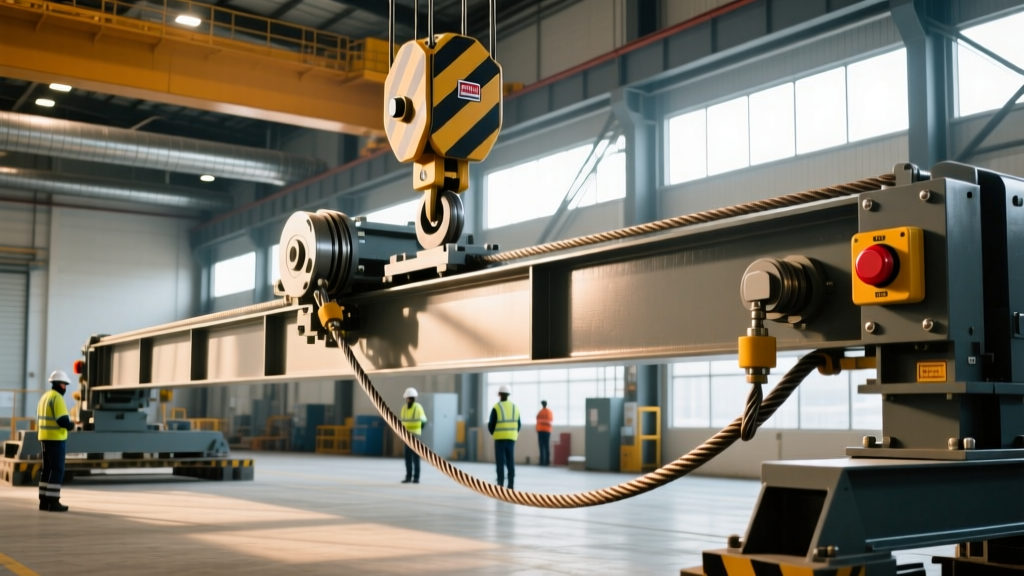
Bridge Crane Checks Before Using Material Handling Equipment to Move Ammunition
Master the critical pre-operational checks and bridge crane configurations required before using material handling equipment to move ammunition safely.
Handling live ordnance, missile components, and bulk propellants within military depots and defense manufacturing facilities represents one of the most high-stakes environments in industrial logistics. A dropped load or uncontrolled swing in a munitions magazine can result in catastrophic detonation, structural failure, and mass casualties. Consequently, the operational parameters for overhead and bridge cranes in these facilities far exceed standard manufacturing tolerances. Understanding the exact mechanical configurations and the rigorous inspection protocols required before using material handling equipment to move ammunition is not merely a regulatory formality; it is a critical survival mechanism for facility personnel.
Mandatory Bridge Crane Configurations for Munitions Handling
Standard workshop cranes are entirely unsuited for ammunition handling. Facilities operating under Department of Defense (DoD) guidelines and Crane Manufacturers Association of America (CMAA) standards must deploy specialized bridge crane systems engineered for absolute load control and spark mitigation.
- CMAA Class D (Heavy Duty) or Class E (Severe Duty): Ammunition depots typically require Class D minimum, characterized by high-cycle endurance and robust structural factors. For automated missile assembly lines, Class E is mandated to handle continuous, high-speed, heavy-capacity lifts (often 20-ton to 50-ton capacities) without structural fatigue.
- Redundant Hoist Braking Systems: A single mechanical brake is unacceptable. Munitions cranes must feature a primary mechanical load brake and a secondary dynamic or regenerative braking system. The primary brake must be capable of holding 125% of the rated load independently.
- Active Anti-Sway Technology: Modern facilities utilize closed-loop anti-sway systems (such as those developed by Konecranes or Demag). These systems use sensors and variable frequency drives (VFDs) to automatically adjust trolley and bridge acceleration, eliminating pendulum effects. When moving unstable liquid propellants or precision-guided munitions, sway must be limited to less than 2 inches at full hoist height.
- Spark-Resistant Components: In areas classified as hazardous (e.g., propellant mixing or warhead arming zones), below-the-hook (BTH) devices, hooks, and trolley wheels must be constructed from non-sparking alloys like beryllium copper or bronze. Bridge girders require specialized non-sparking epoxy coatings to prevent friction-sparks during runway contact.
The Pre-Operational Protocol: What to Verify Before Use
The checklist executed before using material handling equipment to move ammunition is vastly more stringent than standard daily crane inspections. Operators must perform a multi-tiered verification process focusing on electrical integrity, mechanical tolerances, and environmental hazards. According to OSHA Standard 1910.179 for overhead and gantry cranes, any defect identified during a pre-shift inspection requires immediate lockout/tagout (LOTO). In munitions handling, the threshold for LOTO is significantly lower.
1. Electrical and Control System Verification
Operators must test all upper and lower limit switches under no-load conditions before attaching any rigging. The upper limit switch must be verified to cut power to the hoist motor before the hook block contacts the drum or sheave assembly. Additionally, all pendant controls or radio transmitters must be checked for 'stickiness' or delayed spring-return on the pushbuttons. A delayed stop command of even half a second can cause a suspended missile to strike a magazine wall.
2. Mechanical and Wire Rope Inspection
Wire rope used in ammunition handling is subjected to strict discard criteria based on ASME B30.9 standards. Operators must visually inspect the entire length of the hoist rope for:
- Broken Wires: More than 6 randomly distributed broken wires in one rope lay, or 3 broken wires in one strand in one lay, mandates immediate rope replacement.
- Diameter Reduction: Any loss of nominal rope diameter exceeding 1/64th of an inch for ropes up to 3/4 inch in diameter requires discard.
- Hook Throat Deformation: The hook throat opening must be measured with calipers. An increase of more than 15% over the manufacturer's baseline dimension indicates plastic deformation and requires hook destruction and replacement.
Pre-Lift Inspection Matrix for Ammunition Depots
The following matrix outlines the exact tolerances and actions required during the pre-operational inspection phase.
| Component | Inspection Criteria & Tolerance | Required Action if Failed |
|---|---|---|
| Upper Limit Switch | Must halt hoist motion at least 6 inches below the drum. | Immediate LOTO. Do not lift. |
| Hoist Load Brake | Must hold 125% of rated capacity without slipping. | Ground crane. Adjust or replace brake pads. |
| Sheave Grooves | No corrugation, pitting, or flange wear exceeding 1/32 inch. | Replace sheave. Inspect rope for corresponding damage. |
| Runway End Stops | Bumpers intact, capable of absorbing trolley kinetic energy at 50% rated speed. | Restrict bridge speed to creep. Schedule bumper replacement. |
| Radio Transmitter | Intrinsically safe seal intact; emergency stop (E-Stop) button functional. | Remove from service. Switch to tethered pendant. |
Below-the-Hook (BTH) Devices and Rigging Specifics
The interface between the crane hook and the ammunition is where localized stress and sparking risks are highest. Standard chain slings are strictly prohibited in most munitions handling scenarios due to the risk of impact sparks and the potential to crush or dent sensitive warhead casings.
Synthetic Slings and Edge Protection
Operators must utilize high-tenacity polyester or nylon synthetic slings (often color-coded per WLL capacity). When lifting metal ammunition crates or missile tubes, hardened steel edges will slice a synthetic sling under tension. Operators must apply heavy-duty polyurethane edge protectors or use slings with integrated Kevlar-reinforced wear pads. The sling angle must never exceed 60 degrees from the horizontal to prevent excessive tension multiplication on the casing.
Vacuum Lifters for Smooth Ordnance
For large-diameter, smooth-cased munitions (such as specific artillery shells or rocket motors), specialized vacuum lifting beams are preferred to eliminate the crushing force of mechanical clamps. Before using a vacuum lifter on live ordnance, the operator must verify the vacuum retention test: the system must hold 99.5% of its vacuum pressure for a minimum of 5 minutes with the power disconnected, relying solely on the accumulator tank. Furthermore, the audible low-vacuum alarm must be tested to ensure it triggers at 80% of the operating vacuum level.
Intrinsically Safe Communications and Human Factors
Magazines and ammunition storage bunkers are often constructed with thick, reinforced concrete and earth-berms, creating severe dead-zones for standard radio frequencies. Furthermore, standard commercial radios can act as ignition sources in environments where volatile propellant vapors or dust may be present.
"Effective communication during a blind lift in a munitions facility requires ATEX or IECEx certified intrinsically safe radios. Standard cellular devices or unmodified two-way radios introduce an unacceptable thermal and electrical spark risk in classified hazardous zones."
Operators and riggers must be trained in standardized DoD hand signals, serving as a failsafe if electronic communication fails. Cognitive load management is equally critical; ammunition handling requires sustained, hyper-vigilant focus. Facility protocols mandate mandatory 15-minute rest periods for crane operators every two hours during high-tempo loading operations to mitigate the micro-sleeps and attention drift that lead to load-swing incidents.
Ultimately, the safe movement of explosives via overhead bridge cranes relies on an uncompromising adherence to mechanical tolerances and pre-lift verification. By treating every inspection point as a critical defense against catastrophic failure, operators ensure the integrity of both the ordnance and the facility.
Related reading

AGVs vs Traditional Material Handling Equipment: 2026 ROI Analysis
Troubleshooting Forklift Attachments for Storeroom Bulk Material Handling Equipment Installations in California