AGVs vs Traditional Material Handling Equipment: 2026 ROI Analysis
Compare automated guided vehicles (AGVs) against traditional material handling equipment. Analyze 2026 costs, ROI timelines, and warehouse integration.
The Shift from Manual to Autonomous Material Handling Equipment
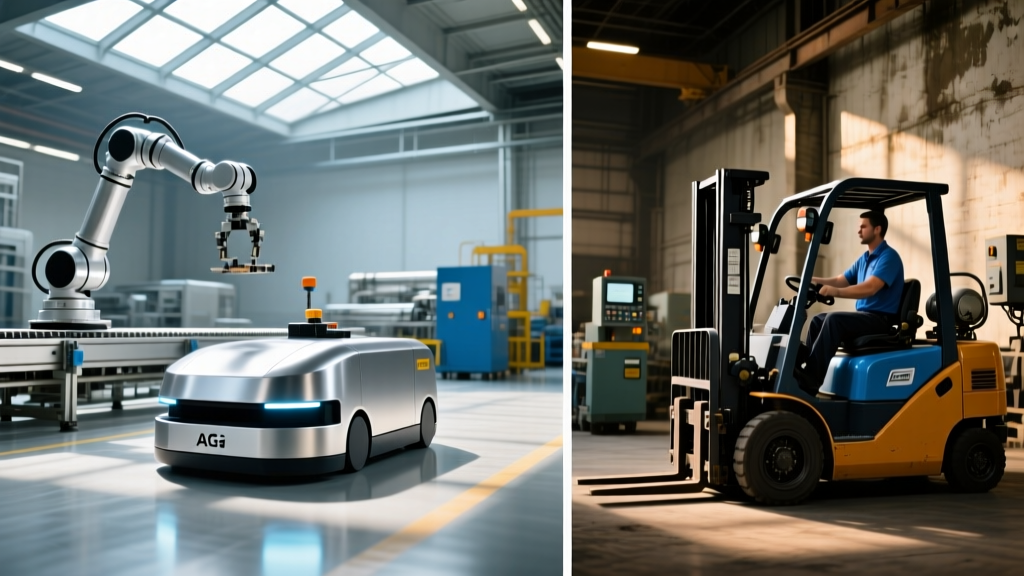
The decision to integrate Automated Guided Vehicles (AGVs) into a warehouse operation is no longer a question of technological feasibility, but of precise financial and operational alignment. When evaluating automated guided vehicles against traditional material handling equipment—specifically Class I electric forklifts and fixed conveyor systems—facility managers must look beyond the initial purchase price. The true differentiator lies in the Total Cost of Ownership (TCO), navigation reliability in brownfield environments, and the specific failure modes inherent to each system.
This analysis breaks down the 2026 landscape of warehouse automation, comparing AGVs directly with manual alternatives to provide a concrete framework for capital allocation.
Capital Expenditure and Total Cost of Ownership (2026)
The most common miscalculation in warehouse automation is isolating the hardware cost from the integration and labor variables. A standard Class I electric forklift, such as the Toyota 8FBMT25, requires a lower upfront capital expenditure but carries a heavy, compounding operational expense. Conversely, an industrial AGV like the MiR1000 or KUKA KMP 1500 demands significant upfront software and mapping investments, but drastically reduces variable labor costs.
| Cost Metric (USD) | Class I Electric Forklift (e.g., Toyota 8FBMT25) | Heavy-Duty AGV (e.g., MiR1000 / KUKA KMP 1500) |
|---|---|---|
| Base Unit Hardware Cost | $45,000 - $55,000 | $85,000 - $115,000 |
| Fleet Management & Software | $0 (Telematics optional: $1,200/yr) | $12,000 - $18,000 (Initial setup + licensing) |
| Facility Infrastructure Prep | $0 | $5,000 - $25,000 (Wi-Fi 6E upgrades, floor leveling) |
| Annual Maintenance & Parts | $2,500 - $4,000 | $3,500 - $5,500 (Sensor calibration, battery swaps) |
| Operator Labor (Fully Burdened) | $45,000 - $60,000 per year, per shift | $0 (Reallocated to exception handling/supervision) |
| 3-Year TCO (Single Shift) | $200,000 - $250,000 | $145,000 - $180,000 |
| 3-Year TCO (Three Shifts) | $550,000 - $680,000 | $165,000 - $210,000 |
Navigation Technologies and Infrastructure Requirements
Traditional material handling equipment relies entirely on human spatial awareness, requiring only standard aisle widths (typically 12 to 14 feet for counterbalanced forklifts, or 8 feet for narrow-aisle reach trucks). AGVs, however, require a digital and physical infrastructure that dictates their operational ceiling.
Legacy vs. Modern AGV Navigation
- Magnetic Tape & Wire Guidance: Largely obsolete in 2026 for dynamic warehouses. While cheap to implement ($2-$4 per linear foot), tape degrades under heavy forklift traffic and requires facility downtime to reroute.
- QR Code / 2D Matrix Grid: Common in goods-to-person robotic systems (like Amazon's Kiva-derived fleet). Requires a perfectly flat floor and restricts the AGV to a rigid grid, limiting flexibility in brownfield sites.
- LiDAR SLAM (Simultaneous Localization and Mapping): The 2026 industry standard for heavy payload AGVs. By mapping natural features (columns, racking uprights, walls), LiDAR SLAM allows AGVs to adapt to minor environmental changes without infrastructure modifications. According to the Material Handling Industry (MHI), over 75% of new heavy-duty AGV deployments now utilize natural feature SLAM.
Operational Failure Modes: Where AGVs Stall
Proponents of automation often gloss over the edge cases that cause AGV fleets to bottleneck. Understanding these failure modes is critical when comparing them to the predictable, albeit human-dependent, failure modes of manual material handling equipment.
AGV Edge Cases and Sensor Blind Spots
- The Shrink-Wrap Reflection Problem: Standard 2D LiDAR sensors operate on infrared or near-infrared wavelengths. Black shrink-wrap absorbs these wavelengths, while highly reflective metallic banding scatters them. An AGV approaching a pallet wrapped in black plastic may register the space as 'empty' and collide with the load. Mitigation: Require standardized white or clear stretch wrap in AGV zones, or deploy 3D vision systems with RGB cameras, which add $8,000-$12,000 per unit.
- Pallet Overhang and Dimensional Variance: A human forklift operator intuitively adjusts fork width and tilt for a broken or overhanging pallet. An AGV programmed for a standard 48x40-inch footprint will trigger an emergency stop (E-stop) if it detects a 4-inch overhang via its safety bumpers or LiDAR fields.
- Wi-Fi 6E Dead Zones in Racking Aisles: AGVs require continuous handshake latency below 50ms with the Fleet Management System (FMS). Deep, narrow aisles flanked by metal racking and liquid-filled containers create Faraday cage effects. If the AGV loses connection, safety protocols dictate an immediate halt.
Manual Equipment Failure Modes
Conversely, manual forklifts suffer from mechanical and human degradation. The OSHA Powered Industrial Trucks guidelines highlight that operator fatigue, improper load balancing, and failure to conduct pre-shift inspections lead to mast chain snapping, hydraulic hose ruptures, and costly product damage. While an AGV will never drive a fork through a pallet rack upright due to distraction, a manual forklift will never halt operations because a piece of stray corrugated cardboard blocked its path.
Safety Standards and Compliance
Facilities deploying AGVs must adhere to the ITSDF B56.5 safety standards, which mandate specific sensor performance, braking distances, and audible/visual warning systems. Unlike manual forklifts where safety relies on operator training, AGV safety is engineered into the hardware, drastically reducing the liability and workers' compensation premiums associated with pedestrian-vehicle collisions.
The Decision Matrix: AGV vs. Traditional Alternatives
Use the following framework to determine whether automated guided vehicles or traditional material handling equipment is the correct capital investment for your specific operational profile.
Deploy AGVs When:
- Throughput is predictable: You move >400 standard pallets per day over fixed, repeatable routes (e.g., receiving dock to reserve racking).
- Multi-shift operations: You run 2 or 3 shifts, making the labor arbitrage mathematically undeniable.
- Labor scarcity is acute: Your facility is in a region with a <15% unemployment rate and high turnover in material handling roles.
- Product is uniform: Loads are consistently palletized, within standard dimensions, and free of excessive overhang.
Retain Traditional Material Handling Equipment When:
- High SKU variability: You handle mixed, non-palletized, or oversized goods (e.g., lumber, loose appliances, varying drum sizes).
- Dynamic routing: Aisles are frequently blocked, layouts change seasonally, and 'exception handling' makes up >20% of daily movements.
- Outdoor or yard operations: Moving loads across uneven asphalt, gravel, or in inclement weather (AGVs are strictly indoor, smooth-floor solutions unless heavily modified).
- Single-shift, low-volume: The TCO of a $110,000 AGV cannot be justified against a single $45,000 forklift and one operator.
Final Integration Strategy
The most successful warehouse operations in 2026 do not view this as a binary choice. The optimal strategy is a hybrid fleet. Deploy AGVs for the 'middle mile' of warehouse logistics—long-haul, repetitive movements from receiving to storage zones. Reserve traditional, narrow-aisle manual reach trucks for the 'last 50 feet' of put-away and picking, where human dexterity and spatial problem-solving remain economically superior to robotics. By mapping the exact failure modes and TCO variables to your facility's specific throughput data, you can engineer a material handling ecosystem that maximizes both uptime and return on invested capital.