Storeroom Material Handling Equipment Installations in Oakland: Robotic Palletizer Safety
Navigate Cal/OSHA and ANSI/RIA R15.06 safety standards for robotic palletizing and storeroom material handling equipment installations in Oakland.
Executing compliant storeroom material handling equipment installations in Oakland requires addressing both the spatial constraints typical of MRO (Maintenance, Repair, and Operations) rooms and the strict regulatory environment of Alameda County. As Bay Area logistics and manufacturing facilities increasingly deploy robotic palletizing and depalletizing systems to handle heavy parts, drums, and raw materials, safety compliance has shifted from a post-installation checklist to a primary engineering constraint.
In 2026, facility managers must navigate a complex intersection of federal OSHA machine guarding mandates, Cal/OSHA’s Injury and Illness Prevention Program (IIPP), and localized seismic building codes. This guide details the exact safety hardware, anchoring specifications, and risk assessment frameworks required to legally and safely operate robotic palletizers in confined industrial storerooms.
⚠️ Bay Area Seismic & Regulatory Warning: Oakland falls within Seismic Design Category D due to its proximity to the Hayward Fault. Robotic palletizers exceeding 4,000 lbs (such as the FANUC M-410iC/185) require dynamic load calculations for base anchoring. Furthermore, Cal/OSHA strictly enforces Title 8 Section 3203, mandating that all automated material handling risks be explicitly documented in your site's IIPP.Core Safety Standards for Robotic Palletizers
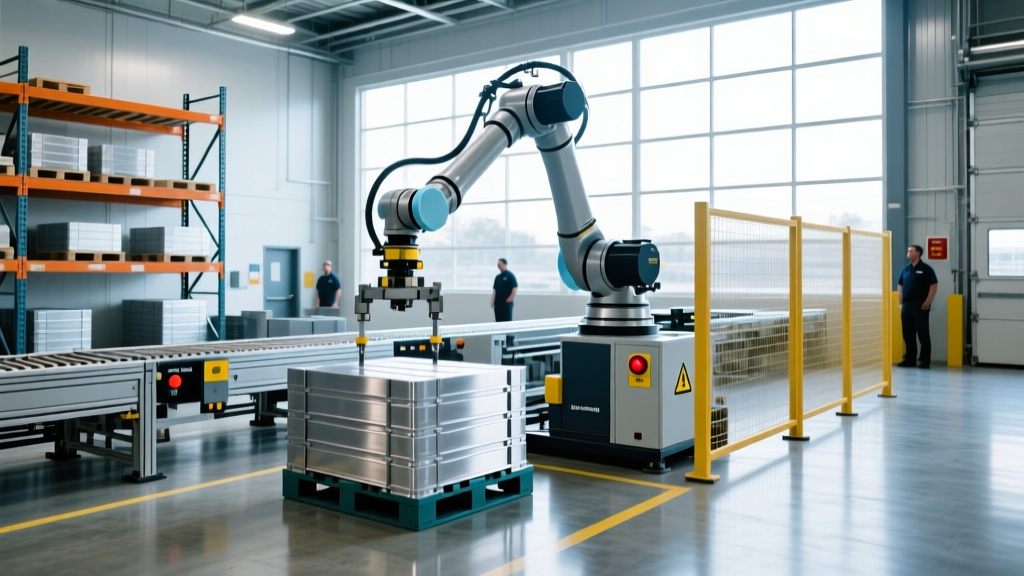
Unlike standard conveyor systems, robotic palletizers operate with high kinetic energy and unpredictable payload shifts. The foundational safety architecture for these systems in the United States is governed by the ANSI/RIA R15.06 standard (harmonized with ISO 10218-1 and ISO 10218-2). For storeroom installations, where human operators frequently enter the workspace to retrieve misaligned pallets or clear jams, compliance hinges on three critical pillars:
- Speed and Separation Monitoring (SSM): Utilizing safety-rated LiDAR scanners to slow the robot when an operator enters the warning zone (typically 2.5 meters) and halt it entirely in the protective zone (1.2 meters).
- Hand Guiding Protocols: Implementing three-position enabling devices on teach pendants for depalletizing reprogramming, ensuring the operator maintains conscious control.
- Collaborative vs. Industrial Classification: Most heavy-duty palletizers (payloads >50kg) cannot operate in true "collaborative" mode (ISO/TS 15066) due to the kinetic energy of the end-of-arm tooling (EOAT). They must rely on safeguarded spaces.
Spatial Constraints in Storeroom Installations
Storerooms rarely offer the expansive 20x20 foot footprints required for traditional hard-caging. When space is at a premium, facilities must rely on electro-sensitive protective equipment (ESPE). However, placing safety scanners too close to the robot's maximum reach envelope results in nuisance trips, while placing them too far violates the minimum safety distance formula outlined in ISO 13855.
Safety Hardware Specifications & Cost Estimates
Selecting the right perimeter guarding is critical for maintaining throughput in tight MRO storerooms. Below is a comparison of 2026 market-leading safety hardware for robotic palletizing cells.
| Hardware Type | Recommended Model | Protective Range | Response Time | Est. Cost (USD) |
|---|---|---|---|---|
| Safety Laser Scanner | SICK microScan3 Pro | Up to 5.5m | ~90 ms | $4,200 - $5,500 |
| Safety Light Curtain | Keyence GL-R Series (Type 4) | Up to 15m | ~15 ms | $2,800 - $4,000 |
| Hard Perimeter Caging | Troax ST30 Mesh (with interlocked gates) | Physical Barrier | N/A (Interlock <20ms) | $85 - $120 / linear ft |
| Safety PLC / Controller | Allen-Bradley GuardLogix 5580 | System-wide Logic | <10 ms | $7,500 - $11,000 |
Navigating Cal/OSHA and Bay Area Seismic Compliance
Federal OSHA 1910.212 dictates general machine guarding, but California’s Division of Occupational Safety and Health (DOSH) enforces stricter documentation and training protocols. For Oakland facilities, seismic stability is not just a building code issue; it is a worker safety mandate. A toppled robotic palletizer during a seismic event or due to improper forklift impact represents a catastrophic crushing hazard.
Seismic Anchoring Specifications for Heavy Palletizers
Standard wedge anchors are insufficient for the dynamic, multi-directional torque generated by a 6-axis robot accelerating a 150kg payload. For installations in Oakland's Seismic Design Category D zones, engineering teams must specify chemical epoxy anchors.
- Base Plate Preparation: Ensure the robot mounting plate is a minimum of 1.5-inch thick A36 steel, machined flat to prevent point-loading.
- Adhesive Selection: Use Hilti HIT-HY 200-A injectable mortar, which provides high-load capacity in cracked concrete (essential for older Bay Area industrial floors).
- Anchor Specs: M20 or M24 HAS-E threaded rods with a minimum embedment depth of 170mm to 210mm, depending on the concrete compressive strength (minimum 2,500 psi required).
- Torque Verification: Apply the manufacturer-specified installation torque (typically 220 Nm for M20) using a calibrated digital torque wrench, and log the serial numbers in the site's IIPP maintenance registry.
Common Failure Modes and Edge Cases in Storerooms
Risk assessments (HAZOP studies) for storeroom robotic palletizers frequently overlook environmental and operational edge cases. Addressing these during the design phase prevents costly compliance failures during Cal/OSHA inspections.
🚨 Critical Failure Mode: High-Bay LED BlindingModern storerooms utilize high-lumen LED bay lighting. If a safety laser scanner's optical path aligns directly with an overhead light fixture, the sensor can experience "blinding" or false-clear signals, allowing the robot to operate while a human is in the protective zone. Fix: Mandate physical hoods over scanner lenses and angle scanners at a 3-degree downward pitch during installation.
Edge Case: Pallet Collapse and Reach-Through Hazards
When depalletizing irregular MRO parts, a collapsed pallet can cause an operator to reach through a light curtain to restack boxes while the robot is paused but not fully locked out. Under Cal/OSHA Title 8 Section 3203, if an operator can break the plane of the light curtain without triggering a full system reset, the installation is non-compliant. Facilities must implement "muting" sequences that require dual optical sensors to verify a forklift—not a human—is entering the zone, or rely on hard-caging with trapped-key interlock systems.
"The most common citation we see in automated storerooms isn't a lack of guarding; it's the failure to integrate the robot's E-stop circuit with the facility's main fire alarm and HVAC shutdown systems. In a confined MRO room, a robotic palletizer must immediately drop to a zero-energy state if the fire suppression system triggers."
— Industrial Safety Auditor, Bay Area Manufacturing Consortium (2025 Report)
Step-by-Step Compliance Checklist for Oakland Facilities
Before energizing a new robotic palletizing cell in an Oakland storeroom, facility managers must verify the following compliance milestones:
- [ ] ISO 12100 Risk Assessment: Complete and sign off on a formalized risk assessment documenting all pinch points, crushing zones, and EOAT shear hazards.
- [ ] Cal/OSHA IIPP Update: Integrate the robotic cell's specific Lockout/Tagout (LOTO) procedures and daily sensor-check routines into the facility's master IIPP document.
- [ ] Seismic PE Stamp: Obtain a Professional Engineer (PE) stamp on the dynamic load calculations and epoxy anchoring layout specific to the building's concrete core samples.
- [ ] Validation Testing: Conduct physical "test dummy" intrusions into the safety scanner fields at maximum robot operating speeds to verify the stopping distance formula (S = (K x T) + C) holds true under real-world conditions.
- [ ] Operator Certification: Ensure all storeroom personnel complete ANSI/RIA-approved robotic safety training, with documented proof retained on-site for minimum 3 years.
By treating safety compliance as an integrated engineering parameter rather than an administrative afterthought, Oakland facilities can safely leverage robotic palletizers to maximize storeroom throughput while maintaining an unimpeachable safety record.