Material Handling Specialty Equipment: Conveyor Belts for Bulk Solids
Explore how material handling specialty equipment adapts to bulk solids. Case studies on conveyor belt types for abrasive, sticky, and food-grade materials.
The Hidden Cost of Belt-Material Mismatch
When engineers specify material handling specialty equipment for bulk processing, the conveyor belt is often treated as a commodity rather than a highly engineered component. This approach leads to catastrophic operational bottlenecks. According to industry downtime metrics, a single belt failure on a primary aggregate or biomass feed line can cost facilities between $12,000 and $45,000 per hour in lost production, excluding the labor required for emergency hot vulcanization.
Selecting the correct belting compound, carcass construction, and topography is not a one-size-fits-all calculation. It requires a precise mapping of material properties—abrasiveness, moisture content, particle size, and chemical reactivity—to specific elastomer formulations and tension ratings. Below, we examine three distinct industrial case studies that demonstrate how specialized conveyor belting solves complex material transport challenges.
Warning: The Danger of Over-Specifying PIWSpecifying a higher Pounds per Inch of Width (PIW) rating than required does not always improve belt life. An excessively stiff carcass on smaller pulley diameters causes excessive bending fatigue, leading to ply separation and premature cover cracking. Always match the carcass flexibility to the minimum pulley diameter specified by the manufacturer.
Case Study 1: Abrasive Aggregates in Mining Operations
The Failure Mode: Carcass Delamination and Cover Gouging
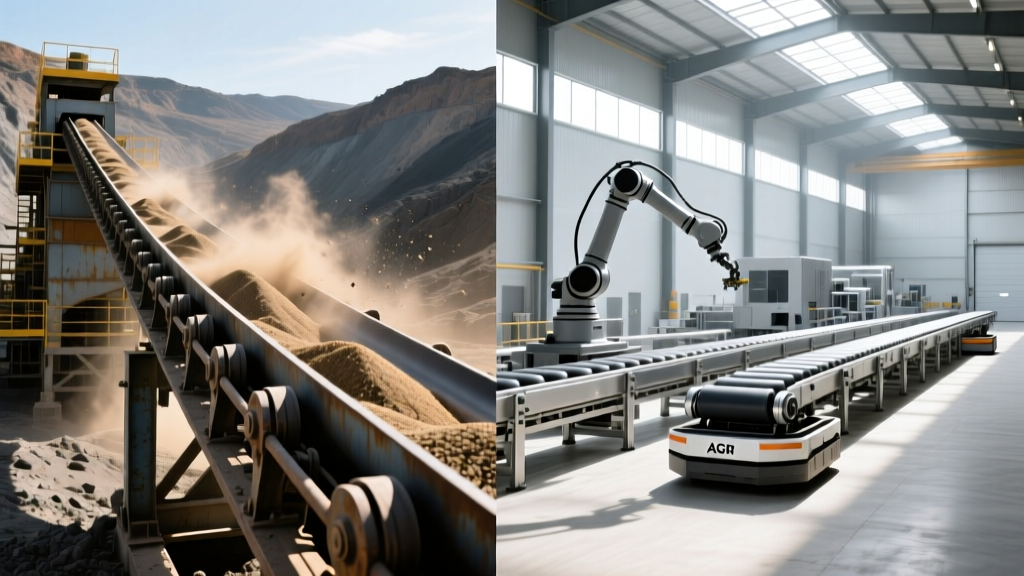
In a high-tonnage iron ore transfer application, standard SBR (Styrene-Butadiene Rubber) belts were experiencing severe cover gouging and edge delamination within six months. The sharp, angular nature of the 4-inch minus ore was slicing through the standard 6mm top cover, exposing the fabric carcass to moisture and subsequent rot.
The Engineering Solution: The facility upgraded to a heavy-duty steel cord belt (ST1000 to ST2500 series) featuring a DIN 22102 Grade 'W' (Wear-resistant) cover compound. Grade 'W' compounds are specifically formulated with high-tensile synthetic rubbers that resist cutting and gouging from sharp, heavy materials.
- Top Cover Thickness: Increased to 10mm to absorb the impact energy of the dropping ore.
- Bottom Cover: Maintained at 4mm to minimize rolling resistance.
- Impact Protection: Installed heavy-duty impact beds with UHMW (Ultra-High Molecular Weight) polyethylene bars at the loading zone to absorb kinetic energy and prevent longitudinal tearing.
'In highly abrasive environments, the initial capital expenditure of a Grade W steel-cord belt is typically 40% higher than standard fabric belts, but the total cost of ownership drops by over 60% due to a lifespan extension from 8 months to 3+ years.' — Fleet Maintenance Director, Tier-1 Mining Operation
For heavy-duty belt tracking and cleaning, integrating primary and secondary belt cleaners is non-negotiable. Tungsten-carbide tipped cleaners are required here to maintain a clean return side, preventing abrasive carryback from destroying the tail pulley lagging. For comprehensive safety and operational guidelines on heavy-duty bulk conveyors, refer to the standards published by the Conveyor Equipment Manufacturers Association (CEMA).
Case Study 2: Sticky, High-Moisture Biomass in Power Generation
The Failure Mode: Carryback, Belt Slip, and Material Buildup
Woodchip and municipal solid waste (MSW) biomass fuels present a completely different set of challenges. These materials are highly cohesive, retain significant moisture (often 30-50%), and tend to pack into crevices. In a 50MW biomass power plant, standard flat rubber belts suffered from massive carryback, causing material to build up on the return idlers, eventually seizing them and causing belt fires due to friction.
The Engineering Solution: The plant transitioned to a specialized chevron-cleated belt with a Neoprene (Polychloroprene) cover compound. Neoprene offers superior resistance to the mild acids and oils present in decaying organic matter, preventing the rubber from swelling and degrading.
| Cover Compound | Best Application | Weakness | Cost / Linear Ft (36" Belt) |
|---|---|---|---|
| SBR (Standard) | General bulk, dry aggregates | Degrades in oils/acids | $18 - $25 |
| Neoprene | Biomass, MSW, mild chemicals | Poor extreme cold flexibility | $32 - $45 |
| Nitrile (NBR) | Oily coal, petroleum coke | Low ozone resistance | $38 - $55 |
| UHMWPE Coated | Extremely sticky clays/sludge | Difficult to splice | $60 - $85 |
To combat the sticky nature of the biomass, the facility also applied ceramic lagging to the drive pulleys. The 92% alumina ceramic tiles embedded in the rubber lagging increased the coefficient of friction by over 200%, eliminating belt slip even in wet, muddy conditions. Furthermore, implementing a dual-blade urethane cleaner system with a water spray bar reduced carryback by 94%. For more on the integration of these systems in modern facilities, the Material Handling Industry (MHI) provides extensive technical resources on conveyor and sortation equipment.
Case Study 3: Food-Grade Powder Conveying (FDA/USDA Compliance)
The Failure Mode: Microbial Harborage and Static Discharge
In the conveyance of dry food ingredients like flour, starch, and powdered sugar, the primary concerns shift from physical wear to hygiene and safety. Flour dust is highly combustible, and standard rubber belts generate static electricity, posing a severe explosion risk. Additionally, the porous nature of standard fabric belts harbors bacteria, failing rigorous FDA washdown protocols.
The Engineering Solution: The processing plant installed anti-static, FDA-compliant Thermoplastic Polyurethane (TPU) solid woven belts. TPU belts are non-porous, impermeable to moisture, and can withstand aggressive caustic washdowns (pH 10-12) at temperatures up to 180°F (82°C).
Tip: Verifying Food-Grade ComplianceDo not rely on a supplier's verbal claim of 'food grade.' Require documentation that the belt compound complies with FDA 21 CFR 177.1520 (for polymers) and EU Regulation 10/2011. Furthermore, ensure the belt surface resistivity is tested and certified to be less than 10^9 ohms per ISO 284 to prevent static buildup in explosive dust environments.
Key Specifications Implemented:
- Surface Profile: A matte finish was chosen over gloss to reduce light glare for optical sorting cameras positioned above the belt.
- Edge Sealing: The belt edges were sealed with a specialized TPU edge-welding process to prevent fraying and eliminate a primary harbor point for listeria and salmonella.
- Splicing Method: Instead of metal lacing (which introduces corrosion points and foreign object debris risks), the belt was spliced using a hot-air thermoplastic weld, creating a seamless, flush joint that passes through automated metal detectors without triggering false rejects.
Maintaining safety in food and combustible dust environments requires strict adherence to operational guidelines. The Occupational Safety and Health Administration (OSHA) outlines critical guarding, lockout/tagout, and combustible dust mitigation standards that must be integrated into the conveyor's physical design.
Decision Matrix: Matching Material Properties to Belt Specs
Use this framework to narrow down your material handling specialty equipment requirements before requesting quotes from manufacturers.
| Material Property | Primary Threat to Belt | Required Belt Feature | Recommended Carcass / Cover |
|---|---|---|---|
| Heavy, Sharp, Abrasive | Impact cutting, gouging | High impact absorption, tear resistance | Steel Cord / DIN Grade W or X Cover |
| Oily / Petroleum-based | Rubber swelling, ply separation | Oil and chemical resistance | Polyester-Nylon (EP) / Nitrile (NBR) Cover |
| Hot (Clinker, Ash) | Cover burning, adhesive failure | Thermal stability, heat dissipation | Fiberglass carcass / EPDM Heat-Resistant Cover |
| Incline / Cohesive | Material rollback, slip | Surface friction, physical barriers | Fabric / Ribbed, Cleated, or Pocketed Profile |
Advanced Splicing and Tracking for Specialty Loads
The most advanced belt compound will fail if the splice and tracking mechanisms are inadequate for the specific material load. For belts handling heavy, abrasive materials, mechanical fasteners (like Flexco SR or BR series) offer quick installation but create a hinge point that accelerates pulley wear and allows fine abrasive dust to infiltrate the carcass. Hot vulcanization, while requiring a 4 to 8-hour downtime window, provides a continuous, flexible joint that restores up to 90% of the belt's original tensile strength.
For lightweight, sticky materials on high-speed incline conveyors, belt tracking is a persistent headache. Standard crowned pulleys are insufficient and can actually cause edge damage on thin TPU belts. Instead, specify V-guided tracking. A continuous polyurethane V-profile is welded to the underside of the belt, which mates perfectly with a V-groove machined into the pulleys and guided by matching idlers. This provides positive, mechanical steering that is entirely unaffected by the uneven loading patterns typical of sticky bulk solids.