Material Handling Equipment Batteries: Forklift Attachment Drain Fixes
Diagnose and fix voltage drops and premature drain in material handling equipment batteries caused by high-demand specialized forklift attachments.
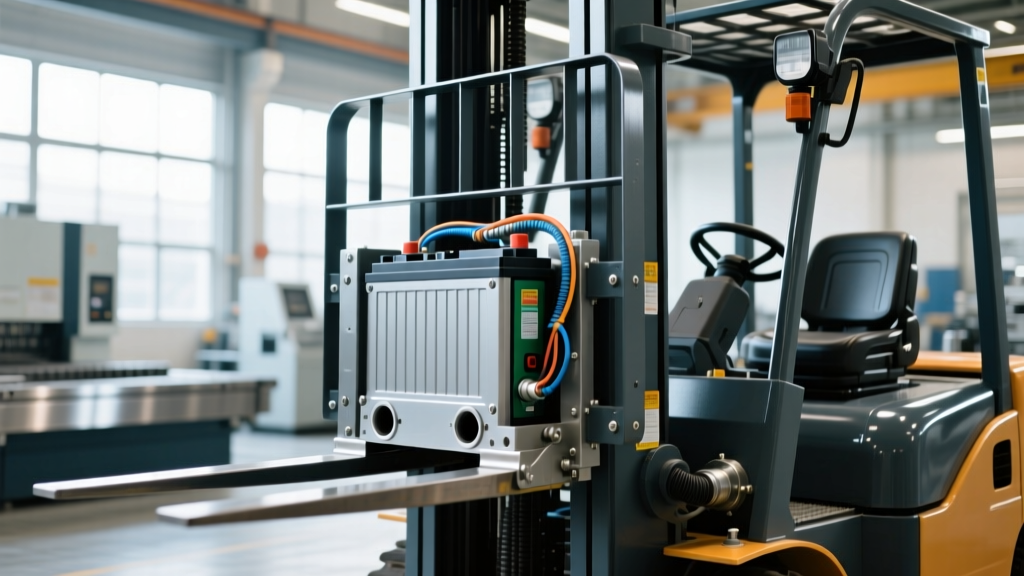
Specialized forklift attachments—such as Cascade paper roll clamps, rotating forks, and slip-sheet push-pulls—transform standard lift trucks into highly capable assets. However, the auxiliary hydraulic demands of these attachments place severe transient loads on material handling equipment batteries. When an operator actuates a heavy-duty clamp, the hydraulic pump motor can spike to 250+ amps for several seconds. If the battery cannot sustain this current without excessive voltage sag, the truck's motor controller (e.g., Curtis 1238 or Zapi AC-3) will trigger a low-voltage cutoff, leaving the load unsecured and halting production.
⚠️ CRITICAL WARNING: Bypassing low-voltage cutoffs on Li-ion Battery Management Systems (BMS) to maintain attachment clamping force will void warranties and risks thermal runaway. Never override factory BMS limits to compensate for undersized battery packs.The Hydraulic-Amp Draw Correlation
Unlike standard pallet forks that only require hydraulic power for lifting and tilting, specialized attachments require continuous or high-spike hydraulic flow for clamping, rotating, or side-shifting. This auxiliary demand is routed through the main traction battery. Understanding the peak amp draw of your specific attachment is the first step in diagnosing battery-related fault codes.
| Attachment Type | Hydraulic Flow (GPM) | Peak Amp Draw (80V System) | Common Controller Fault |
|---|---|---|---|
| Paper Roll Clamp (e.g., Cascade 66F) | 18 - 22 GPM | 210A - 260A | Curtis Error 3,4 (Undervoltage) |
| 360-Degree Rotating Forks | 15 - 20 GPM | 180A - 230A | Zapi Alarm 44 (Battery Low) |
| Slip-Sheet Push/Pull | 20 - 25 GPM | 240A - 290A | SME AC Controller Code 12 |
| Carton Clamps (Standard) | 10 - 14 GPM | 120A - 160A | Rare (Within normal limits) |
Symptom-to-Cause Diagnostic Matrix
When operators report that 'the battery is dying too fast' or 'the attachment loses grip,' the root cause is rarely a defective battery cell. Use this matrix to isolate the actual failure point.
| Reported Symptom | Root Cause | Verification Test |
|---|---|---|
| Attachment slips under load after 4 hours of use. | Voltage sag drops hydraulic pump RPM, reducing clamping pressure below required PSI. | Measure pump outlet pressure with a flow meter during clamp actuation at 30% State of Charge (SOC). |
| Intermittent controller shutdown during rotation. | Peak amp draw exceeds the Li-ion BMS continuous discharge limit, triggering a safety cutoff. | Capture amp draw via telemetry or oscilloscope during peak rotation engagement. |
| Battery inter-cell connectors melting or showing heat discoloration. | High-frequency, high-draw attachment use causes thermal buildup in undersized lead-acid cables. | Scan connectors with a FLIR thermal camera immediately after a 10-minute high-draw cycle. |
Step-by-Step Voltage Sag Troubleshooting
Follow this precise testing protocol to determine if your material handling equipment batteries are failing, or if the hydraulic system is misconfigured.
Step 1: Baseline Resting Voltage Measurement
Using a calibrated multimeter (e.g., Fluke 87V), measure the battery's resting voltage after it has sat idle for at least 30 minutes. For a nominal 48V lead-acid system, a fully charged resting voltage should be 50.9V. For an 80V Li-ion system, expect 89.6V. Record this baseline.
Step 2: Loaded Actuation Test
With the forklift at 50% SOC, engage the specialized attachment against its maximum rated load (e.g., clamping a 2,000 lb paper roll). Hold the hydraulic lever in the actuate position until the relief valve kicks in (deadhead). Measure the voltage at the main battery terminals during this exact moment. If an 80V system drops below 72V under load, the controller will register a fault.
Step 3: Relief Valve Calibration (The Phantom Draw)
Many mechanics blame the battery when the real issue is an incorrectly set hydraulic relief valve. If a carton clamp's relief valve is set to 2,400 PSI instead of the manufacturer's required 1,800 PSI, the hydraulic pump works against a higher deadhead pressure. This increases amp draw by up to 22%, rapidly depleting the battery and causing premature contactor welding. Connect a hydraulic pressure gauge to the auxiliary test port and adjust the relief valve to the exact specification listed on the attachment's data plate.
Li-Ion BMS Throttling vs. Lead-Acid Sag
The transition from lead-acid to lithium-ion in material handling equipment has fundamentally changed how attachments interact with power sources. Understanding this difference is critical for fleet managers.
Lead-Acid Behavior: Under a 250-amp spike from a rotating fork, a lead-acid battery will experience severe voltage sag (dropping 10-15 volts temporarily). While this can trigger controller faults, the battery will continue to output current, albeit with accelerated sulfation and heat generation in the cells.Li-Ion Behavior: Lithium-ion Battery Management Systems (BMS) actively monitor current output. If the attachment demands 260 amps, but the BMS is hardcoded to a 200-amp continuous limit, the BMS will instantly throttle or cut power to protect the cells. The operator experiences this as a 'dead' attachment, even if the battery is at 90% SOC.
According to safety and operational guidelines outlined by OSHA's Powered Industrial Trucks standard (1910.178), any modifications to a forklift's power system or hydraulic attachments that affect capacity and safe operation must be evaluated. Upgrading to a high-discharge Li-ion pack (e.g., an 80V 800Ah unit with a 400A continuous BMS rating) is often the only permanent fix for fleets running high-draw attachments, though this upgrade typically costs between $14,000 and $18,000 per unit in 2026.
Upgrading to Auxiliary Power Units (APUs)
For extreme applications—such as multi-pallet handlers with independent hydraulic circuits—drawing power from the main traction battery is no longer viable. Modern fleets are integrating 24V or 48V Auxiliary Power Units (APUs) mounted directly to the attachment carriage. These dedicated lithium-ion packs power the attachment's hydraulics independently, completely isolating the main material handling equipment batteries from transient voltage spikes and extending the primary battery's lifespan by up to 30%.
Preventative Maintenance for High-Draw Fleets
To maximize the lifespan of batteries powering specialized attachments, implement these strict maintenance protocols:
- Telemetry Monitoring: Utilize fleet management software (like Crown's InfoLink or Raymond's iWarehouse) to set alerts for 'High Hydraulic Pump Amp' events. If a specific truck consistently logs 200+ amp draws, inspect the attachment's hydraulic fluid for contamination, which increases pump friction and electrical draw.
- Contactor Inspection: High-draw attachments cause arcing across the main hydraulic contactor tips. Inspect and dress contactor tips every 1,000 hours. Replacement costs for a heavy-duty 80V contactor range from $450 to $800, but failing to replace pitted tips will cause voltage drops that mimic a failing battery.
- Cable Sizing Verification: Ensure all battery-to-controller cables are at least 2/0 AWG for 48V systems and 4/0 AWG for 80V systems running continuous auxiliary hydraulics. Undersized cables act as resistors, generating heat and stealing voltage before it reaches the hydraulic pump motor.
For comprehensive guidance on matching power systems to specialized material handling configurations, refer to the engineering resources provided by the Material Handling Industry (MHI) Forklift Truck sector. Properly aligning your battery's discharge capabilities with your attachment's hydraulic demands is the only way to eliminate phantom voltage drops and maintain uninterrupted throughput.