Bridge Crane Maintenance for Automated Material Handling Equipment
Optimize your automated material handling equipment with precise bridge crane maintenance schedules, sensor calibration guides, and ASME compliance tips.
The Shift to Smart Cranes in Automated Material Handling Equipment
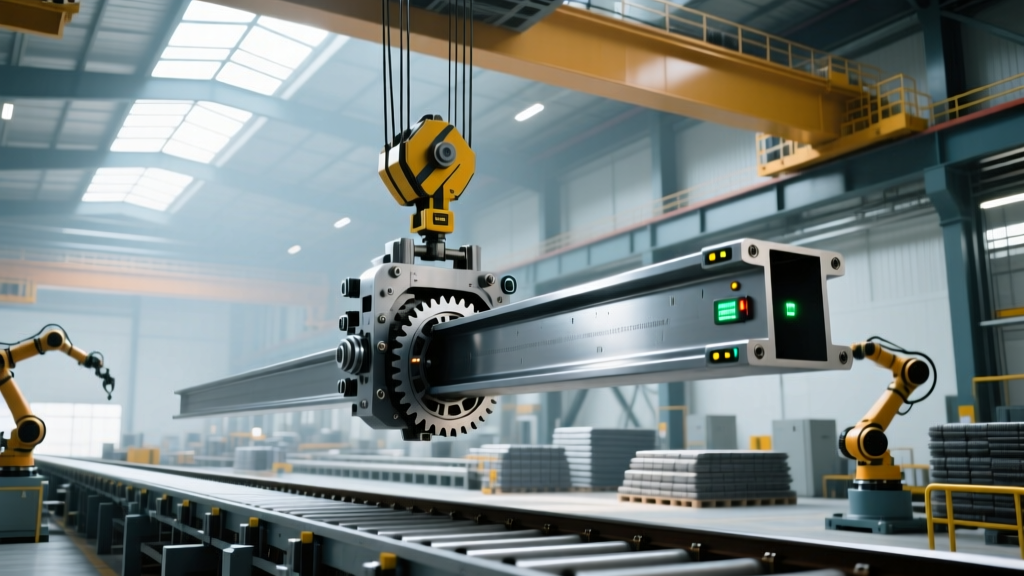
Integrating overhead crane systems and bridge crane configurations into fully automated material handling equipment networks has fundamentally changed warehouse and manufacturing operations. Unlike traditional manually operated cranes, automated overhead traveling cranes rely on programmable logic controllers (PLCs), variable frequency drives (VFDs), and LiDAR-based collision avoidance systems to move loads with millimeter precision. While this automation drastically reduces human error and increases throughput, it introduces complex maintenance variables. A mechanical failure in a manual crane halts one operator; a fault in an automated bridge crane can paralyze an entire facility's automated storage and retrieval system (AS/RS).
To maintain peak operational readiness in 2026, maintenance teams must transition from calendar-based servicing to condition-based and predictive maintenance models, strictly adhering to both mechanical and digital service schedules.
⚠️ CRITICAL COMPLIANCE WARNING: Automated crane systems must comply with OSHA 1910.179 for overhead and gantry cranes, as well as the ASME B30.2 safety standards. Bypassing automated safety limit switches or anti-collision sensors to maintain production speed is a direct violation and voids equipment warranties.Daily Shift-Level Inspection Protocols
Automated material handling equipment operates in high-cycle environments, often running 24/7. Daily visual and functional inspections must be executed by trained technicians before the first automated shift begins. These checks focus on mechanical wear that sensors cannot reliably detect.
- Wire Rope Inspection: Check for broken wires. Under ASME B30.2, replacement is mandatory if there are 6 randomly distributed broken wires in one rope lay, or 3 broken wires in one strand.
- Hook Throat Measurement: Use calipers to measure the hook throat opening. If the opening has increased by more than 5% from the original manufacturer's baseline, the hook must be removed from service.
- Limit Switch Verification: Manually trigger the upper and lower hoist limit switches. In automated systems, a failed upper limit switch will cause the hoist to 'two-block', potentially snapping the wire rope and dropping the load.
- Conductor Bar & Festoon Systems: Inspect the power feed systems. Look for carbon dust buildup on the collector shoes, which can cause arcing and disrupt the clean power required by sensitive VFDs.
Preventative Maintenance Matrix: Weekly to Annual
The following matrix outlines the required service intervals for automated bridge crane configurations. Downtime costs for automated systems average $8,500 per hour due to downstream bottlenecks, making strict adherence to these schedules financially critical.
| Interval | Component | Maintenance Action | Est. Time |
|---|---|---|---|
| Weekly | Trolley & Bridge Wheels | Inspect flanges for wear; check for skewing or rail-gnawing sounds. | 45 mins |
| Monthly | Hoist Gearbox | Check oil levels via sight glass; inspect breather caps for debris. | 30 mins |
| Quarterly | VFD Cooling Fans | Clean heat sink fins; replace filtered intake mats to prevent thermal throttling. | 1 hour |
| Semi-Annual | Runway Rails & Fasteners | Torque check rail clips to 150-200 ft-lbs; survey rail alignment for camber. | 3 hours |
| Annual | Structural & NDT Testing | Magnetic particle inspection on welds; load test at 125% rated capacity. | 8 hours |
Wire Rope Fatigue in High-Cycle Automated Systems
Automated material handling equipment executes precise, repetitive micro-movements that traditional manual cranes do not. This creates unique fatigue patterns in the wire rope. While a manual operator might smoothly accelerate a load, an automated system's PLC might apply aggressive acceleration curves to meet cycle-time KPIs.
Selecting the Right Rope Configuration
For automated bridge cranes operating in high-cycle environments (over 300 lifts per day), standard 6x19 classification wire rope will degrade prematurely due to internal friction. Maintenance managers should specify 6x36 IWRC (Independent Wire Rope Core) with a compacted strand design. The 6x36 configuration offers superior flexibility and fatigue resistance, while the compacted outer wires increase the metallic cross-sectional area, reducing surface pressure on the hoist drum and sheaves. Though the upfront cost is approximately 25% higher (roughly $2,800 vs $2,100 for a 100-foot spool of 3/4-inch rope), the lifespan in automated applications increases by up to 40%.
Calibrating IoT and Positioning Sensors
The defining feature of automated overhead cranes is their ability to position loads without human intervention. This relies on a network of sensors that require strict calibration schedules.
💡 Pro Tip: Laser Distance Sensor AlignmentAutomated cranes use laser distance measurement sensors (e.g., SICK or ifm electronic models) to determine trolley and bridge position. Dust accumulation on the lens or minor vibrations can shift the optical axis. Calibrate and clean these lenses bi-weekly. A misalignment of just 2 degrees can result in a 15mm positioning error at a 30-meter span, causing the crane to miss the AS/RS transfer station.
- Anti-Sway Systems: Automated cranes use electronic anti-sway algorithms built into the VFD. If the mechanical hoist reeving is altered or the load weight profile changes, the anti-sway parameters must be re-tuned via the VFD software interface to prevent pendulum effects.
- LiDAR Collision Avoidance: Clean the protective acrylic shields covering the LiDAR units monthly. Verify the 'warning' and 'stop' zones using physical test barriers to ensure the crane decelerates at the programmed 5-meter warning zone and halts at the 2-meter stop zone.
Reactive vs. Predictive Maintenance Economics
Upgrading your automated material handling equipment maintenance strategy from reactive to predictive requires capital investment in IoT vibration sensors and current analyzers, but the ROI is easily quantifiable.
| Metric | Reactive Maintenance | Predictive Maintenance (IoT Enabled) |
|---|---|---|
| Annual Unplanned Downtime | 45 - 60 hours | 4 - 8 hours |
| Downtime Cost (@ $8,500/hr) | $382,500 - $510,000 | $34,000 - $68,000 |
| Component Failure Mode | Catastrophic (secondary damage) | Controlled (planned replacement) |
| Inventory Carrying Cost | High (must stock full gearboxes) | Low (order parts on condition alert) |
Troubleshooting Common Automated Crane Faults
When an automated bridge crane faults, the PLC will halt operations and display a code. Here is how to address the three most common automated system faults:
- VFD Fault: Overcurrent during Acceleration (e.g., Code 042): This often occurs when the automated system attempts to accelerate a load faster than the mechanical system allows. Fix: Check the mechanical brakes for drag, verify the load weight hasn't exceeded the PLC's programmed limit, and increase the VFD acceleration ramp time by 0.5 seconds.
- Positioning Fault: Target Tolerance Exceeded: The crane stops inches away from the target drop zone. Fix: Inspect the trolley wheels for flat spots causing slippage, clean the laser positioning sensor lens, and recalibrate the VFD braking resistor to ensure rapid deceleration without coasting.
- Communication Fault: PLC to Hoist Node Loss: The crane loses connection to the central warehouse control system (WCS). Fix: Inspect the festoon cable for internal CAN-bus or Profinet wire breaks. Automated systems require high-flex, shielded communication cables; standard cables will fail within 6 months in continuous automated operation.