Material Handling Equipment List: Robotic Palletizing Case Studies
Discover how upgrading your material handling equipment list with robotic palletizing systems transforms throughput. Read real-world case studies and ROI data.
Beyond the Standard Material Handling Equipment List
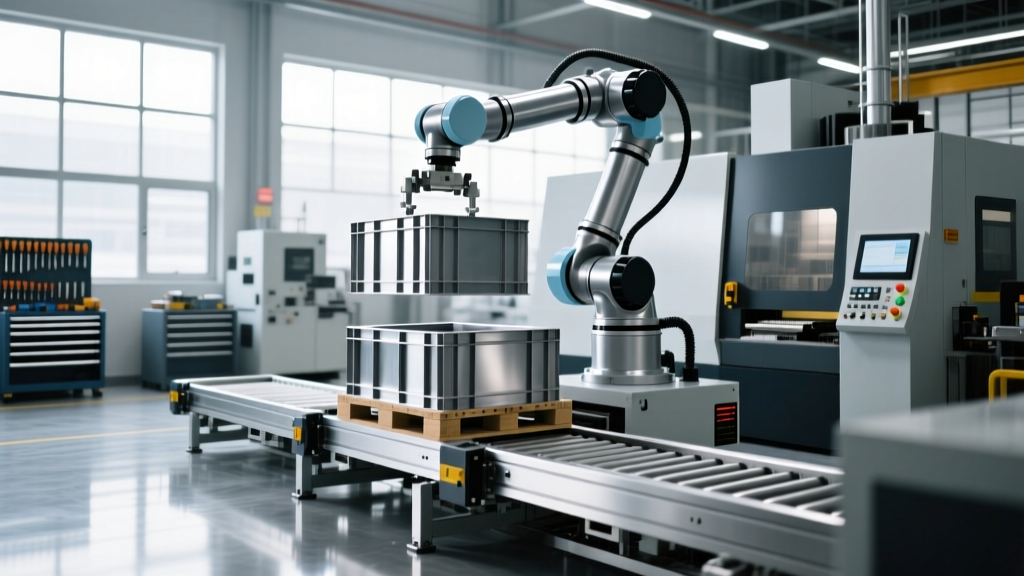
When operations directors audit their facility's material handling equipment list, the transition from manual end-of-line processes to automated robotic cells consistently emerges as the highest-impact capital expenditure. In 2026, with warehouse labor turnover hovering near 42% annually and ergonomic injury claims rising, robotic palletizing and depalletizing systems have shifted from optional upgrades to baseline operational imperatives. This analysis explores real-world applications, contrasting system architectures, and the hidden engineering bottlenecks that dictate success or failure on the warehouse floor.
Case Study 1: High-Speed Beverage End-of-Line Integration
A major regional beverage distributor in the Midwest recently overhauled its material handling equipment list to address severe bottlenecks in its mixed-SKU palletizing lines. The facility processes over 4,500 cases per hour across four distinct production lines, requiring rapid layer building and precise slip-sheet placement.
System Architecture and Specifications
The integrator deployed two FANUC M-410iC/110 robots. According to FANUC's official palletizing specifications, this 4-axis model offers a 110 kg payload capacity and a 2,403 mm reach, optimized specifically for high-speed layer building. The system was integrated with an Allen-Bradley ControlLogix PLC communicating via EtherNet/IP, allowing seamless handshake with the upstream case packers and downstream stretch wrappers.
The Corrugated Dust Challenge
During the initial 30-day burn-in phase, the system experienced a 14% fault rate. The root cause was corrugated dust accumulating on the vacuum cups, breaking the seal and dropping cases. The engineering team replaced standard nitrile cups with Piab piGRIP polyurethane cups featuring integrated mesh filters and decentralized vacuum generators. This modification reduced drop faults to 0.2% and increased sustainable cycle times to 14 cases per minute.
Engineering Warning: When specifying vacuum End-of-Arm Tooling (EOAT) for corrugated packaging, always mandate decentralized vacuum generation (e.g., Piab piCOMPACT) directly on the tooling. This minimizes response time and mitigates dust ingestion into centralized vacuum pumps, which is a primary cause of unplanned downtime in beverage applications.Case Study 2: Heavy-Duty Building Materials in Hostile Environments
Palletizing 50 kg cement and mortar bags requires an entirely different approach to the material handling equipment list. A building materials manufacturer in Texas replaced three aging conventional layer palletizers with robotic cells to handle multi-format bag sizes without mechanical changeovers.
Mechanical vs. Vacuum Gripping
Unlike rigid beverage cases, cement bags are porous, deformable, and heavily dusted. Vacuum systems fail rapidly in this environment. Instead, the facility utilized KUKA KR 120 R3200 PA robots equipped with custom mechanical clamp-and-scoop EOATs. As detailed by the Association for Advancing Automation (A3), mechanical grippers provide the necessary positive retention for porous, heavy payloads where vacuum adhesion is mathematically impossible due to air leakage through the product substrate.
| Metric | Beverage Application (FANUC) | Cement Application (KUKA) |
|---|---|---|
| Robot Model | M-410iC/110 | KR 120 R3200 PA |
| EOAT Type | Decentralized Vacuum Array | Mechanical Clamp & Scoop |
| Effective Payload | 85 kg (Cases + Tooling) | 105 kg (Bags + Tooling) |
| Cycle Time | 14 cycles / min | 6 cycles / min |
| IP Rating | IP67 (Washdown) | IP65 (Dust Protection) |
Decision Matrix: Robotic vs. Conventional Layer Palletizers
Facility planners frequently debate whether to install conventional layer palletizers (which use a stripping apron to slide layers onto the pallet) or articulated robots. The choice fundamentally alters the facility's material handling equipment list and long-term operational flexibility.
- Speed: Conventional layer palletizers dominate in pure speed, capable of exceeding 100 cases per minute for single-SKU lines. Robots typically max out between 15 and 25 cycles per minute depending on payload.
- Changeover Time: Robots win decisively. Changing a robot's pallet pattern requires only a software recipe change (under 5 seconds). Conventional machines require physical guide rail adjustments and apron tensioning (15 to 45 minutes).
- Floor Space: Robotic cells require a smaller footprint but demand strict radial safety clearances. Conventional machines require long linear footprints for layer accumulation tables.
- Maintenance: Robots require periodic gearbox grease and battery replacements. Conventional palletizers involve high-wear pneumatic clutches, belts, and stripping aprons that demand continuous mechanical adjustment.
The Hidden Bottleneck: End-of-Arm Tooling (EOAT) Weight Penalties
The most common miscalculation when updating a material handling equipment list is ignoring the EOAT weight penalty. A robot rated for a 130 kg payload does not mean you can lift 130 kg of product. The EOAT mass directly subtracts from the available payload.
EOAT Weight Calculation Example:- Robot Rated Payload: 110 kg
- Steel EOAT Frame + Vacuum Array: 45 kg
- Integrated Slip Sheet Dispenser: 25 kg
- Effective Product Payload: 40 kg (Insufficient for heavy multi-case layers)
To counter this, integrators are increasingly utilizing carbon-fiber composite EOAT frames in 2026, reducing tooling weight by up to 35% compared to traditional welded aluminum or steel frames, thereby reclaiming vital payload capacity and reducing the inertial load on the robot's J4 and J5 axes.
Depalletizing Complexity: The Vision System Imperative
While palletizing follows a predictable mathematical pattern, depalletizing mixed-SKU pallets requires advanced machine vision. In 2026, 3D vision systems like the Cognex In-Sight 3D-L4000 are standard for identifying skewed, overlapping, or damaged boxes on incoming pallets. The vision system calculates the centroid and surface normal of each box, transmitting offset coordinates to the robot controller via EtherNet/IP in under 40 milliseconds. Without this, depalletizing systems require expensive, rigid layer-gripping mechanisms that fail catastrophically when load shifting occurs during transit.
Safety Standards and ROI Realities
Integrating these systems requires strict adherence to safety protocols. The OSHA guidelines on material handling emphasize the reduction of repetitive motion injuries, which robotic palletizing directly addresses by removing human operators from heavy lifting zones. However, the physical integration requires RIA 15.06 compliant safety fencing, laser scanners (e.g., SICK microScan3), and muting light curtains for pallet exit conveyors to prevent unauthorized human entry while allowing pallet flow.
The true ROI of a robotic palletizer is rarely found in direct labor reduction alone; it is realized in the elimination of ergonomic injury claims, the reduction of product damage from dropped loads, and the ability to run end-of-line shifts completely unattended.
2026 Financial Breakdown & Payback Metrics
| Cost Category | Estimated Range (USD) | Notes |
|---|---|---|
| Capital Equipment (Robot + EOAT) | $95,000 - $140,000 | Varies by payload and reach |
| Cell Integration (Conveyors, Fencing) | $50,000 - $80,000 | Includes safety scanners and PLC |
| Installation & Commissioning | $30,000 - $50,000 | On-site engineering and programming |
| Annual Maintenance | $4,500 - $6,000 | Grease, vacuum cups, oil analysis |
| Typical Payback Period | 18 - 26 Months | Based on two-shift operation |
Ultimately, optimizing your material handling equipment list with robotic palletizing requires looking past the robot arm itself. Success is dictated by the precision of the EOAT, the robustness of the vision systems, and the rigorous application of safety standards. Facilities that invest in these peripheral technologies alongside the primary robot arm consistently achieve the highest throughput and the fastest return on capital.