Which Is an Example of Manual Material Handling Equipment vs Powered?
Discover which is an example of manual material handling equipment and when to upgrade to battery or propane forklifts with our 2026 TCO case studies.
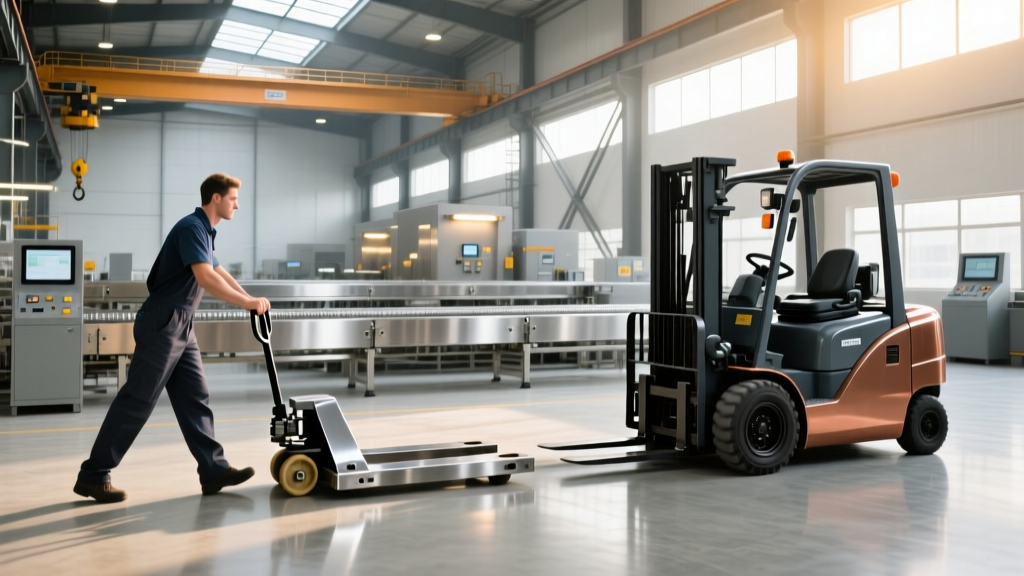
When facility safety auditors and warehouse trainees ask, "which is an example of manual material handling equipment?", the definitive answer is the manual hydraulic pallet jack (such as the Crown PTH50 series) or a standard two-wheel hand truck. These tools rely entirely on human kinetic energy to pump hydraulics and push loads. However, in modern 2026 logistics operations, manual equipment hits a hard operational and ergonomic ceiling. According to NIOSH ergonomic guidelines, repetitive manual pushing and pulling leads to a severe spike in musculoskeletal disorders (MSDs) when initial push forces exceed 50 pounds or when operators move loads over distances greater than 100 feet repeatedly.
Once your facility moves beyond moving 5,000-lb pallets over short, flat distances, you must transition to powered industrial trucks. The primary debate for fleet managers is no longer about manual vs. powered, but rather the optimal powertrain for the application: Lithium-Ion (Li-Ion) Battery vs. Propane (LPG). Below, we break down the technical specifications, real-world case studies, and 5-year Total Cost of Ownership (TCO) to help you make the right upgrade.
The Ergonomic and Throughput Ceiling of Manual Handling
Manual pallet jacks are inexpensive (typically $350 to $600 per unit) and require zero charging infrastructure. However, their limitations become a bottleneck in high-throughput environments. OSHA's material handling standards heavily emphasize the reduction of manual strain. When a warehouse scales beyond 50 pallet moves per hour, or requires vertical stacking beyond 6 inches, manual equipment becomes a liability. The transition to powered forklifts—specifically 5,000-lb capacity sit-down counterbalanced models—introduces the choice between electric (Li-Ion) and internal combustion (Propane).
⚠️ Warning: The Hidden Cost of Manual Fleet ExpansionAdding more manual pallet jacks and hiring more floor labor to compensate for slow throughput costs an average of $42,000 annually per additional full-time equivalent (FTE) worker, including benefits and workers' compensation premiums. A single powered forklift can replace the throughput of three manual operators.
Lithium-Ion Battery Forklifts: The Indoor Throughput Champion
The shift from legacy lead-acid batteries to Lithium Iron Phosphate (LFP) Li-Ion packs has completely altered the electric forklift landscape. Models like the Crown FC4500 or Toyota 8FBMT18 now come with integrated LFP batteries that offer superior thermal stability and zero off-gassing.
Technical Realities of Li-Ion in 2026
- Capacity & Voltage: Standard 48V, 600Ah LFP packs provide equivalent runtime to an 8,000-lb lead-acid battery but weigh 40% less, requiring the forklift to carry a dedicated counterweight box.
- Opportunity Charging: Li-Ion batteries accept ultra-fast charges without memory degradation. A 15-minute charge during a standard operator coffee break yields 2.5 hours of runtime.
- Infrastructure: Eliminates the need for a dedicated, ventilated battery room. Requires 480V 3-phase drop chargers installed directly at loading docks.
- Upfront Cost: A 5,000-lb Li-Ion forklift typically ranges from $45,000 to $55,000, heavily skewed by the $14,000+ cost of the integrated battery pack.
Propane (LPG) Forklifts: The Heavy-Duty Outdoor Workhorse
Internal combustion engines fueled by liquid propane remain the undisputed kings of mixed-terrain, outdoor, and heavy-load applications. The Yale GLP050VX and Hyster H50FT are industry staples that deliver immediate, high-torque power without voltage sag.
Technical Realities of Propane in 2026
- Fuel Density: A standard 33-lb DOT propane cylinder holds roughly 8 gallons of LPG, yielding 6 to 8 hours of continuous, heavy-load operation.
- Refueling Speed: A trained operator can swap an empty cylinder for a full one in under 3 minutes, requiring zero downtime for charging.
- Emissions & IAQ: Modern 2026 LPG models feature advanced 3-way catalytic converters. While they drastically reduce carbon monoxide (CO) and nitrogen oxides (NOx), EPA alternative fuel data still mandates strict indoor ventilation rates (typically 5,000 CFM per operating forklift) to maintain safe Indoor Air Quality (IAQ).
- Upfront Cost: A base 5,000-lb propane forklift ranges from $28,000 to $35,000, making the initial CapEx significantly lower than Li-Ion alternatives.
Head-to-Head: Li-Ion Battery vs. Propane Specifications
| Feature | Li-Ion Electric (e.g., Crown FC4500) | Propane LPG (e.g., Yale GLP050VX) |
|---|---|---|
| Base Unit Cost | $48,500 (incl. battery) | $31,000 |
| Energy/Fuel Cost per Hour | $1.85 (at $0.12/kWh) | $5.40 (at $3.50/gal LPG) |
| Cold Storage Performance | Excellent (LFP chemistry resists cold) | Poor (Vaporizers freeze, power drops) |
| Indoor Air Quality Impact | Zero emissions | Requires heavy HVAC ventilation |
| Maintenance Intervals | Every 500 hours (grease/filters) | Every 250 hours (oil/plugs/filters) |
Industry Case Studies: Application-Specific Selections
Case Study 1: Cold Storage Food Distribution (Li-Ion Victory)
A 120,000 sq. ft. cold storage facility in Chicago (operating at -10°F) previously utilized a fleet of eight propane forklifts. The facility faced two massive issues: propane exhaust tainted the porous packaging of dairy products, and the extreme cold caused propane vaporizers to freeze, leading to a 22% drop in engine power and frequent stalling.
The Solution: The facility transitioned to a fleet of Li-Ion electric forklifts equipped with heated, insulated battery compartments. Because LFP batteries do not suffer the same voltage sag in sub-zero temperatures as lead-acid, throughput increased by 18%. Furthermore, the elimination of propane exhaust allowed the facility to reduce its massive indoor air-replacement HVAC costs by $34,000 annually. The Li-Ion fleet achieved full ROI in 2.8 years.
Case Study 2: Lumber and Building Supplies (Propane Dominance)
A regional building materials supplier operating across 4 acres of mixed indoor racking and outdoor lumber yards attempted to switch to electric forklifts. The operation requires moving 6,000-lb bundles of treated lumber across uneven gravel and mud.
The Failure & Reversion: The electric forklifts suffered from severe dust and moisture ingress in the charging ports, leading to $8,000 in electrical repairs in the first six months. Additionally, the 45-minute fast-charge times were insufficient for the continuous, multi-shift outdoor operations where operators simply swap a 33-lb propane cylinder in 3 minutes. The company reverted to Hyster H50FT propane models, which offer higher ground clearance, aggressive pneumatic tires, and the raw torque required to push through muddy terrain without battery drain anxiety.
💡 The Facility Manager's Rule of Thumb:If your forklift spends more than 70% of its time indoors, on smooth concrete, or in temperature-controlled environments, Li-Ion is the mandatory choice for 2026 compliance and TCO. If your forklift operates on gravel, dirt, steep grades, or in unheated outdoor yards, Propane remains the superior workhorse.
5-Year Total Cost of Ownership (TCO) Projection
When upgrading from manual material handling equipment, purchasing agents often suffer from "sticker shock" regarding Li-Ion forklifts. However, analyzing the 5-year TCO (based on a single-shift, 2,000-hour/year operation) reveals the true financial picture:
- Li-Ion Electric TCO (5 Years):
- Capital Expense: $48,500
- Energy Costs (5 yrs): $18,500
- Scheduled Maintenance: $3,200
- Total 5-Year Cost: $70,200
- Propane LPG TCO (5 Years):
- Capital Expense: $31,000
- Fuel Costs (5 yrs): $54,000
- Scheduled Maintenance & Engine Overhauls: $11,500
- Total 5-Year Cost: $96,500
Despite a nearly $17,500 higher upfront purchase price, the Li-Ion forklift saves the operation $26,300 over a 60-month period, primarily driven by the massive disparity between commercial electricity rates and delivered propane gas prices, compounded by the elimination of internal combustion engine maintenance (spark plugs, belts, oil changes, and catalytic converter replacements).
The Final Decision Matrix
Knowing which is an example of manual material handling equipment is only the first step in warehouse education. Recognizing when to retire that manual equipment in favor of mechanized power is what separates profitable logistics hubs from stagnant ones. Use this final matrix to finalize your fleet procurement:
- Choose Li-Ion Battery if: You operate a food/beverage, pharmaceutical, or cold-storage facility; you run 2-3 shifts and can utilize opportunity charging; you want to eliminate indoor emissions and reduce HVAC overhead.
- Choose Propane if: You operate a lumber yard, recycling center, or heavy manufacturing plant with outdoor transit; you lack the electrical infrastructure (480V 3-phase) to support high-speed chargers; you require maximum torque for steep ramps and uneven terrain.
Related reading
Ergonomic Warehouse Materials Handling Equipment: Lift Assists Compared
Storeroom Semi-Automated Material Handling Equipment Fulfillment Solutions: Sortation Training