Ekko Material Handling Equipment: Battery vs Propane Safety Guide
Compare Ekko material handling equipment safety standards for battery vs propane forklifts. Expert compliance guide for indoor and outdoor operations.
The Regulatory Baseline: OSHA and ANSI Standards
Selecting the optimal powertrain for your material handling fleet requires navigating a complex web of occupational safety regulations. When evaluating Ekko material handling equipment, facility managers must weigh the compliance overhead of internal combustion (propane/LPG) against the infrastructure demands of electric (battery) models. The foundational regulatory framework for both powertrains is governed by OSHA 29 CFR 1910.178 (Powered Industrial Trucks) and the ANSI/ITSDF B56.1 engineering standard. However, the specific compliance pathways diverge drastically once you move from the operator seat to the refueling or recharging station.
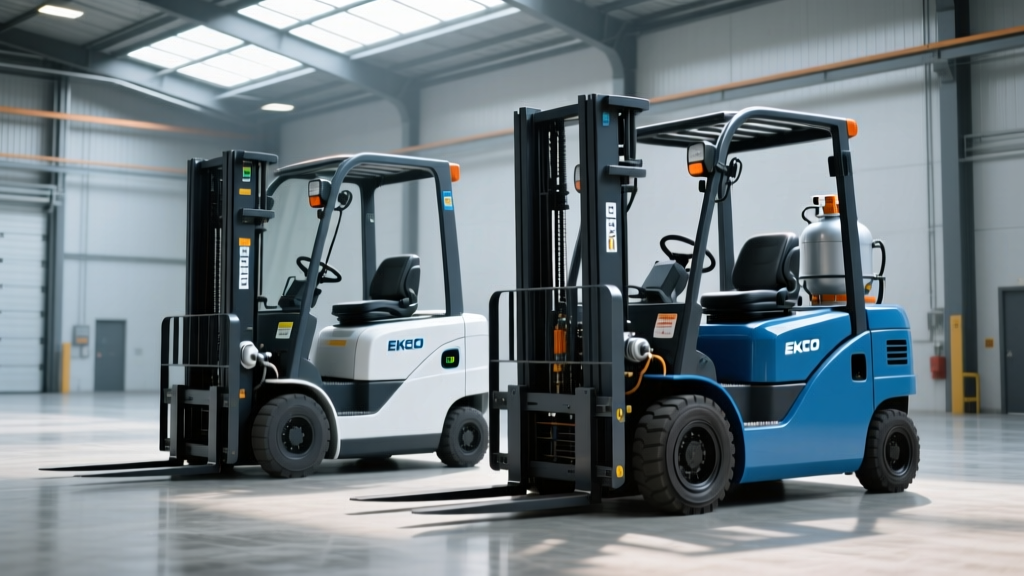
Choosing between a propane-powered unit like the Ekko EK50P (5,000 lb capacity) and an electric model like the Ekko EK35B (3,500 lb capacity) is not merely an operational decision; it is a facility compliance decision. Below, we break down the exact safety standards, infrastructure costs, and regulatory edge cases for both powertrains.
Core Compliance Mandate
OSHA requires that all modifications and additions to powered industrial trucks that affect capacity and safe operation be approved by the manufacturer. Furthermore, OSHA's Powered Industrial Truck guidelines strictly prohibit the use of internal combustion trucks in areas where hazardous concentrations of flammable gases or vapors exist (Class I, Division 1 locations), mandating electric equipment in those zones.
Propane (LPG) Compliance for Ekko IC Models
Propane forklifts, such as the Ekko EK50P, are favored for their high torque, rapid refueling, and outdoor/all-weather capability. However, introducing LPG into a facility triggers stringent fire safety and air quality compliance requirements under OSHA and the NFPA 58 (Liquefied Petroleum Gas Code).
Carbon Monoxide (CO) Monitoring and Ventilation
The most critical safety hazard associated with propane material handling equipment is carbon monoxide (CO) off-gassing. While modern Ekko propane models feature catalytic converters and electronic fuel injection (EFI) that drastically reduce emissions, poorly tuned engines or extended indoor idling can quickly elevate CO levels.
- OSHA PEL (Permissible Exposure Limit): 50 parts per million (ppm) over an 8-hour time-weighted average.
- NIOSH REL (Recommended Exposure Limit): 35 ppm. The CDC's NIOSH guidelines on carbon monoxide emphasize that acute exposure in poorly ventilated warehouses can cause severe neurological and cardiovascular distress well before the OSHA PEL is breached.
Actionable Compliance Step: Facilities operating propane Ekko forklifts indoors must install fixed, continuous CO monitoring systems with audible alarms set to trigger at 35 ppm. Expect to budget $250 to $450 per sensor node, plus annual calibration costs of approximately $120 per unit.
Cylinder Handling and Storage Protocols
Propane is stored in 33-lb DOT cylinders. OSHA 1910.178(p) dictates strict handling protocols to prevent catastrophic vapor releases.
CRITICAL SAFETY WARNING: When installing a 33-lb propane cylinder on an Ekko forklift, the relief valve on the cylinder MUST be positioned at the highest point (pointing straight up) and aligned with the locator pin on the forklift bracket. If the cylinder is rotated even 15 degrees off-center, the relief valve may discharge liquid propane instead of vapor if the tank is overfilled, creating an immediate flash-fire hazard.Battery-Powered Compliance for Ekko Electric Models
Electric forklifts, including the Ekko EK35B, produce zero localized emissions, making them the default choice for food-grade, pharmaceutical, and indoor environments. However, the compliance burden shifts from air quality to chemical handling, electrical safety, and thermal management at the charging station.
Lead-Acid vs. Lithium-Ion Infrastructure
Most Ekko electric forklifts can be configured with either traditional flooded lead-acid (FLA) batteries or modern Lithium-ion (Li-ion) packs. The safety compliance requirements for these two chemistries are fundamentally different.
| Compliance Metric | Flooded Lead-Acid (FLA) | Lithium-Ion (Li-ion) |
|---|---|---|
| Ventilation Requirements | Mandatory. Hydrogen off-gassing during the final 20% of the charge cycle requires HVAC to maintain H2 below 1% concentration (25% of the 4% LEL). | Not required for normal operation. No off-gassing occurs during standard charging. |
| Eyewash Stations | OSHA/ANSI Z358.1 mandates a plumbed or self-contained eyewash station within 25 feet (10 seconds travel) of the battery watering area. | Not required by OSHA for charging areas, though standard facility first-aid protocols apply. |
| PPE Requirements | Face shields, acid-resistant aprons, and neoprene gloves required during watering and maintenance. | Standard safety glasses and insulated gloves for high-voltage connector handling. |
| Thermal Runaway Risk | Negligible. Primary risk is sulfuric acid thermal burns. | Present. Requires integrated Battery Management Systems (BMS) and NFPA 855-compliant storage spacing if charging multiple units. |
| Estimated Setup Cost | $4,500 - $8,000 (Ventilation, eyewash, acid spill containment, battery extractor). | $1,200 - $2,500 (Dedicated 480V/240V drop, UL-listed fast charger mount). |
Managing Hydrogen Off-Gassing in Lead-Acid Stations
When charging lead-acid batteries for Ekko electric forklifts, the electrolysis of water within the battery cells releases hydrogen gas. Hydrogen is highly combustible, with a Lower Explosive Limit (LEL) of 4% by volume in air. OSHA and NFPA 70 (National Electrical Code) require that charging areas be equipped with continuous exhaust ventilation capable of preventing hydrogen accumulation above 1% concentration. Failure to install adequate ventilation or explosion-proof electrical fixtures in the charging zone is a frequent target for OSHA citations, often resulting in penalties exceeding $15,000 per violation.
Facility Decision Framework: Which Powertrain Fits Your Compliance Profile?
To determine whether propane or battery Ekko material handling equipment aligns with your facility's safety capabilities, use the following decision matrix:
Choose Propane (e.g., Ekko EK50P) If:
- Your operation is primarily outdoors, in lumber yards, or in heavily ventilated transit sheds.
- You lack the capital expenditure ($5,000+) required to upgrade electrical panels and install acid-containment infrastructure for lead-acid batteries.
- You operate multi-shift schedules where opportunity charging is impossible, and battery swapping infrastructure is cost-prohibitive.
- Compliance Trade-off: You are willing to absorb the recurring cost of CO monitoring calibration and enforce strict cylinder-handling training.
Choose Battery / Li-Ion (e.g., Ekko EK35B) If:
- Your facility processes food, beverages, pharmaceuticals, or cold-storage goods where CO and particulate emissions are strictly prohibited.
- You can invest in Li-ion technology, entirely bypassing the OSHA ventilation and eyewash station mandates associated with lead-acid batteries.
- You operate in noise-sensitive environments (Li-ion forklifts operate at roughly 65-70 dB, compared to 85-90 dB for propane IC engines), reducing the need for mandatory hearing conservation programs under OSHA 1910.95.
Maintenance and Inspection Compliance
Regardless of the powertrain, OSHA mandates daily pre-shift inspections. For Ekko propane models, operators must inspect the LPG hose for abrasion, verify the O-ring on the cylinder connector, and test the hydrostatic relief valve. For Ekko electric models, the daily checklist must include inspecting the heavy-duty battery cables for fraying, verifying the integrity of the charger connector pins, and checking for electrolyte leaks (if using FLA batteries).
Documentation is your primary defense during an OSHA audit. Implement a digital fleet management system that requires operators to complete a forced, timestamped checklist on a tablet before the forklift's ignition circuit will engage. This eliminates 'pencil-whipping' of safety inspections and ensures strict adherence to ANSI/ITSDF B56.1 operator protocols.
Related reading
Comparing Material Handling Equipment Tires for Warehouse AGVs
Troubleshooting Forklift Attachments for Storeroom Bulk Material Handling Equipment Installations in California