Comparing Material Handling Equipment Tires for Warehouse AGVs
Compare polyurethane, Vulkollan, and rubber material handling equipment tires for AGVs. Analyze cost, odometry impact, and warehouse failure modes.
The Hidden Bottleneck in AGV Navigation: Tire Selection
When facility managers deploy Automated Guided Vehicles (AGVs) or Autonomous Mobile Robots (AMRs) like the MiR1000 or KUKA KMP 1500, the focus is typically on LiDAR sensors, SLAM algorithms, and fleet management software. However, the physical interface between the robot and the warehouse floor—specifically the material handling equipment tires and drive wheels—dictates the actual operational success of the system. As of 2026, with heavy-payload AGVs routinely moving 1,500 kg to 2,500 kg loads at speeds up to 2.0 m/s, tire deflection, slip ratio, and material degradation are primary causes of navigational drift and unplanned downtime.
📊 Data Highlight: The Cost of Tire-Induced DowntimeAccording to industry fleet analyses, up to 14% of AGV navigational faults (where the robot loses its positional certainty and halts) are traced back to wheel slippage and odometry errors caused by worn or improperly specified tires. Replacing a standard drive wheel takes 45 minutes of technician time, but the resulting traffic jam in a high-density warehouse aisle can cost upwards of $800 per hour in lost throughput.
The Core Contenders: Polyurethane vs. Vulkollan vs. Rubber
Selecting the right material handling equipment tires for automated systems requires balancing traction, load capacity, and rolling resistance. The warehouse AGV market is currently dominated by three primary elastomer compounds.
1. Standard Polyurethane (PU)
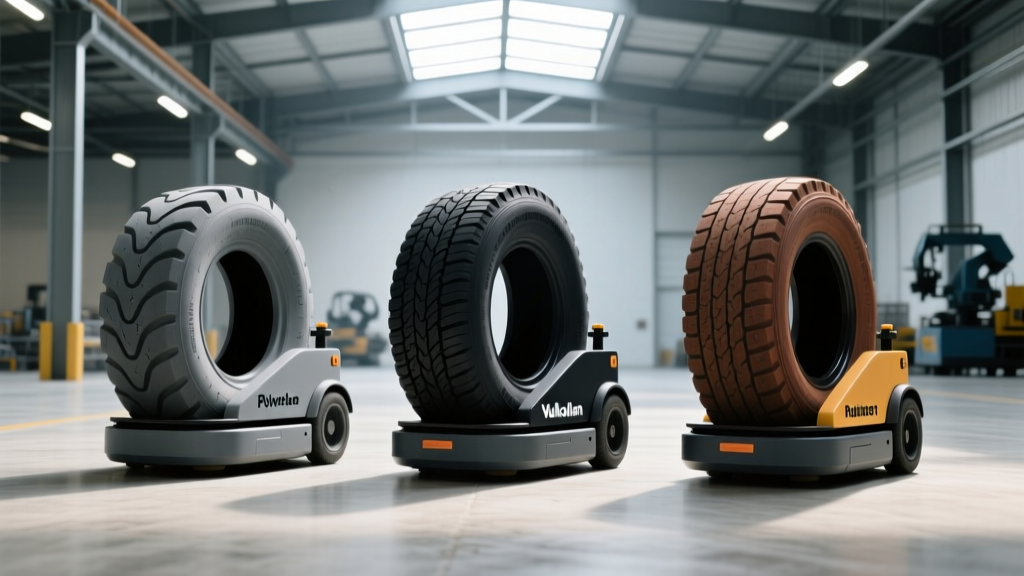
Standard cast polyurethane (typically 85A to 92A Shore A hardness) is the default choice for 80% of light-to-medium duty AGVs. It offers an excellent balance of floor protection and rolling resistance. However, standard PU is susceptible to heat buildup during continuous high-speed operation, leading to tread chunking.
2. Vulkollan (Premium High-Performance PU)
Vulkollan, a specialized high-performance polyurethane originally developed by Bayer, is the gold standard for heavy-payload AGVs and automated forklifts. Its unique molecular structure provides superior dynamic load capacity and exceptional resistance to flat-spotting. While standard PU wheels cost between $150 and $300 per unit, Vulkollan drive wheels range from $450 to $850, a premium justified by a 3x to 4x longer lifespan in 24/7 operations.
3. Solid and Nitrile Rubber
Rubber tires provide the highest coefficient of friction, making them ideal for AGVs operating on ramp inclines or in cold-storage environments where PU becomes brittle. The trade-off is high rolling resistance (which drains AGV batteries 15-20% faster) and significant tire deflection under load.
| Tire Material | Shore Hardness | Dynamic Load Limit (per wheel) | Rolling Resistance | Est. Cost (2026) |
|---|---|---|---|---|
| Standard Polyurethane | 85A - 92A | 400 kg - 800 kg | Low | $150 - $300 |
| Vulkollan (Premium PU) | 90A - 95A | 800 kg - 1,500 kg+ | Very Low | $450 - $850 |
| Nitrile Rubber | 75A - 85A | 300 kg - 600 kg | High | $120 - $250 |
| Solid Rubber | 80A - 90A | 1,000 kg - 2,000 kg | Medium-High | $300 - $600 |
The Odometry Problem: How Tire Deflection Breaks SLAM
Modern AGVs rely on wheel encoders to calculate distance traveled (dead-reckoning odometry), which is then fused with LiDAR data for SLAM (Simultaneous Localization and Mapping). When polyurethane treads compress under a heavy payload, the effective rolling radius of the wheel decreases.
⚠️ Engineering Warning: The Slip Ratio TrapIf an AGV is calibrated with empty-load tire dimensions, picking up a 1,000 kg pallet can compress a 90A PU tire by 2mm to 4mm. This reduces the rolling circumference. The wheel encoder will register more rotations than the actual distance traveled. Over a 100-meter transit, this 0.5% to 1.2% odometry error can result in a positional drift of 50cm to 120cm—enough to cause the AGV to miss a conveyor transfer station or collide with racking uprights.
Actionable Fix: For heavy-payload AGVs, specify tires with a high Shore A hardness (93A-95A) or use Vulkollan to minimize deflection. Additionally, ensure the AGV's firmware utilizes dynamic load-compensation algorithms that adjust odometry calculations based on the real-time weight data from the robot's lift mechanism.
Alternatives Analysis: Omni-Directional and Caster Configurations
Beyond the drive tires, the support and steering wheels drastically alter an AGV's footprint and maneuverability.
Mecanum Wheels for Omnidirectional Movement
Used heavily in aerospace manufacturing and tight-aisle warehousing (e.g., KUKA omniMove systems), Mecanum wheels feature angled rollers around the circumference, allowing the AGV to strafe laterally without turning.
- Pros: Zero turning radius; eliminates the need for wide aisles; perfect for precise docking with CNC machines or tight rack placements.
- Cons: Extremely high cost ($2,500 to $6,000 per set of four); the small peripheral rollers are prone to jamming from warehouse debris (shrink wrap, banding straps); high maintenance overhead.
Spring-Loaded Polyurethane Casters
For standard differential-drive AGVs, the passive support wheels must maintain constant floor contact to prevent the robot from rocking, which distorts LiDAR scans. Spring-loaded or polyurethane-sprung casters (from brands like Hamilton Caster or Albion) absorb floor unevenness. Specifying casters with sealed precision bearings (ABEC-7 or higher) is critical to prevent dust ingress in environments like corrugated packaging plants.
Real-World Failure Modes in Warehouse Environments
Understanding how material handling equipment tires fail in specific environments prevents catastrophic fleet grounding.
- Hydrolysis in Cold Storage: Standard polyurethane is highly susceptible to hydrolysis—chemical breakdown caused by moisture. In high-humidity cold storage facilities (e.g., -20°C with fluctuating defrost cycles), standard PU tires will crack and delaminate from the aluminum hub within 6 to 9 months. Solution: Specify hydrolysis-resistant PU compounds or specialized low-temperature rubber formulations.
- Flat-Spotting from Static Loads: When AGVs are parked at charging stations for 48+ hours during weekend shutdowns, the continuous static weight on a single point of a rubber or soft PU tire causes permanent flat-spotting. When the fleet resumes on Monday, the AGVs will vibrate violently, triggering IMU (Inertial Measurement Unit) fault codes. Solution: Program AGVs to perform a micro-roll (moving 2 inches forward and back) every 12 hours while docked, or specify Vulkollan, which has superior elastic memory.
- Chemical Degradation from Spills: In facilities handling automotive fluids or industrial solvents, standard PU tires will swell and soften upon contact with oils. Nitrile rubber is mandatory in these environments due to its oil-resistant properties.
Procurement Framework: Matching Tire to Application
Use this decision matrix when specifying replacement tires or commissioning new AGV fleets:
- Light Payload (< 500 kg), Clean Room / Pharma: Standard 85A PU. Non-marking, low particulate shedding. Avoid black rubber entirely.
- Medium Payload (500 - 1000 kg), E-Commerce Fulfillment: 92A PU with precision sealed bearings. Focus on low rolling resistance to maximize battery shift life.
- Heavy Payload (1000 - 2500 kg), Automotive / Pallet Moving: Vulkollan (93A+). Mandatory for maintaining SLAM odometry accuracy under shifting center-of-gravity loads.
- Ramp / Incline Operations (> 5 degrees): High-traction Nitrile Rubber or specialized micro-ribbed PU treads to prevent drive-wheel slip.
"The safety and performance standards for automated guided vehicles, as outlined by the Industrial Truck Standards Development Foundation (ITSDF B56.5), require that AGVs maintain precise braking and steering control under maximum rated loads. Tire selection is not merely a mechanical preference; it is a direct compliance factor for automated braking distance and navigational safety."
Summary: The ROI of Premium Elastomers
While it is tempting to reduce capital expenditure by outfitting warehouse AGVs with standard, off-the-shelf material handling equipment tires, the operational math heavily favors premium compounds. Upgrading a fleet of 20 heavy-payload AGVs from standard PU to Vulkollan drive wheels may cost an additional $12,000 upfront. However, by eliminating flat-spotting downtime, reducing battery drain through lower rolling resistance, and preventing SLAM-navigational faults caused by tire deflection, the ROI is typically realized within the first 14 weeks of 24/7 operation. Treat your AGV's tires not as consumables, but as critical navigational sensors.