Troubleshooting Forklift Attachments for Storeroom Bulk Material Handling Equipment Installations in California
Expert troubleshooting guide for forklift attachments in California bulk storerooms. Fix hydraulic drops, rotator gear failures, and Cal/OSHA compliance.
Diagnostic Protocols for High-Cycle Forklift Attachments in California Bulk Facilities
Large-scale storeroom bulk material handling equipment installations in California—particularly across the Central Valley agricultural corridors and the Inland Empire industrial zones—subject forklift attachments to extreme operational stress. Continuous three-shift operations, high ambient temperatures, and abrasive particulate matter (such as almond dust, fertilizer granules, and cementitious powders) accelerate wear on hydraulic seals, gearboxes, and structural welds. When managing specialized attachments like side shifters, rotators, and push-pull mechanisms, maintenance teams must move beyond generic OEM manuals and apply site-specific diagnostic frameworks. This guide provides deep-level troubleshooting procedures, exact pressure specifications, and Cal/OSHA compliance parameters for maintaining specialized attachments in 2026.
Hydraulic Pressure Drops in Cascade Side Shifters & Fork Positioners
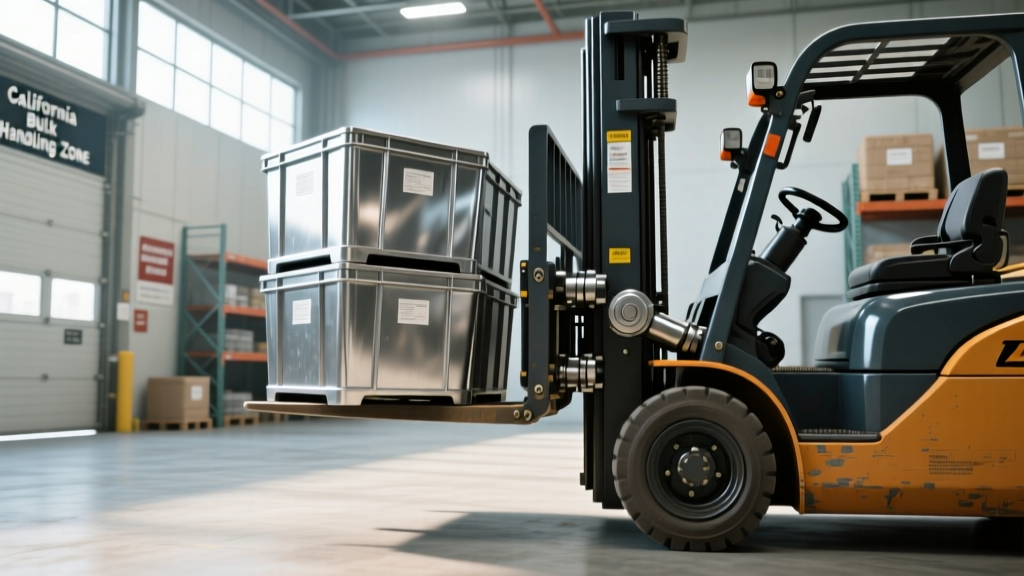
Side shifters and fork positioners (such as the Cascade 55F Series) are foundational for bulk bag and palletized drum handling. A common failure mode in dusty California storerooms is a gradual loss of lateral holding force, causing loads to drift during high-mast stacking. This is rarely a pump issue; it is almost always an internal bypass or seal degradation problem.
Step-by-Step Diagnostic Flow
- Isolate the Attachment Circuit: Install a 3000 PSI inline hydraulic flow meter between the truck's quick-disconnect couplers and the attachment's hydraulic manifold. Run the side shifter to the mechanical stop and hold the spool valve open for 5 seconds.
- Measure Flow at Pressure: The system should read near-zero flow at 2250–2500 PSI. If the flow meter registers >0.5 GPM under deadhead pressure, you have internal cylinder bypass.
- Inspect Rod Seals for Particulate Scoring: In bulk fertilizer storerooms, potassium chloride dust mixes with atmospheric humidity to form a highly abrasive, corrosive paste. This destroys standard nitrile (Buna-N) rod seals. Action: Upgrade to polyurethane (Urethane) rod seals with integrated PTFE scraper rings during rebuilds.
- Check the Pilot-Operated Check Valves: If the cylinder holds pressure but drifts when the truck is turned off, the pilot check valves in the attachment manifold are contaminated. Disassemble and clean the valve spools; replace the O-rings using a dedicated Cascade seal kit (Part #368915 or equivalent, typically costing $180–$240).
If you hear a high-pitched whining noise during rapid side-shifting, your hydraulic fluid velocity is exceeding 15 ft/sec in the supply lines. Upgrade the attachment hose inner diameter from 3/8-inch to 1/2-inch to reduce fluid velocity and prevent cavitation pitting on the cylinder walls.
Troubleshooting Rotator Attachment Gearbox Failures in Dust-Heavy Environments
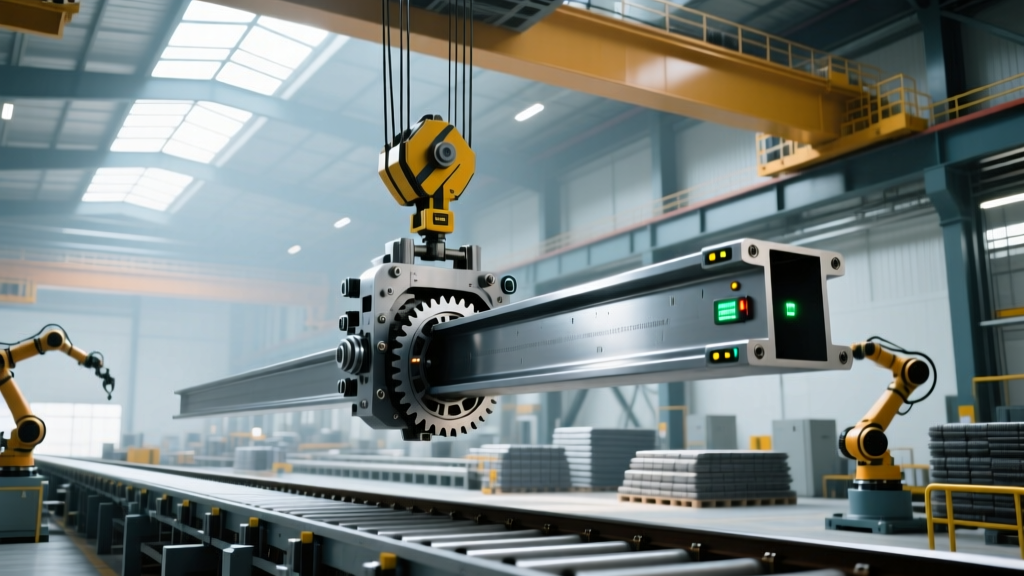
Rotators (e.g., Bolzoni Auramo 1000G Series) used for dumping bulk bins or rotating industrial hoppers rely on a worm-gear drive system. In California's agricultural bulk storerooms, fine organic dust infiltrates the gearbox breather caps, mixing with the synthetic gear oil to form a lapping compound that destroys the bronze worm wheel.
| Symptom | Root Cause | Corrective Action & Cost Estimate |
|---|---|---|
| Jerky rotation under load; audible grinding | Bronze worm wheel tooth spalling due to abrasive dust ingress | Complete gearbox teardown and wheel replacement ($2,800–$3,500) |
| Rotator drifts when hydraulic power is off | Worn internal hydraulic motor crossover relief valves | Replace crossover relief valve cartridge and recalibrate to 2100 PSI ($350) |
| Overheating at the mounting flange | Lack of lubrication on the main thrust bearing race | Inject NLGI Grade 2 Moly-Lithium grease via zerk fittings; flush old grease |
| Complete seizure during summer months | Thermal expansion binding due to incorrect gear oil viscosity | Drain and refill with ISO 320 Synthetic EP Gear Oil (suited for 110°F+ ambient) |
To prevent dust ingress, retrofit the gearbox breather plug with a desiccant-style breather featuring a 3-micron particulate filter. This $45 modification extends gearbox life by an average of 4,000 operational hours in high-dust environments.
Push-Pull Slip Sheet Attachments: Hydraulic & Mechanical Binding
For bulk bag handling without pallets, push-pull attachments are standard. The most frequent repair ticket involves the faceplate failing to retract fully, tearing the plastic slip sheets. This mechanical binding is usually caused by misaligned pantograph linkage arms.
The Fix: Place the faceplate on a flat steel surface. Use a laser alignment tool to check the parallelism of the upper and lower scissor arms. If the variance exceeds 1/16-inch over a 48-inch span, the pivot bushings are elongated. Press out the sintered bronze bushings and replace them with hardened steel, grease-grooved bushings. Re-torque the pivot pins to 185 ft-lbs using a calibrated torque multiplier.
Cal/OSHA Compliance & Load Backrest Extension Cracking
When handling unstable bulk loads (like stacked 50lb seed bags or chemical drums), operators rely on load backrest extensions. The constant impact and vibration in storeroom installations cause micro-fractures at the weld joints where the backrest grid meets the carriage base.
Regulatory Context: Under Cal/OSHA Title 8, Section 3664, all modifications or repairs to industrial truck attachments must not reduce the structural integrity or the rated capacity of the truck. Field-welding a cracked backrest without engineering approval is a direct citation risk and voids the OEM liability shield.
Approved Repair Protocol for Backrests
- Inspection: Perform Magnetic Particle Inspection (MPI) on the base welds every 1,000 hours. Visual inspection misses sub-surface fatigue cracks.
- Welding Standard: If cracks are found, gouge out the defective weld to sound metal. Re-weld using ER70S-6 MIG wire, strictly adhering to AWS D1.1 Structural Welding Code standards. Do not use stick welding (SMAW) in the field, as slag inclusions in vertical welds will fail under dynamic shock loads.
- Re-certification: Post-repair, the facility must update the forklift's data plate to reflect any weight changes to the attachment, recalculating the net lifting capacity per OSHA's Powered Industrial Truck standards.
Quick-Coupler & Hydraulic Line Diagnostic Matrix
Hydraulic leaks at the quick-disconnect couplers between the forklift carriage and the attachment are the number one cause of environmental contamination fines in California bulk storerooms. Upgrading coupler architecture solves 90% of these issues.
| Coupler Type | Max Flow Rate | Failure Mode in Bulk Storerooms | Recommended Upgrade |
|---|---|---|---|
| Standard Poppet (ISO 5675-A) | 12 GPM | Dust packs behind the poppet seal, preventing full engagement and causing external weeping. | Switch to Flat-Face Couplers |
| Flat-Face (ISO 16028) | 15 GPM | O-ring extrusion if connected while residual pressure is trapped in the attachment lines. | Install inline pressure-relief bleed valves on attachment hoses |
| Screw-Together (High Pulse) | 20+ GPM | Thread galling due to chemical exposure (e.g., liquid fertilizer storerooms). | Use 316 Stainless Steel bodies with Viton (FKM) seals |
Preventative Maintenance Schedules for High-Throughput California Facilities
To maximize uptime in 24/7 bulk material installations, maintenance intervals must be compressed compared to standard warehouse environments. Implement the following strict schedule:
- Every 250 Hours: Purge and re-grease all attachment pivot points using a synthetic, water-resistant calcium sulfonate grease. Standard lithium grease washes out during the washdown cycles required in food-grade bulk storerooms.
- Every 500 Hours: Sample the attachment hydraulic fluid. Test for ISO 4406 cleanliness codes. If the particulate count exceeds 18/16/13, replace the return-line filters (upgrade to 10-micron absolute beta-rated elements) and perform a partial fluid exchange.
- Every 1,000 Hours: Dye-penetrant test all structural welds on rotator yokes and side-shifter mounting hooks. Replace any hook exhibiting >5% throat opening deformation.
By applying these targeted diagnostic and repair protocols, facility managers can drastically reduce attachment-related downtime, ensure strict adherence to California's rigorous safety codes, and protect the massive capital investments tied up in modern bulk material handling infrastructure.