Forklift Attachments: Material Handling Equipment Certification Rules
Explore how IoT-enabled forklift attachments impact material handling equipment certification, including ANSI B56.1 compliance, costs, and testing.
The Shift from Mechanical to Intelligent Attachments
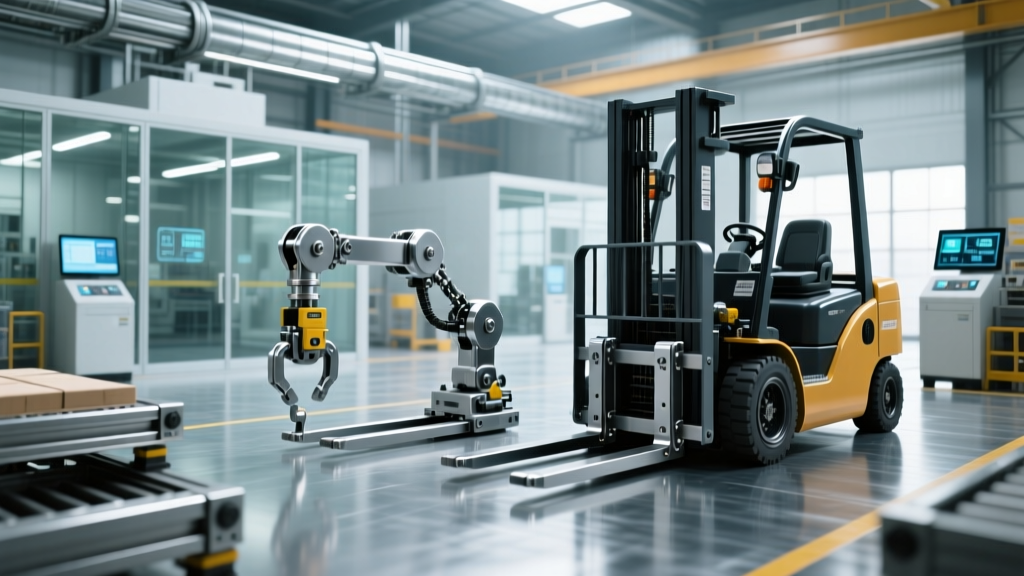
The integration of IoT sensors, LiDAR proximity arrays, and automated hydraulic clamping into forklift attachments has fundamentally altered how facilities approach material handling equipment certification. Historically, an attachment was a static piece of forged steel or welded aluminum. Today, specialized attachments like the Cascade SmartForks or Bolzoni Aurora intelligent paper roll clamps are active data-gathering nodes. They feature embedded strain gauges, auto-adjusting pressure valves, and telematics transmitters that relay real-time load data to warehouse management systems.
While these technological advancements drastically reduce product damage and optimize fleet utilization, they introduce complex variables into the certification process. Adding a sensor-laden, 450-lb smart clamp to a standard 5,000-lb capacity lift truck does not merely require subtracting the attachment's weight from the truck's baseline capacity. The forward shift in the center of gravity (CG), combined with the electronic failure modes of the attachment, demands a rigorous re-evaluation under current safety frameworks.
Why Smart Attachments Trigger Re-Certification
Under OSHA's 1910.178 standard for powered industrial trucks, any modification or addition that affects the capacity, stability, or safe operation of a forklift requires written approval from the manufacturer or a qualified engineer. When you mount an IoT-enabled rotator or a multi-pallet handler, you are altering the vehicle's fundamental physics and operational logic.
⚠️ Critical Compliance Warning: Operating a forklift with an unapproved smart attachment voids the OEM warranty and exposes facility managers to severe penalties. As of 2026, OSHA penalties for willful or repeated violations regarding uncertified load capacities exceed $16,000 per instance. If an un-certified smart attachment fails and causes an injury, the liability falls entirely on the facility operator, not the attachment manufacturer.The primary engineering hurdle in securing proper material handling equipment certification for these devices is the 'Load Center Shift.' A standard forklift is rated at a 24-inch load center. However, intelligent clamps often require thicker backrests and deeper hydraulic cylinder housings, pushing the effective load center out to 26 or 28 inches. This exponential increase in the overturning moment requires physical tilt-table testing and finite element analysis (FEA) to establish a new, legally binding capacity plate.
ANSI/ITSDF B56.1 and ISO 3691 Compliance for Sensor-Equipped Forks
In North America, the governing framework is ANSI/ITSDF B56.1, while global operations align with ISO 3691-1:2020. Both standards have been updated in recent years to address the proliferation of electronic and automated attachments. Certification bodies now require a Failure Mode and Effects Analysis (FMEA) for any attachment featuring electronic load-sensing or auto-clamping capabilities.
Key Certification Requirements for Intelligent Attachments
- Hydraulic Pressure Retention: Smart clamps must maintain minimum clamping pressure for 72 hours in the event of a total electrical or hydraulic power failure.
- Sensor Redundancy: LiDAR and ultrasonic proximity sensors used for auto-positioning must feature dual-redundant circuits to prevent false-negative readings that could lead to dropped loads.
- Electromagnetic Interference (EMI) Shielding: Because modern warehouses are saturated with 5G and Wi-Fi 6E signals, the attachment's internal logic boards must pass strict EMI shielding tests to ensure telemetry data does not corrupt the forklift's drive-by-wire steering systems.
Mechanical vs. Smart Attachment Certification Matrix
The cost and timeline for material handling equipment certification vary wildly depending on the technological complexity of the attachment. Below is a comparative matrix based on 2026 industry averages for third-party engineering sign-offs.
| Attachment Type | Avg. Weight | CG Shift Impact | FMEA Required? | Est. Certification Cost | Timeline |
|---|---|---|---|---|---|
| Standard Side Shifter (Mechanical) | 350 lbs | Low (Static) | No | $1,200 - $1,800 | 1-2 Weeks |
| Telescopic Forks (Hydraulic) | High (Dynamic) | No | $3,500 - $4,500 | 3-4 Weeks | |
| IoT Paper Roll Clamp (Smart) | Extreme | Yes | $6,200 - $8,500 | 5-7 Weeks | |
| LiDAR-Guided Auto-Rotator | Moderate | Yes | $7,000 - $9,200 | 6-8 Weeks |
Step-by-Step: Securing Material Handling Equipment Certification
Facility managers and fleet procurement officers must follow a strict, documented workflow to legally integrate specialized attachments into their operations. Bypassing these steps invalidates insurance policies and invites regulatory action.
Step 1: OEM Data Acquisition and FEA Modeling
Before purchasing a smart attachment, request the exact 3D CAD files and hydraulic flow schematics from the attachment manufacturer. Submit these to an independent, certified material handling engineering firm. The engineers will run Finite Element Analysis (FEA) to simulate the stress on the forklift's carriage and mast rollers when the attachment is subjected to dynamic braking forces at maximum capacity.
Expert Tip: Never rely on the attachment manufacturer's 'generic' capacity derating charts. A Cascade smart clamp will derate a Toyota 8FGU25 entirely differently than a Hyster S5.0FT due to variations in mast geometry and counterweight distribution.
Step 2: Physical Load Testing with Telematics
Once the FEA is approved, the physical truck and attachment must undergo tilt-table testing per ISO 3691 protocols. For smart attachments, this phase also includes 'telematics validation.' Engineers will intentionally trigger sensor failures (e.g., covering LiDAR arrays, cutting power to strain gauges) to verify that the attachment defaults to a safe, locked state rather than dropping the load or initiating an uncommanded hydraulic release.
Step 3: Issuing the New Capacity Plate and Digital Twin Update
Upon successful testing, the engineering firm issues a stamped certificate of compliance. The physical forklift must be fitted with a new, riveted aluminum capacity plate detailing the exact truck-and-attachment combination. In 2026, this process also involves updating the forklift's 'Digital Twin' in the fleet management software, ensuring that the onboard telematics system enforces the new, lower weight limits via the drive-by-wire throttle controller.
Real-World Edge Cases: Auto-Clamping Failures
The most common point of failure in smart attachment certification involves hydraulic pressure bleed-off in auto-clamping devices. Traditional clamps rely on manual pilot-operated check valves. Intelligent clamps use solenoid-driven proportional valves to adjust grip pressure based on the load's fragility (e.g., gripping a cardboard box of glass bottles vs. a solid steel coil).
If the solenoid fails due to voltage spikes from the forklift's regenerative braking system, the clamp can release mid-transit. To pass modern material handling equipment certification, smart attachments must now feature mechanical lock-valves installed downstream of the electronic solenoids. This ensures that even if the IoT logic board completely fries, the mechanical hydraulic pressure remains trapped in the cylinders, keeping the load secure until the operator manually resets the system.
Dynamic Digital Certification: The 2026 Paradigm Shift
The industry is currently transitioning from static metal capacity plates to dynamic digital certification. Advanced forklifts equipped with OEM-integrated smart attachments now calculate the load's weight and CG in real-time using mast-mounted inclinometers and fork-strain gauges. If the operator attempts to pick up a load that exceeds the dynamic stability triangle, the forklift's CPU physically locks the hydraulic lift circuit and sounds an audible alarm.
While this technology represents a massive leap forward in warehouse safety, regulatory bodies still require the baseline physical certification and derating calculations. The digital system acts as an active enforcement layer on top of the foundational material handling equipment certification, ensuring that human error and sensor degradation never result in a catastrophic tip-over event.