Storeroom Semi-Automated Material Handling Equipment: Hoist Training
Master operator training for semi-automated storeroom hoist machinery. Learn VFD controls, load limits, vertical transport safety, and inspection protocols.
When facility managers deploy storeroom semi-automated material handling equipment machinery, the focus often lands on throughput metrics, inventory density, and spatial optimization. However, the most critical variable in vertical material transport remains the human operator. Hoist and winch systems—ranging from 1-ton Columbus McKinnon (CM) Lodestar chain hoists to 5-ton Harrington NER wire rope models—operate in high-density storerooms where clearances are tight and the margin for error is zero. Proper operator training is not merely a compliance exercise; it is the primary defense against catastrophic load drops, two-blocking incidents, and structural racking damage.
The Shift to Semi-Automated Hoist Systems in Storerooms
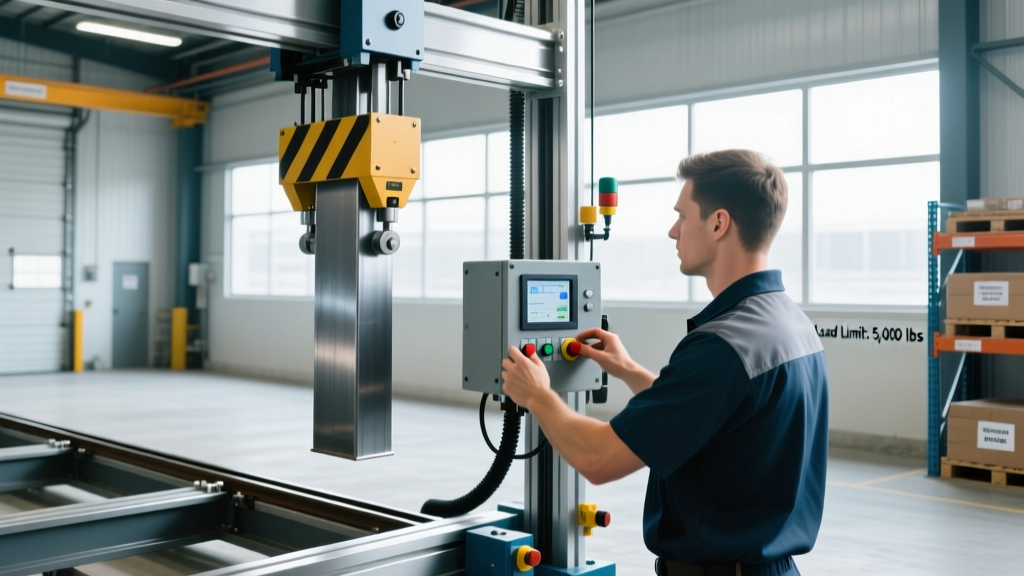
Unlike fully manual chain falls or fully automated AS/RS (Automated Storage and Retrieval Systems) cranes, semi-automated hoists blend manual rigging and load-spotting with motorized lifting and Variable Frequency Drive (VFD) trolley travel. In a typical MRO (Maintenance, Repair, and Operations) storeroom, these systems are mounted on jib cranes or enclosed track bridge cranes to move heavy motors, pumps, and raw stock from high-bay shelving to ground-level staging areas.
As of 2026, modern VFD controllers allow operators to program specific ramp-up and ramp-down acceleration curves. This semi-automation drastically reduces load swing, but it introduces a new training requirement: operators must understand how to interface with digital pendant controls rather than relying solely on the tactile feedback of manual chains.
CRITICAL WARNING: Never allow operators to bypass the lower limit switch on a semi-automated hoist to gain an extra few inches of lift. Bypassing this switch allows the hook block to travel into the upper sheave, causing 'two-blocking,' which can instantly snap the wire rope or chain and drop the load.Pre-Shift Inspection Matrix: The 7-Point Check
According to OSHA Standard 1910.179, overhead and gantry cranes, including attached hoists, require documented daily inspections by the operator before the first shift. For semi-automated storeroom equipment, this inspection must go beyond a visual glance. Operators must be trained to measure and quantify wear.
| Component | Inspection Action | Rejection Criteria (Remove from Service) |
|---|---|---|
| Load Chain (Alloy) | Caliper measurement of 5-link segments | Elongation exceeds 3% over original 5-link pitch length. |
| Wire Rope (6x19 Class) | Visual and tactile check along entire spool | 6 or more broken wires in one rope lay, or 1/3 reduction in outer wire diameter. |
| Hook & Safety Latch | Check throat opening and latch spring tension | Throat opening stretched >15% from original; latch fails to auto-close. |
| VFD Pendant Cable | Inspect strain relief and outer jacket | Exposed copper wiring, cracked strain relief, or sticky push-buttons. |
| Upper/Lower Limit Switches | Run hoist empty to trigger both limits | Motor fails to cut power immediately upon limit actuation. |
| Load Brake | Lift test load 10 inches and hold | Any visible load drift or descent when power is cut. |
| Storeroom Trolley Track | Check flange wear and end stops | Flange wear >20%; missing or loose mechanical end stops. |
VFD Programming and Load Swing Mitigation
In narrow storeroom aisles, a swinging 2,000 lb load can easily crush high-bay racking or strike pedestrians. Semi-automated hoists utilize VFDs to provide 'soft starts' and 'soft stops.' Operators must be trained to understand how the programmed ramp times affect their specific loads.
The 1.5-Second Rule for High-Density Aisles
For storerooms with aisles narrower than 12 feet, maintenance teams should program the VFD acceleration ramp to a minimum of 1.5 seconds. Operators must be trained to press and hold the directional button smoothly, rather than 'jogging' (rapidly tapping) the button. Jogging a VFD-controlled hoist defeats the soft-start algorithm, sending shockwaves through the gear case and inducing pendulum swing. Training drills should require operators to move a 55-gallon drum filled with water across a 20-foot track without spilling a single drop, enforcing smooth pendant manipulation.
Rigging Hardware and Center of Gravity (CG) Calculations
The hoist is only as effective as the rigging connecting it to the load. OSHA Standard 1910.184 dictates strict removal criteria for slings, but operators must first know how to select the right rigging based on the load's Center of Gravity.
When lifting asymmetrical machinery—such as a gearbox with a heavy cast-iron housing on one side and a lightweight aluminum output shaft on the other—the CG is not in the physical center. Operators must be trained to perform a trial lift: raising the load exactly two inches off the floor. If the load tilts, it must be lowered immediately, and the rigging adjusted.
"An operator who relies solely on the physical center of a load rather than calculating the Center of Gravity is introducing a severe side-loading risk to the hoist's lower hook block, which can lead to catastrophic bearing failure." — Best Practices in Industrial Rigging, 2025 Edition.
Sling Angle Stress Multipliers
Operators must memorize the stress multipliers associated with sling angles. When using a two-leg wire rope sling (e.g., Crosby Group 6x19 IWRC) to lift a pallet of raw bar stock:
- 90° (Vertical): Sling stress equals 50% of the load weight per leg.
- 60° Angle: Sling stress increases to 58% of the load weight per leg.
- 30° Angle: Sling stress spikes to 100% of the load weight per leg.
Training must enforce a strict rule: never use sling angles below 45° in a storeroom environment, as the horizontal crushing force exerted on the load can buckle packaging or damage precision-machined parts.
Two-Blocking Prevention and Limit Switch Calibration
Two-blocking occurs when the lower hook block is drawn up into the upper block or hoist drum, creating a direct mechanical pull against the hoist's structural mounts. In semi-automated wire rope hoists, this is prevented by an upper limit switch. However, limit switches are designed to stop the motor, not to act as a physical structural stop.
Operators must be trained to stop the hoist manually via the pendant before the limit switch engages. Relying on the limit switch as a daily operational stop point will eventually wear out the switch contacts, leading to a failure during a critical lift. Furthermore, operators must verify that the limit switch weight (the small metal tear-drop hanging from the switch cable) is free of debris and not tangled in the wire rope, a common issue in dusty storeroom environments.
Emergency Drop-Zone Protocols and Brake Failure
While modern hoists feature mechanical load brakes that automatically engage when power is cut, brake linings can fail due to oil contamination from leaking gear cases or excessive heat from high-cycle operations.
According to guidelines outlined by the Canadian Centre for Occupational Health and Safety (CCOHS), operators must establish and enforce a dynamic 'Drop Zone' whenever a load is suspended. In a busy storeroom, this requires:
- Audible/Visual Signaling: Utilizing the hoist's integrated warning horn or a personal two-way radio to announce overhead movements before the load leaves the floor.
- The 10-Foot Rule: No personnel may enter a 10-foot radius of the suspended load's footprint. Because storeroom aisles are narrow, operators must physically walk ahead of the load (via motorized trolley) to clear the path, rather than walking backward while holding the pendant.
- Emergency Lowering: If a load becomes snagged on racking while in transit, the operator must never attempt to pull it free using the hoist's lateral trolley movement. The operator must lower the load to the ground, reposition the rigging, and lift again. Lateral dragging can snap the wire rope or pull the entire jib crane mounting out of the concrete floor.
Summary of Operator Certification Requirements
Facilities utilizing semi-automated material handling machinery must maintain documented proof of training for every operator. This training must include a minimum of 4 hours of classroom instruction on load dynamics and VFD controls, followed by 8 hours of supervised practical operation in the specific storeroom environment where the equipment is deployed. Refresher evaluations must be conducted annually, or immediately following any near-miss incident or equipment modification.