Storeroom Bulk Material Handling Equipment Installations Guide
Compare pallet racking and AS/RS for storeroom bulk material handling equipment installations. Includes costs, floor specs, and ROI metrics.
When engineering storeroom bulk material handling equipment installations, facility planners face a critical divergence: maximize cubic volume with high-density static racking, or invest in Automated Storage and Retrieval Systems (AS/RS) for dynamic throughput. The decision hinges on SKU velocity, building clear height, and capital expenditure limits. Missteps in these installations frequently stem from underestimating infrastructure prerequisites, such as floor flatness tolerances and seismic bracing requirements. This guide dissects the technical specifications, hidden costs, and structural realities of both paradigms to inform your procurement strategy.
Quick Decision Matrix: Racking vs. AS/RS
- Choose High-Density Racking if: Clear height is under 45 feet, SKU count exceeds 5,000 with low individual velocity, and capital budget is restricted to under $400 per pallet position.
- Choose Unit-Load AS/RS if: Clear height exceeds 60 feet, throughput requires 80+ dual cycles per hour per aisle, labor availability is constrained, and the land footprint must be minimized.
Pallet Racking Architectures: Beyond Basic Selective
Standard selective racking offers 100% accessibility but utilizes only 40% to 50% of available cubic space due to aisle requirements. For bulk storeroom environments where space is at a premium, advanced configurations are mandatory.
Push-Back and Pallet Flow Systems
Push-back racking utilizes nested carts on inclined rails, allowing forklifts to load and unload from a single aisle. It operates on a Last-In, First-Out (LIFO) basis and is ideal for bulk ingredients or packaging materials with moderate turnover. Pallet flow systems use gravity rollers and operate on a First-In, First-Out (FIFO) basis, making them essential for date-sensitive bulk goods.
- Push-Back Cost: $350 to $500 per pallet position (installed).
- Pallet Flow Cost: $450 to $650 per pallet position (installed, heavily dependent on roller type and braking systems).
- Density Gain: Increases storage density by 60% to 75% compared to selective racking by eliminating up to four aisles per bay.
Mobile Pallet Racking
For cold storage or highly constrained urban facilities, mobile pallet racking mounts standard selective racks on motorized carriages. This collapses multiple aisles into one movable access aisle. While the mechanical infrastructure adds significant weight and cost, it yields up to 85% floor space utilization. Expect to pay $700 to $950 per pallet position, factoring in the sub-floor rail installation and automated safety light curtains required by OSHA material handling guidelines.
Automated Storage and Retrieval Systems (AS/RS)
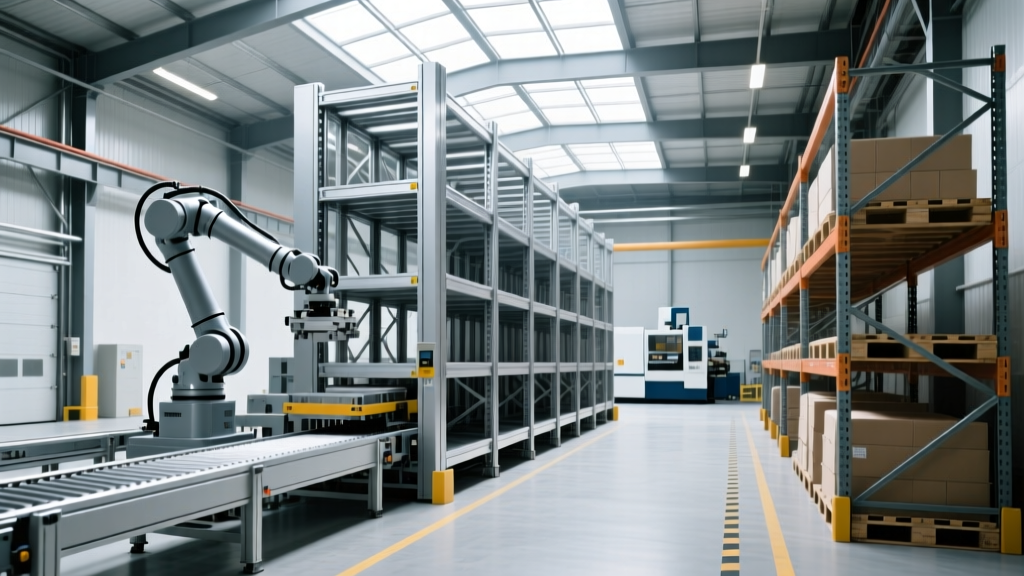
Automated systems remove the human variable from bulk transport, drastically reducing product damage and mispicks. According to the MHI Automated Storage Group, modern unit-load AS/RS can operate in complete darkness and utilize clear heights up to 120 feet, a physical impossibility for counterbalance or reach forklifts.
Unit-Load Crane Systems vs. Shuttle Systems
Traditional unit-load AS/RS relies on aisle-captive cranes (stacker cranes) that travel horizontally and vertically simultaneously. A single crane can service 10,000 to 15,000 pallet positions but represents a single point of failure for that aisle. Modern shuttle systems decouple horizontal and vertical movement. Lifts move pallets between levels, while autonomous shuttles travel deep into the racking structure. This decoupling allows for higher throughput redundancy; if one shuttle fails, others can be rerouted, albeit at a slower cycle time.
Expert Insight: Do not specify an AS/RS crane system without evaluating your building's roof deflection. A 100-foot tall AS/RS mast tolerates less than 1.5 inches of lateral sway at the top guide rail. If the building structure flexes beyond this during high wind loads, the crane's laser positioning systems will fault, halting operations.
Infrastructure Prerequisites: Where Installations Fail
The most common cause of budget overruns in storeroom bulk material handling equipment installations is inadequate site preparation. Racking and AS/RS are only as stable as the concrete beneath them.
Floor Flatness and Levelness (FF/FL)
Standard selective racking can tolerate typical warehouse floors (FF 25 / FL 20). However, Very Narrow Aisle (VNA) racking and AS/RS demand extreme precision. A VNA turret truck operating in a 66-inch aisle at 40 feet high requires an F-min 100 rating. If the floor deviates, the mast sways, risking catastrophic rack collisions. Grinding a 50,000 sq. ft. floor to F-min 100 post-construction costs between $4.00 and $7.00 per square foot. Always specify super-flat floors during the initial concrete pour.
Seismic Bracing and ANSI MH16.1
All engineered racking must comply with the ANSI MH16.1 standard, as enforced by the Rack Manufacturers Institute (RMI). In seismic zones (IBC Seismic Design Categories D, E, or F), bulk storerooms storing dense materials like liquids or metals require heavy-duty diagonal bracing, larger baseplates, and potentially seismic isolation pads. Underestimating the seismic importance factor (moving from Category II to Category III for essential facilities) can increase structural steel tonnage—and costs—by 20% to 30%.
Capital Expenditure and ROI Matrix
The following table outlines the realistic 2026 capital expenditure ranges for a 10,000-pallet-position facility, comparing high-density static systems with automated alternatives.
| System Type | Est. Cost per Pallet Pos. | Total System Cost (10k Pos.) | Throughput (Pallets/Hr) | Labor Requirement |
|---|---|---|---|---|
| Drive-In Racking | $250 - $350 | $2.5M - $3.5M | 40 - 60 | High (Forklifts) |
| Pallet Flow (FIFO) | $450 - $650 | $4.5M - $6.5M | 60 - 90 | Medium (Forklifts) |
| Mobile Pallet Racking | $700 - $950 | $7.0M - $9.5M | 30 - 50 | Medium (Forklifts) |
| Unit-Load AS/RS | $1,200 - $1,800 | $12M - $18M | 120 - 180 | Low (System Techs) |
Phased Procurement and Implementation Strategy
Executing a bulk material handling installation requires a rigid sequence to prevent compounding errors. Follow this phased approach to mitigate risk:
- Data Profiling (Months 1-2): Extract 24 months of historical order data. Map SKU dimensions, weights, and velocity. Do not rely on average pallet weights; design for the 95th percentile heaviest load to prevent beam deflection failures.
- Geotechnical and Structural Survey (Month 3): Core-test the existing concrete slab. Verify compressive strength (minimum 4,000 PSI for heavy bulk loads) and thickness. If building a new facility, lock in super-flat floor specifications with the general contractor before pouring.
- Fire Suppression Engineering (Month 4): High-density racking and AS/RS alter fire dynamics. Standard ceiling sprinklers cannot penetrate deep into a 60-foot rack. You will likely need Early Suppression, Fast Response (ESFR) systems combined with in-rack sprinkler lines at every 15-foot vertical interval. Consult a fire protection engineer specialized in NFPA 13 warehouse standards.
- Vendor Selection and FAT (Months 5-8): Require a Factory Acceptance Test (FAT) for all AS/RS cranes and shuttle lifts before they ship to your site. Verify cycle times and positioning accuracy using your actual pallet dimensions and weights, not the vendor's idealized test loads.
- Site Acceptance and Commissioning (Months 9-12): Conduct a Site Acceptance Test (SAT) running the system at 110% of peak expected throughput for 72 continuous hours to identify software bottlenecks and mechanical wear points before go-live.
Ultimately, the choice between advanced racking and automation is not merely a question of budget, but of operational philosophy. Static racking offers flexibility and lower initial capital outlay, while AS/RS provides predictable throughput, massive cubic utilization, and long-term labor insulation. Align your selection with your 10-year facility roadmap to ensure the installation delivers sustained ROI.