Smart Forklift Attachments: Material Handling Equipment Integration
Discover how smart forklift attachments drive material handling equipment integration in 2026, featuring CAN bus tech, AI clamps, and ROI frameworks.
The Shift to Sensor-Driven End-Effectors
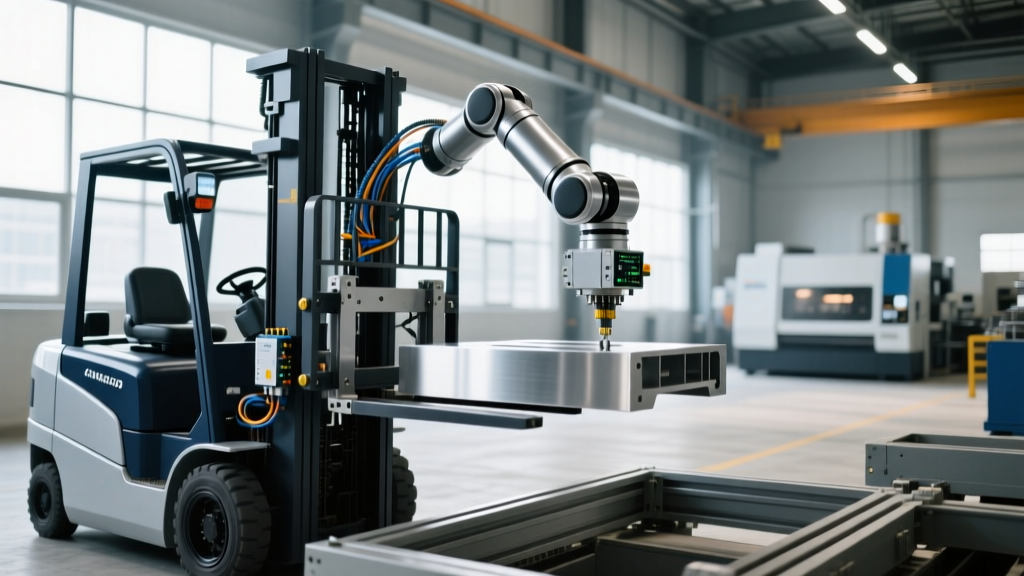
Historically, forklift attachments were viewed as 'dumb iron'—purely mechanical extensions of the lift truck's hydraulic system. In 2026, this paradigm has completely inverted. As warehouses transition to fully digitized, IoT-enabled environments, the end-effector (the attachment) has become a critical data node. True material handling equipment integration now requires the attachment to communicate bidirectionally with the forklift's telematics, the Warehouse Management System (WMS), and automated guided vehicle (AGV) routing software.
According to recent data from the Material Handling Industry (MHI), facilities that integrate sensor-equipped attachments into their fleet telematics report a 22% reduction in product damage and a 14% increase in throughput. The attachment is no longer just moving the load; it is verifying the load's weight, dimensions, and structural integrity in real-time.
Data Highlight: The Cost of 'Dumb' Attachments
In high-volume corrugated and paper roll handling, mechanical clamps relying solely on operator 'feel' result in an average of $42,000 in annual crushed-inventory losses per facility. Smart attachments eliminate this variable by enforcing programmed clamping pressures at the hydraulic valve level.
Top 3 Innovations Driving Material Handling Equipment Integration
1. Telematics-Enabled Side Shifters and Fork Positioners
Standard side shifters simply move the carriage left or right. Modern integrated units, such as those developed by industry leaders like Cascade Corporation, feature built-in linear transducers and load-sensing hydraulics. These sensors feed real-time fork positioning data to the forklift’s CAN bus network. When integrated with an automated storage and retrieval system (AS/RS) or a digital twin WMS, the system automatically adjusts the fork positioner to the exact pallet width scanned by the mast-mounted RFID reader, eliminating the 3-to-5-second manual adjustment cycle per pick.
2. AI-Vision and Force-Feedback Paper Roll Clamps
Handling cylindrical loads like paper rolls or aerospace piping requires precise hydraulic pressure—too little, and the load drops; too much, and the core crushes. Next-generation clamps utilize proportional solenoid valves controlled by Pulse Width Modulation (PWM) signals. When paired with mast-mounted LiDAR or stereoscopic cameras, the attachment's onboard microcontroller calculates the exact surface area and material density of the roll, automatically limiting the hydraulic clamping force to the safe threshold defined by OSHA material handling guidelines and the manufacturer's specs.
3. Automated Rotators with Collision Avoidance
For dump hoppers and specialized rotators, integration means safety interlocks. Modern rotators feature integrated ultrasonic sensors that halt rotation if a pedestrian or racking upright is detected within a 1.5-meter sweep zone. This localized sensor data is integrated directly into the forklift's central safety ECU, overriding the operator's hydraulic controls to prevent catastrophic facility damage.
Legacy vs. Integrated Attachments: A Technical Comparison
| Feature | Legacy Mechanical Attachment | Smart Integrated Attachment (2026) |
|---|---|---|
| Hydraulic Control | Manual spool valves, operator-dependent pressure | Proportional valves, PWM electronic control |
| Data Output | None | Clamp pressure, fork width, load weight |
| Network Protocol | N/A | SAE J1939 / CANopen |
| Avg. Unit Cost (Carton Clamp) | $6,500 - $8,200 | $11,800 - $15,500 |
| WMS Integration | Manual barcode scanning required | Automated dimension/weight verification |
Overcoming the Integration Bottleneck: Hydraulics vs. Electronics
The primary barrier to advanced material handling equipment integration is the physical mismatch between heavy hydraulic flows and delicate data networks. Modern forklifts utilize a Controller Area Network (CAN bus), specifically the SAE J1939 protocol, to allow the engine, transmission, and mast controllers to talk to one another.
When retrofitting a smart attachment, facilities often make the critical error of tapping directly into the main hydraulic pump without installing a priority flow divider. Smart proportional valves require a highly stable hydraulic flow rate (typically 4 to 8 GPM) to maintain accurate electronic pressure mapping. If the operator simultaneously tilts the mast, the flow drops, the PWM signal loses its hydraulic correlation, and the clamp pressure spikes, damaging the load.
⚠️ Warning: CAN Bus Ground Loop Failures
When wiring smart attachments via quick-disconnect electrical couplers, ensure the ground pin is slightly longer than the data pins. If the ground disconnects before the CAN-High and CAN-Low lines during an attachment swap, the resulting voltage spike can permanently fry the forklift's main telematics gateway module—a $2,500+ repair mistake.
Calculating the ROI of Smart Attachment Integration
Justifying the $12,000+ premium for a smart carton clamp over a mechanical one requires a strict analytical framework. Use the following metrics to build your business case:
- Damage Reduction: Calculate your annual write-offs for crushed corrugated goods. Smart pressure-limiting clamps typically reduce this to near zero. (Average savings: $25,000/year per truck).
- Hydraulic Fluid & Pump Wear: Mechanical clamps often 'deadhead' the hydraulic pump when fully closed, generating excess heat and degrading hydraulic fluid. Smart attachments bypass fluid back to the tank at low pressure once the target clamp force is reached, extending hydraulic fluid life by up to 30%.
- Operator Onboarding Time: With automated pressure presets linked to RFID load tags, new operators do not need to spend weeks 'learning the feel' of different paper grades or box densities. Training time on specialized attachments drops from 14 days to 2 days.
Sourcing and Compatibility Checklist for 2026
Before issuing a purchase order for integrated attachments, verify the following technical prerequisites with your dealer and IT department:
- ECU Firmware Version: Confirm the forklift’s main ECU is running firmware capable of parsing third-party J1939 PGNs (Parameter Group Numbers) specific to the attachment.
- Electrical Coupler Rating: Standard 4-pin couplers are insufficient. Require IP68-rated, 12-pin Deutsch-style connectors to accommodate power, ground, CAN-High, CAN-Low, and auxiliary analog sensor returns.
- WMS API Readiness: Ensure your WMS provider supports MQTT or REST API ingestion for real-time attachment telemetry. If your WMS only accepts batch CSV uploads at the end of a shift, the real-time damage-prevention features of the attachment are rendered useless.
- Quick-Disconnect Hydraulics: Specify flat-face, non-spill hydraulic couplers with integrated electrical continuity rings to prevent fluid contamination and data loss during rapid attachment changeovers.
'The forklift of 2026 is essentially a mobile robotic arm. If your end-effector isn't feeding data back to the central brain, you aren't doing material handling equipment integration; you're just moving boxes blindly.' — Director of Automation, Top 10 North American 3PL
Upgrading to sensor-driven attachments is no longer a luxury reserved for fully automated dark warehouses. It is a fundamental requirement for any facility looking to close the data gap between the physical movement of goods and the digital ledger of the WMS. By prioritizing CAN bus compatibility, proportional hydraulic controls, and API-ready telematics, fleet managers can transform their lift trucks from isolated vehicles into intelligent, integrated nodes of the modern supply chain.
Related reading
Troubleshooting Forklift Attachments for Storeroom Bulk Material Handling Equipment Installations in California
Types of Material Handling Equipment in Warehouse: Robotic Palletizers