Types of Material Handling Equipment in Warehouse: Robotic Palletizers
Explore how robotic palletizing systems rank among essential types of material handling equipment in warehouse operations, featuring 2026 ROI case studies.
The Shift to End-of-Line Automation
When facility managers audit the various types of material handling equipment in warehouse environments, end-of-line automation consistently yields the highest immediate return on investment. Manual palletizing and depalletizing are notoriously inefficient, accounting for a disproportionate number of musculoskeletal disorders (MSDs). According to the Occupational Safety and Health Administration (OSHA), repetitive lifting and awkward postures in manual palletizing result in injury rates significantly higher than the warehouse average, driving up workers' compensation costs and causing severe labor retention issues.
In 2026, robotic palletizing has evolved from rigid, caged systems to highly adaptive, vision-guided solutions. The integration of advanced 3D Time-of-Flight (ToF) sensors and machine learning algorithms allows modern robots to handle mixed-SKU pallets, damaged corrugated packaging, and variable slip sheets without manual intervention. The Material Handling Institute (MHI) reports that over 68% of high-volume distribution centers have now integrated some form of cognitive robotics at their shipping and receiving docks.
2026 Market Snapshot: Robotic Palletizing
- Average System Cost: $160,000 - $320,000 (Traditional Articulated)
- RaaS (Robotics-as-a-Service) Rates: $8,500 - $14,000 per month per unit
- Average Cycle Time: 8 to 14 cases per minute (depending on payload and pattern)
- Primary Vision Standard: 3D Laser Profiling (e.g., SICK Ranger3, Cognex In-Sight 991)
Case Study 1: High-Speed Beverage Depalletizing
A major regional beverage distributor in the Midwest faced a critical bottleneck at their inbound receiving dock. They were processing 40 inbound trailers daily, requiring the depalletizing of mixed layers of glass bottles, PET plastics, and aluminum cans. Manual crews were limited to 4 cases per minute due to the 45-pound weight of glass trays and the constant need to manually remove wooden slip sheets.
System Architecture & Implementation
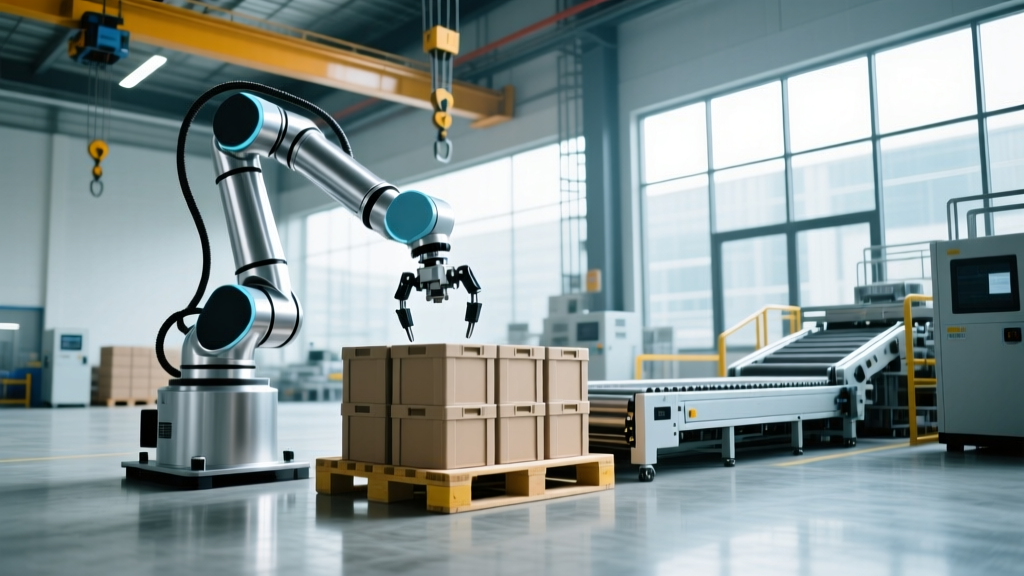
The facility deployed a FANUC M-410iC/110 articulated arm equipped with a custom multi-zone vacuum area gripper. Unlike standard cup grippers, the Schmalz area gripper utilizes a porous foam pad that maintains suction even if up to 30% of the product surface is uneven or missing. To handle the slip sheets, a secondary pneumatic pinch-tool was integrated into the end-of-arm tooling (EOAT).
The vision system, a SICK Ranger3 3D camera, was mounted on the ceiling above the staging area. This top-down perspective allowed the robot to detect the exact height of the remaining stack and identify the edges of the slip sheets, even when heavily glare-affected by industrial shrink wrap. The system successfully increased throughput to 11 cycles per minute, effectively doubling the dock's processing capacity while eliminating all manual heavy lifting.
Case Study 2: Mixed-SKU E-Commerce Palletizing
While traditional robots excel at uniform layers, e-commerce fulfillment requires building 'rainbow pallets'—mixed SKUs of varying dimensions, weights, and packaging qualities. A leading 3PL provider upgraded their outbound staging area to automate the palletization of randomized tote outputs.
Cognitive Robotics and Edge Computing
The 3PL integrated a cognitive robotics platform powered by a cloud-trained neural network. Unlike traditional layer-palletizers that require pre-programmed tier patterns, this system calculates the optimal 3D tetris-like placement for every individual box in real-time. The robot, a high-payload collaborative arm (cobot) mounted on a heavy-duty mobile base, utilizes force-torque sensors to detect if a poorly taped corrugated box is crushing under the weight of the EOAT. If compression exceeds 15 Newtons, the system dynamically adjusts its grip force and re-routes the item to a manual QA station.
This flexibility reduced outbound trailer cubage waste by 14%, as the AI optimizer consistently built denser, more stable pallets than human operators who typically defaulted to simpler, less space-efficient column patterns.
Comparative Matrix: Palletizing Equipment Types
Selecting the correct configuration depends heavily on the specific SKU profile, facility footprint, and capital expenditure (CapEx) strategy. Below is a technical comparison of the primary robotic configurations available in 2026.
| System Type | Max Payload | Speed (Cases/Min) | Footprint Requirement | Best Application | 2026 Est. CapEx |
|---|---|---|---|---|---|
| Traditional Articulated (4-Axis) | 80kg - 300kg | 12 - 20 | Large (Requires safety caging) | High-speed uniform layers (Beverage, FMCG) | $180k - $250k |
| Heavy-Payload Cobot | 20kg - 35kg | 6 - 10 | Compact (Fenceless operation) | Mixed-SKU, tight aisles, human-adjacent zones | $95k - $140k |
| Mobile Depalletizer (e.g., Stretch) | 22kg (50 lbs) | Up to 14 (800/hr) | Dynamic (Moves to trailer) | Inbound receiving, truck unloading | $300k+ or RaaS |
| Gantry / Cartesian Palletizer | 50kg - 500kg+ | 10 - 15 | Overhead (Saves floor space) | Heavy building materials, bagged goods | $220k - $350k |
Hidden Failure Modes & Edge Cases
Vendor demonstrations often showcase flawless operation in sterile environments. In real-world warehouse conditions, robotic palletizers face several non-obvious failure modes that can halt production if not engineered for in advance.
1. Corrugated Dust and Vacuum Degradation
Recycled corrugated cardboard sheds microscopic fibers and dust with every movement. In vacuum-based EOATs, this dust accumulates in the venturi generators and porous foam pads, causing a 20% to 40% drop in suction within a single shift. Solution: Specify multi-stage vacuum generators with integrated blow-off pulses that clean the cups during the release phase, and mandate weekly maintenance schedules for vacuum line filters.
2. Shrink Wrap Glare and Vision Blindness
Inbound pallets wrapped in clear, heavy-gauge polyethylene stretch film create severe specular highlights under warehouse LED lighting. Standard 2D cameras interpret this glare as part of the product geometry, leading to miscalculated grip coordinates and dropped loads. Solution: Mandate 3D laser triangulation or Time-of-Flight (ToF) sensors, which rely on structured light and infrared pulses rather than ambient light reflection, effectively 'seeing through' the glare to map the actual box edges.
3. Slip Sheet Misalignment
Wooden or heavy-duty cardboard slip sheets often overhang the pallet base by 2 to 4 inches. If the robot's layer-removal tool attempts to clamp the center of the slip sheet, the overhang will snap or fold, dropping the bottom layer of product. Solution: Implement edge-detection routines that calculate the slip sheet's exact perimeter and deploy corner-specific suction cups rather than centralized clamps.
Integration Warning: WES Latency
Robotic palletizers do not operate in isolation; they rely on the Warehouse Execution System (WES) to dictate the build pattern. If your WES communicates via legacy batch-processing rather than real-time event streaming (like MQTT or OPC-UA), the robot will idle for 2-4 seconds between pallets waiting for the next coordinate matrix. Ensure your middleware supports sub-100ms latency to prevent artificial bottlenecks.
Strategic Procurement Advice for 2026
When evaluating these advanced types of material handling equipment in warehouse networks, avoid the trap of over-specifying payload. Purchasing a 150kg payload robot for a facility where 90% of boxes weigh under 20kg results in unnecessary energy consumption, slower acceleration curves, and massive safety cage requirements. Instead, utilize modular cobot arrays or high-speed delta-style pick-and-place systems for lighter goods, reserving heavy articulated arms strictly for dense, uniform layers.
Furthermore, the shift toward Robotics-as-a-Service (RaaS) has fundamentally altered the procurement landscape. For facilities with high seasonal variability, committing $250,000 in CapEx for a system that sits idle for four months is financially detrimental. RaaS models allow operators to scale robotic fleets up or down based on Q3/Q4 peak volumes, shifting the expense to OpEx and ensuring the technology pays for itself strictly during high-throughput windows.