Cleanroom Material Handling Equipment Tire Maintenance: A Fab Guide
Master cleanroom material handling equipment tire maintenance for semiconductor fabs. Learn ESD wheel troubleshooting, particulate control, and ISO protocols.
The Hidden Yield Killer: Tire Degradation in ISO Class 3-5 Fabs
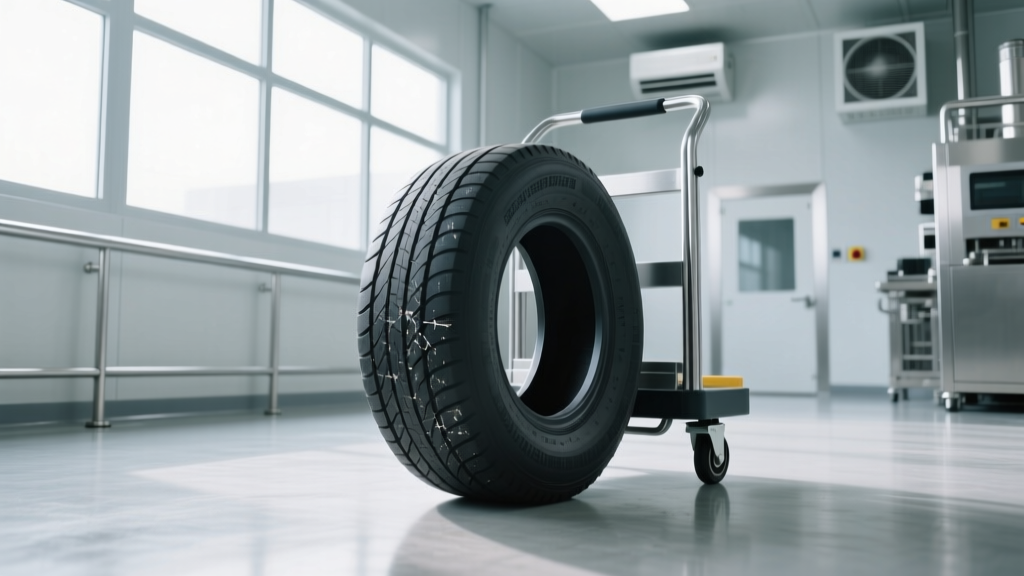
In semiconductor manufacturing environments, material handling equipment (MHE) such as wafer-cassette Automated Guided Vehicles (AGVs), cleanroom pallet jacks, and manual transfer carts operate under extreme constraints. Standard industrial tires shed micro-particulates, outgas volatile organic compounds (VOCs), and accumulate electrostatic charge. When a cleanroom AGV's drive wheel degrades, it does not merely cause mechanical friction—it generates sub-micron particulates and electrostatic discharges (ESD) that can instantly destroy multi-million-dollar wafer lots.
Effective material handling equipment tire maintenance in a fab is less about mechanical longevity and strictly about yield protection. According to guidelines established by SEMI (Semiconductor Equipment and Materials International), any mobile equipment operating in a cleanroom must adhere to strict outgassing and particulate generation limits. This guide details the exact troubleshooting protocols, diagnostic matrices, and repair procedures required to maintain MHE tires in ISO 14644-1 compliant environments.
⚠️ CRITICAL WARNING: The Micro-Abrasion TrapStandard polyurethane (PU) wheels rated for industrial use will undergo rapid hydrolysis and micro-tearing when exposed to the aggressive cleaning agents (like vaporized hydrogen peroxide, VHP) used in fab decontamination cycles. Never substitute a degraded cleanroom-rated wheel with a standard industrial PU wheel, even temporarily. The resulting particulate spike will breach ISO Class 5 limits within hours.
Diagnosing Cleanroom Wheel Failure Modes
Troubleshooting cleanroom MHE tires requires looking beyond physical wear. The three primary failure modes in a fab are ESD coating degradation, particulate shedding, and chemical outgassing. Use the following diagnostic matrix to identify the root cause of your equipment's failure.
| Symptom / Diagnostic Reading | Root Cause Analysis | Corrective Action & Repair Protocol |
|---|---|---|
| Surface resistance reads > 1011 Ω | ESD conductive coating worn off; floor wax buildup insulating the wheel. | Strip floor wax with UPW (Ultrapure Water). If wheel reads > 109 Ω, replace with carbon-loaded TPE wheel. |
| Laser particle counter spikes (ISO 5 breach) during cart movement | Polyurethane matrix micro-tearing due to VHP exposure or mechanical shear. | Replace wheels with vacuum-baked Vulkollan or non-shedding conductive elastomers. |
| AMC (Airborne Molecular Contamination) sensors detect VOCs | Off-gassing from standard rubber adhesives or non-cleanroom bonding agents. | Remove equipment immediately. Replace wheels with SEMI F-57 compliant low-outgassing materials. |
| AGV micro-slip and navigation drift on epoxy floors | Tire contact patch hardened (Shore A hardness increased) due to chemical aging. | Replace drive wheels. Specify 85A-92A Shore hardness for optimal traction without shedding. |
Step-by-Step Material Handling Equipment Tire Maintenance Protocols
Routine maintenance in a semiconductor fab cannot utilize standard shop rags or degreasers. The following protocol ensures wheels are cleaned without introducing new contaminants or stripping the ESD-safe properties of the tire.
Phase 1: Weekly Particulate and Chemical Decontamination
- Preparation: Secure the MHE in a designated cleanroom maintenance bay (typically ISO Class 7 or 8 gowning area).
- Solvent Selection: Use only 99.9% Ultrapure Isopropyl Alcohol (IPA) or Ultrapure Water (UPW) with a resistivity of 18.2 MΩ·cm. Standard IPA contains trace moisture and impurities that leave conductive residues.
- Wiping Technique: Use a lint-free Class 100 polyester wipe. Saturate the wipe—do not spray the wheel directly, as aerosolized IPA can settle on nearby HEPA filters.
- Unidirectional Stroking: Wipe the tire contact patch using a single, unidirectional stroke. Rotate the wheel and use a fresh side of the wipe for each pass. This prevents embedding dislodged particulates back into the polyurethane matrix.
Phase 2: Monthly ESD Conductivity Verification
Compliance with ANSI/ESD S20.20 is non-negotiable in wafer handling areas. ESD wheels rely on a homogeneous distribution of carbon black or specialized conductive polymers. Over time, physical abrasion can expose non-conductive sub-layers.
- Equipment Required: Megohmmeter (e.g., Monroe Electronics or Trek Model 152A) with a 5-lb concentric ring electrode.
- Testing Procedure: Place the electrode directly on the cleaned tire contact patch. Apply 100V DC for exactly 15 seconds.
- Acceptable Range: The reading must fall between 1.0 × 10⁵ and 1.0 × 10⁹ ohms.
- Troubleshooting Failures: If the reading exceeds 109 ohms, clean the wheel again with UPW to remove microscopic floor oils. If it still fails, the conductive matrix is permanently compromised, and the wheel must be pressed off the hub and replaced.
"In advanced nodes (3nm and below), the acceptable margin for electrostatic discharge is virtually zero. A cleanroom AGV tire that measures 1010 ohms might pass a generic industrial safety audit, but it acts as a capacitor in a fab environment, risking a localized Coulomb discharge that can gate-rupture sensitive MOSFET structures during wafer transfer."
— Lead Yield Integration Engineer, Tier-1 Logic Foundry
Material Comparison: Selecting Replacement Tires
When troubleshooting reveals that a tire has reached the end of its viable life, selecting the correct replacement material is critical. The Material Handling Industry (MHI) notes that specialized elastomers now dominate cleanroom applications, replacing legacy carbon-dusted rubber. Use this matrix to specify the correct replacement based on your equipment's function.
| Material Type | Shore A Hardness | Surface Resistance (Ω) | Best Application | Known Limitations |
|---|---|---|---|---|
| Conductive Polyurethane (PU) | 92A | 106 - 108 | Manual transfer carts, light-duty pallet jacks. | Prone to hydrolysis if exposed to frequent VHP sterilization. |
| Carbon-Loaded TPE (Thermoplastic Elastomer) | 85A | 105 - 107 | AGV/AMR drive wheels requiring high traction and micro-slip resistance. | Can leave faint black scuff marks on pristine epoxy floors under heavy load. |
| Vulkollan (Low-Outgassing) | 95A | > 1012 (Static Dissipative coating required) | Heavy load-bearing casters for wafer-cassette transport racks. | Requires secondary ESD coating; extremely rigid, transfers vibration to sensitive payloads. |
Advanced Troubleshooting: AGV Drive Wheel Micro-Slip
Automated Guided Vehicles in semiconductor fabs utilize LiDAR and optical floor-tracking. A frequent, yet misdiagnosed, issue in fab MHE is AGV navigation drift. Maintenance teams often recalibrate the software, missing the mechanical root cause: tire micro-slip.
When a cleanroom AGV accelerates or decelerates, the drive wheel undergoes localized shear. If the tire material has hardened due to chemical aging (exposure to cleanroom floor cleaners), the coefficient of friction drops. The wheel slips by fractions of a millimeter per rotation. Over a 100-meter transport route, this results in centimeters of positional error, causing the AGV to misalign with the fab's overhead hoist transport (OHT) drop-off stations.
💡 Pro-Tip: The Durometer CheckKeep a digital Shore A durometer in your cleanroom maintenance kit. If an AGV's original 85A drive wheel now reads 94A or higher, the elastomer has chemically cross-linked and hardened. Replace the wheel immediately, regardless of the remaining physical tread depth, to prevent alignment failures and optical sensor faults.
Summary Checklist for Fab Maintenance Managers
Implementing a rigorous material handling equipment tire maintenance program requires shifting from a reactive replacement model to a predictive, data-driven protocol.
- Audit your chemical inventory: Ensure no standard floor waxes or silicone-based lubricants are used near MHE pathways, as these will instantly neutralize ESD tires.
- Standardize testing: Mandate monthly megohmmeter testing for all motorized AGVs and bi-monthly testing for manual carts.
- Track lifecycle by chemical exposure: Replace VHP-exposed PU wheels on a strict 6-month preventative schedule, rather than waiting for visual wear indicators, which are unreliable in micro-abrasion scenarios.
By treating MHE tires as critical contamination-control components rather than simple wear parts, semiconductor facilities can drastically reduce unexplained yield excursions and maintain the stringent environmental baselines required for next-generation node manufacturing.