Material Handling Equipment Filters for Robotic Palletizer Safety
Ensure robotic palletizer compliance with NFPA 652 and ISO 10218. Explore material handling equipment filters for vacuum EOAT and control cabinets.
The Hidden Hazard: Particulates in Automated Palletizing
Robotic palletizing and depalletizing systems operating in environments with airborne particulates—such as cement packaging, agricultural milling, or chemical processing—face severe operational and regulatory risks. While system integrators typically focus on payload capacity, reach, and cycle times, the degradation of material handling equipment filters is a leading cause of catastrophic load drops and electrical fires. When vacuum end-of-arm tooling (EOAT) filters clog, grip reliability plummets. When control cabinet filtration fails, variable frequency drives (VFDs) overheat or ignite combustible dust layers.
⚠️ 2026 OSHA Compliance Warning:Under OSHA's National Emphasis Program (NEP) for combustible dust, failure to maintain engineered filtration on automated material handling systems is no longer treated as a general housekeeping violation. Citations for inadequate dust control on robotic cells now routinely exceed $16,500 per instance, with willful violations reaching $161,323. Compliance requires documented filter maintenance schedules tied directly to your Dust Hazard Analysis (DHA).
Vacuum EOAT Filtration: Preventing Load Drop Failures
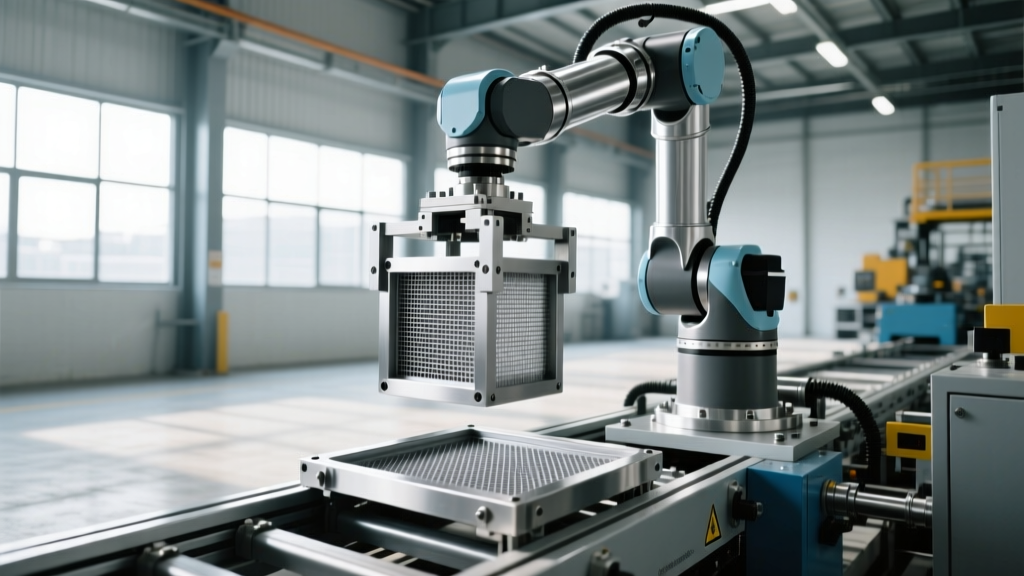
Robotic palletizers handling porous materials like corrugated cardboard, woven polypropylene bags, or unsealed shrink wrap rely on high-flow vacuum generators. These generators pull ambient plant air directly through the suction cups. If the facility air contains fine silica, flour, or polymer dust, the ISO 10218-1:2011 standard for robot safety mandates that gripper systems must maintain secure retention even during partial vacuum loss. However, standard inline filters rapidly choke under heavy particulate loads, dropping vacuum levels below the critical 80% retention threshold.
Selecting the Right Filter Media for Vacuum Grippers
Standard 40-micron sintered bronze filters, commonly shipped with Piab and Schmalz vacuum pumps, are insufficient for heavy-dust palletizing environments. Upgrading to specialized material handling equipment filters with pleated cellulose or PTFE-coated media dramatically increases the dirt-holding capacity without sacrificing initial airflow.
| Filter Media Type | Micron Rating | Best Application | Replacement Interval | Est. Cost (USD) |
|---|---|---|---|---|
| Sintered Bronze (Standard) | 40µm | Clean rooms, sealed plastic totes | 3-6 months | $15 - $25 |
| Pleated Cellulose | 10µm | Corrugated case packing, wood dust | 4-8 weeks | $35 - $50 |
| PTFE-Coated Polyester | 5µm | Flour, cement, combustible powders | 6-12 months (cleanable) | $85 - $140 |
Control Cabinet Climate Control and IP Ratings
A 6-axis palletizing robot, such as the Fanuc R-2000iC or KUKA KR QUANTEC series, requires a dedicated control cabinet housing high-amperage servo drives and power supplies. In dusty environments, facility managers often make the fatal error of installing high-CFM open-loop fan systems to combat VFD heat. This turns the cabinet into a vacuum chamber for ambient dust.
The Thermal Runaway Cycle
When fine particulates bypass degraded intake filter mats, they coat the aluminum heat sinks of the servo amplifiers. This creates an insulating layer that forces the cooling fans to run at maximum RPM, drawing in even more dust. Eventually, the drives trigger thermal overload faults (e.g., Fanuc SRVO-001), halting the palletizing cell. In environments with combustible dust, this accumulated layer inside the cabinet poses a severe deflagration risk if an electrical arc occurs.
'Engineering controls for robotic cells in combustible dust environments must prioritize closed-loop cooling systems with NEMA Type 12 or IP55-rated enclosure air conditioners over filtered fan systems. Filtered fans are only acceptable if a strict, documented differential pressure monitoring protocol is enforced.'
— Guidelines derived from NFPA 652 Fundamentals of Combustible Dust
If open-loop filtered fans must be used due to space or budget constraints, specify Rittal SK 3243 series fan-and-filter units equipped with G3 or G4 synthetic filter mats. These material handling equipment filters must be swapped the moment the differential pressure across the cabinet reaches 50 Pascals, not on a fixed calendar schedule.
Navigating NFPA 652 and OSHA Compliance
Under the NFPA 652 Standard on the Fundamentals of Combustible Dust, facility owners are required to complete a Dust Hazard Analysis (DHA) for all material handling processes. Robotic depalletizing of bulk bags or multi-wall paper sacks inherently generates dust clouds. The DHA must explicitly address the filtration systems protecting the robotic hardware.
DHA Integration Checklist for Robotic Cells
- Identify Dust Generation Points: Map the exact locations where the robot's EOAT compresses or lifts dusty packaging, causing particulate displacement.
- Audit Cabinet Ingress Protection: Verify that all control cabinet seams, cable glands, and filter housings maintain a minimum IP54 rating against the specific particulate size identified in the DHA.
- Establish Filter Change SOPs: Document the exact part numbers, micron ratings, and torque specifications for filter housing re-assembly to prevent bypass leaks.
- Implement Bonding and Grounding: Ensure that all plastic filter housings and vacuum lines are statically dissipative or grounded to prevent electrostatic discharge (ESD) ignition of the captured dust.
For comprehensive regulatory context, facility safety managers should continuously reference the OSHA Combustible Dust Standards portal, which provides updated enforcement directives and inspection procedures specific to automated handling equipment.
Predictive Maintenance: Moving Beyond Calendar Swaps
Replacing material handling equipment filters based on arbitrary time intervals (e.g., 'every 30 days') is an inefficient use of maintenance budgets and leaves systems vulnerable to premature clogging during high-humidity or high-production shifts. Modern robotic palletizing cells must integrate predictive filtration monitoring.
Integrating Differential Pressure Sensors
Install solid-state differential pressure sensors, such as the SMC PSE560 series, directly across the vacuum generator filter housing and the control cabinet intake/exhaust. These sensors output a 1-5V analog signal to the robot's PLC or safety controller.
💡 Pro-Tip: Automated Purge CyclesFor heavy-duty depalletizing of cement or fly ash, specify vacuum generators with integrated reverse-flow blow-off valves. When the PLC detects a 20% drop in vacuum flow via the pressure sensor, it triggers a 200-millisecond compressed air blast in reverse, ejecting the dust cake from the PTFE filter element without requiring manual intervention or halting the palletizing cycle.
By programming the HMI to trigger a 'Filter Maintenance Required' alarm at 75% of the maximum allowable pressure drop, maintenance teams can schedule filter replacements during planned changeovers rather than reacting to emergency E-stops caused by dropped loads or tripped VFDs. This data-driven approach not only ensures continuous compliance with ISO 10218 grip-retention mandates but also reduces unplanned downtime costs, which average $1,500 to $3,000 per hour in high-volume distribution centers.
Final Verification Protocol
After replacing any filter on a robotic palletizer, technicians must execute a standardized vacuum decay test. With the robot holding a maximum-weight payload in a static pose, isolate the vacuum generator. The system must maintain a vacuum level above -60 kPa for a minimum of 15 seconds. If the decay rate exceeds this threshold, the filter housing seal or the suction cup lip is compromised, and the cell must remain locked out until the leak is resolved.