AS/RS & Material Handling Automation Equipment Cost Guide 2026
Analyze 2026 costs for material handling automation equipment. Compare AS/RS, pallet shuttles, and static racking with ROI frameworks and CapEx data.
The Capital Shift: From Static Racking to Automated Storage
Warehouse cubic volume has become the ultimate premium in modern supply chain real estate. As industrial leasing rates remain elevated through 2026, facility planners are aggressively transitioning from static selective racking to high-density automated storage and retrieval systems (AS/RS). However, evaluating the true cost of material handling automation equipment requires looking far beyond the crane and mast price tags. A comprehensive budget must account for structural prerequisites, software integration, and long-term lifecycle maintenance.
This guide dissects the exact capital expenditure (CapEx) and operational expenditure (OpEx) variables required to budget for pallet-based AS/RS and semi-automated shuttle systems, providing a concrete financial framework for warehouse upgrades.
CapEx Breakdown: Static Racking vs. Automation Systems
The initial hardware investment varies drastically based on the level of automation. Below is a comparative matrix of per-pallet-position costs and aisle infrastructure requirements for 2026 market rates.
| System Type | Est. Cost Per Pallet Position | Aisle Width Requirement | Max Vertical Height | Throughput (Pallets/Hour) |
|---|---|---|---|---|
| Selective Pallet Racking | $160 - $240 | 12 ft - 14 ft (VNA: 6 ft) | 40 ft | 15 - 25 (Forklift dependent) |
| Drive-In / Drive-Thru | $260 - $380 | 12 ft - 14 ft | 35 ft | 10 - 15 |
| Semi-Auto Pallet Shuttle | $450 - $650 (plus $45k/cart) | 12 ft - 14 ft | 45 ft | 25 - 40 |
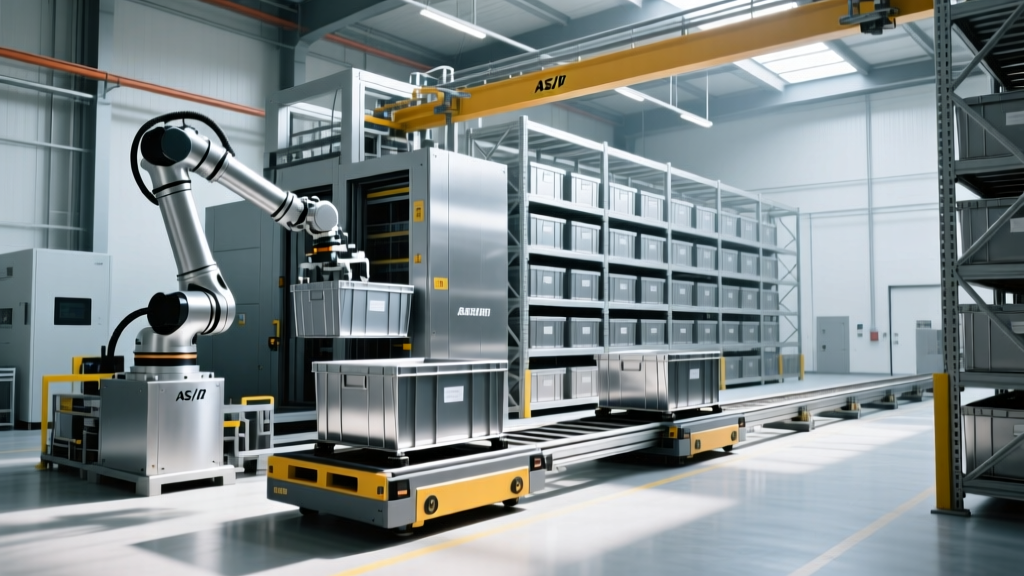
| Unit-Load AS/RS (Single Deep) | $850 - $1,400 | 5 ft - 6 ft (Crane aisle) | 80 ft - 100 ft | 60 - 90 |
| Unit-Load AS/RS (Double Deep) | $700 - $1,100 | 5 ft - 6 ft (Crane aisle) | 80 ft - 100 ft | 45 - 70 |
Note: Unit-Load AS/RS pricing includes the storage rack structure, crane mast, extraction carriage, and conveyor tie-in points, but excludes building modifications and software.
The Hidden Infrastructure Costs of Automation
Procurement teams frequently underestimate the facility preparation required to support high-tolerance material handling automation equipment. Standard warehouse specifications are rarely sufficient for AS/RS deployment.
1. Superflat Floor Requirements (FF/FL Tolerances)
An AS/RS crane operating at 80 feet with a mast sway tolerance of less than an inch requires a Superflat floor. Standard warehouse floors are typically poured to an FF 25 / FL 20 specification. AS/RS aisles require Fmin 100 or TR34 standard tolerances. Upgrading or grinding concrete to meet these specs costs between $9.00 and $15.00 per square foot in the defined aisle zones. Failure to meet these tolerances results in sensor misalignment, wheel wear, and catastrophic mast collisions.
2. NFPA 13 Fire Suppression Upgrades
High-bay automated racking fundamentally alters fire dynamics. According to the National Fire Protection Association (NFPA 13), solid decking in AS/RS structures mandates in-rack sprinkler systems at multiple vertical tiers, or specialized Early Suppression, Fast Response (ESFR) ceiling systems paired with specific flue space dimensions. Budget an additional $18 to $28 per square foot of rack footprint for specialized in-rack fire suppression engineering and plumbing.
3. WCS and WMS Software Integration
The physical crane is only as effective as its logic controller. Integrating a Warehouse Control System (WCS) to manage crane telemetry and handshake with your existing Warehouse Management System (WMS) typically requires $85,000 to $160,000 in licensing, PLC programming, and API development. This cost scales based on the number of I/O points and the complexity of inventory routing rules.
⚠️ Structural Warning: Building Column InterferenceWhen retrofitting an existing facility, internal roof-support columns often fall inside the planned AS/RS footprint. Moving structural steel columns or engineering crane masts to splice around them can add $40,000+ per aisle in custom fabrication. Always overlay AS/RS CAD schematics onto the building's structural column grid before finalizing the layout.
Calculating the True ROI: A 2026 Financial Model
To justify the CapEx of material handling automation equipment, facility directors must quantify labor reduction, real estate optimization, and product damage mitigation. Consider this baseline scenario for a 3-aisle Unit-Load AS/RS replacing 25,000 square feet of selective racking and VNA forklift operations.
The Real Estate Multiplier: According to the Material Handling Institute (MHI), AS/RS can reduce the required warehouse footprint by up to 40% while increasing effective storage volume by 60% compared to traditional racking.
Annual Savings Matrix
- Labor Reduction: Eliminating 4 VNA forklift operators (fully burdened 2026 cost: $78,000/yr each) = $312,000 / year.
- Real Estate Avoidance: Recovering 10,000 sq. ft. of usable floor space. At an industrial NNN lease rate of $9.50/sq. ft. = $95,000 / year.
- Damage & Shrinkage Reduction: Automated handling eliminates forklift rack impacts and product drops (historically 1.2% of inventory value). On $40M throughput = $480,000 / year.
- Energy Savings: AS/RS aisles are unlit and unheated. High-bay LED and HVAC reductions in the automated zone = $22,000 / year.
Total Year-One Operational Savings: $909,000. Against a fully loaded CapEx of $2.8M (including floors, fire, and software), the simple payback period sits at 3.08 years, well within the acceptable 5-year corporate hurdle rate for fixed assets.
Lifecycle OpEx: Maintenance and Downtime Realities
Budgeting for automation does not end at commissioning. Unlike static racking, which requires only annual plumb-and-bolt inspections, AS/RS demands rigorous preventative maintenance.
The 10% Rule of Thumb
Industry standards dictate that annual maintenance contracts, spare parts inventories, and specialized technician retainers will cost between 6% and 10% of the initial mechanical CapEx. For a $2.5M crane and conveyor system, expect to budget $150,000 to $250,000 annually for:
- Wire Rope and Hoist Band Inspections: Mandatory quarterly load testing and replacement cycles.
- Guide Rail Alignment: Laser calibration required bi-annually to prevent carriage binding.
- PLC Battery and Drive Replacements: Variable Frequency Drives (VFDs) typically require capacitor servicing or replacement by year 7.
- Software Support Licenses: Annual WCS updates and remote monitoring telemetry subscriptions.
Decision Framework: When to Automate Pallet Storage
Not every facility warrants the investment in automated storage and retrieval systems. Use this diagnostic checklist to determine if your operation justifies the transition from manual to automated material handling.
Green Light (Proceed with AS/RS Budgeting)
- Your SKU profile features low-to-medium variance with high pallet counts per SKU (ideal for double-deep AS/RS).
- Facility clear height exceeds 50 feet, or local real estate costs exceed $8.00/sq. ft. NNN.
- Throughput requires consistent 24/7 operation where shift-change labor bottlenecks occur.
- Product is high-value, hazardous, or requires strict FIFO/lot-tracking compliance that manual operators struggle to maintain.
Red Light (Stick to Semi-Automated or Static Racking)
- Building clear height is under 30 feet (the ROI on vertical automation collapses).
- SKU velocity is highly erratic, requiring constant slotting optimization that rigid AS/RS structures cannot accommodate without complex software overrides.
- The facility is a leased property with less than 7 years remaining on the term, making structural floor and fire suppression upgrades financially unviable.
Strategic budgeting for material handling automation equipment requires aligning physical building constraints with long-term throughput goals. By accurately forecasting the hidden infrastructure costs and calculating true operational savings, supply chain leaders can confidently deploy AS/RS technologies that secure a definitive competitive advantage in the modern logistics landscape.