How to Find Material Handling Equipment for Bulk Mining & Ag
Expert guide to help you find material handling equipment for bulk mining and agriculture. Compare conveyors, elevators, and TCO metrics.
The High-Stakes Reality of Bulk Material Handling
When moving thousands of tons of iron ore or bushels of grain daily, equipment failure is not a minor inconvenience; it is a catastrophic revenue leak. In large-scale mining, a single hour of unplanned conveyor downtime can cost upwards of $15,000 in lost production. In agriculture, improper grain handling leads to degradation, moisture accumulation, and severe combustible dust hazards. If you need to find material handling equipment capable of surviving these extreme environments, generic warehouse solutions will fail within weeks. This guide provides the exact engineering parameters, supplier vetting frameworks, and total cost of ownership (TCO) metrics required to select heavy-duty bulk handling systems for mining and agricultural applications in 2026.
Core Decision Matrix: Belt vs. Bucket vs. Pneumatic
The first step in system design is matching the material's physical properties (density, abrasiveness, moisture content) to the correct conveying mechanism. Below is a technical comparison to guide your initial specification.
| System Type | Optimal Material Profile | Max Typical Capacity | Distance / Elevation Limit | Primary TCO Driver |
|---|---|---|---|---|
| Overland Belt Conveyor | High-volume, abrasive ore, coal, aggregate | 10,000+ TPH (tons per hour) | Up to 15+ km continuous | Belt replacement & idler maintenance |
| Bucket Elevator | Grain, seeds, dry fertilizers, pellets | 20,000 BPH (bushels per hour) | Vertical lift up to 60m | Chain/belt tensioning & pulley lagging |
| Pneumatic Conveyor | Light powders, grain dust, fine ag products | 150 TPH | Complex routing up to 300m | Energy consumption (blower motors) |
Mining Applications: Sizing Overland and In-Pit Conveyors
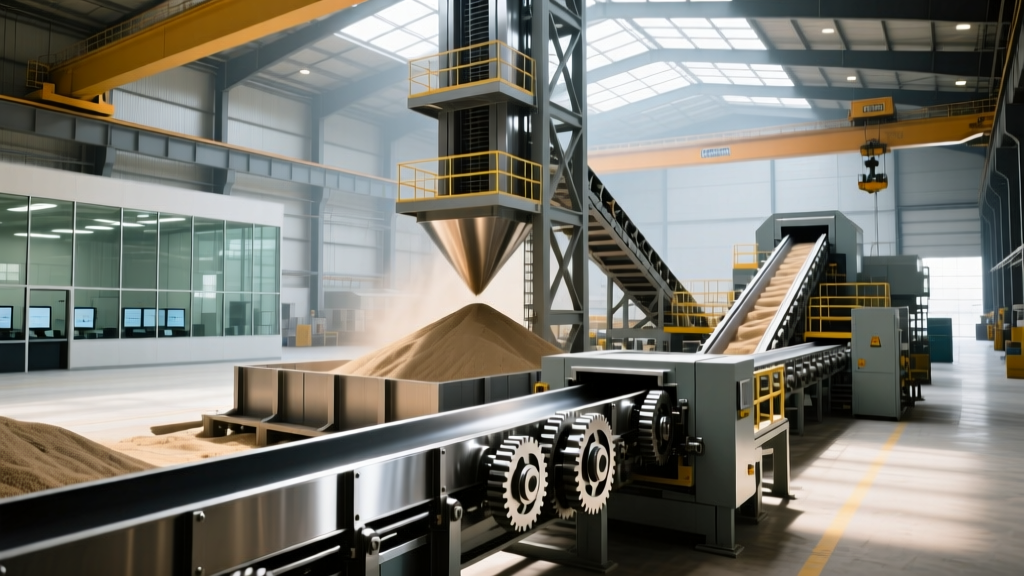
Mining environments demand equipment built to Conveyor Equipment Manufacturers Association (CEMA) Class 6 and Class 7 standards. When evaluating overland conveyors from manufacturers like Metso or Sandvik, focus on the following critical specifications:
Belt Speed and Idler Spacing
For high-tonnage copper or iron ore transport, belt speeds typically range from 3.5 m/s to 5.5 m/s (700 to 1,100 fpm). To prevent belt sag and material spillage at these speeds, impact idlers at the loading zone must be spaced at 1-foot intervals, while carrying idlers on the main run should be spaced no wider than 3 to 4 feet. Specify 6-inch to 8-inch diameter idlers with heavy-duty labyrinth seals to prevent fine particulate ingress, which is the leading cause of premature bearing failure in dusty mining pits.
Chute Design and Wear Liners
Material transfer points are where 80% of conveyor maintenance issues originate. Standard mild steel chutes will be destroyed by abrasive iron ore in less than three months. Mandate the use of AR400 or AR500 (abrasion-resistant) steel for chute liners, or specify engineered ceramic-lined chutes for high-velocity drop zones. Ensure the chute geometry utilizes a 'hood and spoon' design to match the belt speed and trajectory of the incoming material, drastically reducing impact wear and dust generation.
Failure Mode Alert: Belt mistracking is frequently misdiagnosed as a pulley alignment issue. In reality, it is often caused by material buildup on the tail pulley or uneven idler frame settling due to poor foundation compaction. Always specify V-plows with tungsten carbide blades on the return side of the belt to protect the tail pulley.Agricultural Grain Handling: Elevators and Dust Mitigation
Grain handling introduces a completely different set of engineering challenges, primarily centered around product degradation and explosive dust environments. When sourcing bucket elevators from industry leaders like Sukup or Brock Manufacturing, adherence to NFPA 61 (Standard for the Prevention of Fires and Dust Explosions in Agricultural and Food Processing Facilities) is non-negotiable.
Centrifugal vs. Continuous Discharge Elevators
- Centrifugal Discharge: Best for free-flowing, dry grains (corn, wheat, soybeans). Buckets are spaced apart and use centrifugal force to throw the grain into the discharge chute. Typical speeds: 300 to 400 fpm.
- Continuous Discharge: Required for fragile, fluffy, or high-moisture materials (oats, rice, wet distillers grains). Buckets are mounted continuously with no gaps, and material is guided out by the preceding bucket. Speeds are slower (150 to 250 fpm) to prevent kernel damage.
Material and Sanitation Specs
For standard dry grain, galvanized carbon steel (minimum 12-gauge thickness) is the industry baseline. However, if you are handling high-moisture feed, corrosive fertilizers, or food-grade products, you must upgrade to 304-grade stainless steel. While 304 stainless increases the initial capital cost by roughly 40%, it eliminates the rust-induced product contamination that can result in million-dollar recall liabilities. Specify food-grade, oil-resistant belting (such as FDA-approved PVC or polyurethane) and ensure all internal ledges are welded at 45-degree angles to prevent grain accumulation and subsequent rot.
Compliance with OSHA Combustible Dust guidelines requires integrated aspiration systems at all elevator boot and head sections. Never rely solely on passive venting; active dust collection maintaining airflow velocities above 3,500 fpm in ductwork is required to prevent particulate settling.
How to Vet Suppliers and Find the Right Partners
Knowing how to find material handling equipment is only half the battle; vetting the OEM (Original Equipment Manufacturer) or integrator is where projects succeed or fail. When issuing your Request for Proposal (RFP), require the following documentation:
- Discrete Element Method (DEM) Modeling: For mining transfer chutes, the supplier must provide DEM simulation videos proving material flow without blockages at maximum TPH and maximum moisture content.
- Finite Element Analysis (FEA): For bucket elevator casings and head pulleys, demand FEA reports demonstrating structural integrity under maximum startup torque and emergency stop (E-stop) shock loads.
- Spare Parts Guarantee: Require a contractual guarantee of 48-hour delivery for critical wear parts (idlers, belting, elevator buckets) to regional staging hubs. Mining operations cannot wait 6 weeks for overseas shipping.
Total Cost of Ownership (TCO) Calculator Framework
Initial purchase price typically represents only 30% to 40% of a bulk handling system's 15-year lifecycle cost. Use this framework to evaluate bids accurately:
Energy Optimization (VFDs and Gearless Drives)
Standard direct-on-line (DOL) motors waste massive amounts of energy during startup and partial-load operation. Specify Variable Frequency Drives (VFDs) with regenerative braking capabilities. On long overland downhill conveyors, regenerative drives can actually feed electricity back into the mine's grid, turning a cost center into a power generator. For ultra-long overland systems, consider gearless permanent magnet motor (PMM) drives, which eliminate gearbox maintenance and improve efficiency by 3% to 5%, paying for themselves in energy savings within 36 months.
Predictive Maintenance Integration
In 2026, buying 'dumb' steel is a liability. Mandate that all critical idlers and pulley bearings are equipped with wireless vibration and temperature sensors (e.g., SKF Enlight or Emerson AMS). The capital premium for sensor-equipped idlers is roughly $80 to $120 per unit, but it reduces catastrophic belt fires caused by seized idlers by over 90%. Ensure the supplier's control architecture natively integrates these IoT sensors into your site's central SCADA system via IO-Link or WirelessHART protocols.
Selecting bulk handling equipment for mining and agriculture requires moving beyond catalog shopping. By enforcing strict CEMA and NFPA compliance, demanding advanced chute and elevator engineering, and calculating TCO through the lens of energy and predictive maintenance, you secure infrastructure that operates reliably for decades.