Storeroom Material Handling Equipment Installations: Bay Area Hoist Care
Expert guide to hoist maintenance schedules, Cal/OSHA compliance, and service costs for storeroom material handling equipment installations in the Bay Area.
Environmental and Regulatory Realities for Bay Area Storerooms
Vertical material transport in Maintenance, Repair, and Operations (MRO) storerooms demands absolute reliability. Unlike high-volume manufacturing lines, storeroom hoists experience low-cycle, high-load lifts—often pulling awkward, unbalanced replacement parts like pump casings, electric motors, or gearboxes. In the San Francisco Bay Area, facility managers must also navigate a complex intersection of microclimates and stringent state regulations.
Coastal facilities in Oakland, Richmond, and San Francisco battle the marine layer. The chloride-rich moisture accelerates zinc oxidation on standard load chains, creating abrasive white rust that destroys lift wheel pockets. Meanwhile, inland facilities in San Jose and Fremont deal with fine particulate dust from nearby machining operations, which infiltrates hoist gearboxes. Furthermore, California’s Division of Occupational Safety and Health (Cal/OSHA) enforces Title 8 regulations that frequently exceed federal mandates, particularly regarding seismic bracing and annual load testing documentation.
⚠️ Cal/OSHA Compliance Warning: Under Cal/OSHA Title 8, Subchapter 7, all overhead hoists must undergo a documented annual inspection by a qualified technician. Failure to produce these physical or digital logs during an unannounced inspection can result in immediate stop-work orders and fines exceeding $18,000 per violation.Equipment Selection: Chain vs. Wire Rope in MRO Environments
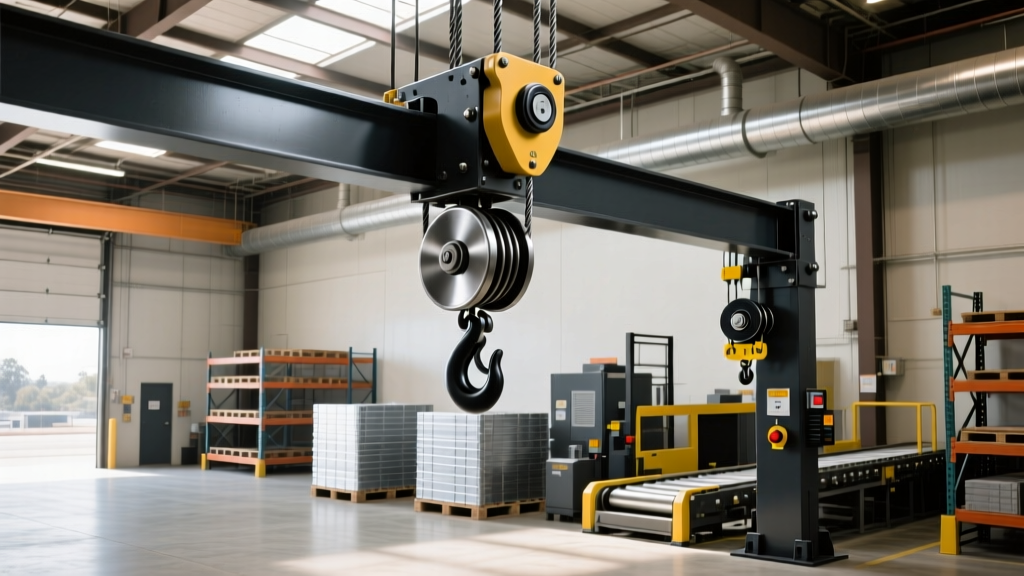
Choosing the right vertical transport mechanism is the first step in minimizing long-term maintenance. For storerooms, electric chain hoists generally outperform wire rope models due to their compact envelope and resistance to damage from off-center loading. However, wire rope remains necessary for higher capacities and faster lift speeds.
| Feature | Harrington NER010 (Chain) | Demag DR-Com (Wire Rope) |
|---|---|---|
| Capacity | 1/2 to 5 Tons | 1 to 10 Tons |
| Lift Medium Durability | High (Resists crushing if side-loaded) | Moderate (Susceptible to bird-caging) |
| Headroom Requirement | Minimal (12-16 inches) | High (Requires 24+ inches) |
| Best Bay Area Use Case | Tight MRO aisles, low-ceiling pump rooms | High-bay aerospace assembly storerooms |
The Preventative Maintenance Matrix
A reactive approach to hoist maintenance guarantees catastrophic failure. According to guidelines published by the Hoist Manufacturers Institute (HMI), maintenance must be tiered based on the severity of service. Storeroom hoists typically fall under 'Normal' to 'Heavy' service classifications.
Daily Operator Checks
- Limit Switch Verification: Run the empty hook block up to test the upper limit switch. The block must stop automatically at least 12 inches below the hoist body or sheave. Never use the limit switch as a routine operating stop.
- Brake Drift Test: Lift a load near the rated capacity, stop, and observe. The mechanical load brake must hold the load with zero visible drift. Any downward creeping indicates worn brake linings requiring immediate adjustment.
- Auditory Inspection: Listen for grinding in the gearcase or a high-pitched squeal from the travel trolley wheels, which indicates dry bearings.
Monthly Technician Service
- Load Chain Elongation: Measure the pitch length of 5 chain links. If the chain has stretched beyond 1.5% of its original factory pitch, it must be discarded. Stretched chain will skip teeth on the lift wheel, causing dangerous load drops.
- Wire Rope Discard Criteria: For wire rope hoists, inspect for broken wires. Per OSHA 1910.179 standards, replace the rope if there are 6 randomly distributed broken wires in one rope lay, or 3 broken wires in one strand.
- Contactor Inspection: Open the electrical panel and inspect the magnetic contactors. Look for pitting or arcing on the copper contacts, which causes single-phasing and motor burnout.
Annual Certified Inspection
This requires a complete teardown by a certified technician. The gearbox oil must be sampled or replaced (use ISO VG 220 gear oil for standard Harrington or Yale models). The hoist must undergo a physical load test at 125% of its rated capacity. For a 2-ton hoist, a certified 5,000 lb test weight is applied, and the structural integrity of the hook, safety latch, and mounting brackets is verified via magnetic particle or dye penetrant testing.
Executing Storeroom Material Handling Equipment Installations
When coordinating storeroom material handling equipment installations, Bay Area facility managers face a unique matrix of seismic codes and microclimate challenges. Standard federal guidelines are insufficient here. California’s building codes require that all overhead lifting anchors, including jib crane base plates and gantry tie-downs, be engineered for seismic lateral loads.
'In the Bay Area, we frequently see storeroom jib cranes fail during audits because they were anchored with standard sleeve anchors into degraded concrete. We mandate the use of Hilti HSL-3 heavy-duty wedge anchors with a minimum 4.5-inch embedment into verified 3,000 PSI concrete to meet local seismic lateral load requirements.' — Senior Structural Engineer, Industrial Facilities Group.
Furthermore, electrical festooning systems (C-track with trolleys) are vastly preferred over enclosed conductor bars for Bay Area storerooms. Conductor bars easily accumulate MRO dust and metallic shavings, leading to phase-to-phase short circuits. Festooning keeps the flat cable elevated and easier to clean.
Troubleshooting Decision Tree: Vertical Transport Failures
When a storeroom hoist goes down, MRO operations bottleneck. Use this diagnostic framework to isolate the failure mode before calling a service technician.
Symptom: Motor Hums, But Hook Will Not Lift
- Cause A: Single-phasing due to a blown fuse or failed contactor on a 3-phase 230V/460V system.
- Fix: Use a multimeter to check voltage across all three phases at the hoist disconnect. Replace pitted contactors or fuses.
- Cause B: The mechanical load brake is seized or the air gap is improperly adjusted, causing the brake to drag against the rotor.
- Fix: Adjust the brake air gap to the manufacturer's spec (typically 0.010 to 0.020 inches). Clean the brake friction surfaces with non-chlorinated brake cleaner.
Symptom: Chain Binding or 'Jumping' Inside the Guide
- Cause: Improper reeving causing the chain to twist, or severe lack of lubrication causing the chain pitch to elongate unevenly.
- Fix: Never attempt to force a twisted chain through the guide. Lower the block to the floor, unreeve the chain, and inspect the lift wheel pockets for wear. Apply a dry-film chain lubricant; avoid wet oils like WD-40 which attract abrasive storeroom grit.
Service Contract Economics and Budgeting
Budgeting for hoist maintenance in the Bay Area requires accounting for premium regional labor rates and specialized equipment logistics. As of 2026, certified hoist technicians in the Silicon Valley and San Francisco corridors command between $175 and $250 per hour.
For a mid-sized MRO storeroom with four 2-ton electric chain hoists and two 5-ton bridge cranes, facility managers should allocate the following annual budget:
- Annual Certified Inspections: $450 - $650 per hoist (includes load testing and documentation).
- Preventative Lubrication & Adjustments: $300 per unit, bi-annually.
- Emergency Call-Out Fees: Expect a $350 minimum dispatch fee, plus double-time hourly rates for weekend or after-hours failures.
By implementing rigorous daily operator checks and adhering to strict monthly chain elongation measurements, facilities can reduce emergency call-outs by up to 60%, ensuring that critical replacement parts reach the maintenance floor safely and on schedule. Always verify that your service provider holds current Cal/OSHA Title 8 certifications and carries adequate liability insurance specific to California's stringent industrial lifting regulations.