Dock Leveler Specs for Bulk Material Handling Equipments
Explore technical specifications, load capacities, and mechanics of dock levelers designed for heavy bulk material handling equipments and loading bays.
Core Mechanics: Hydraulic vs. Mechanical Operation
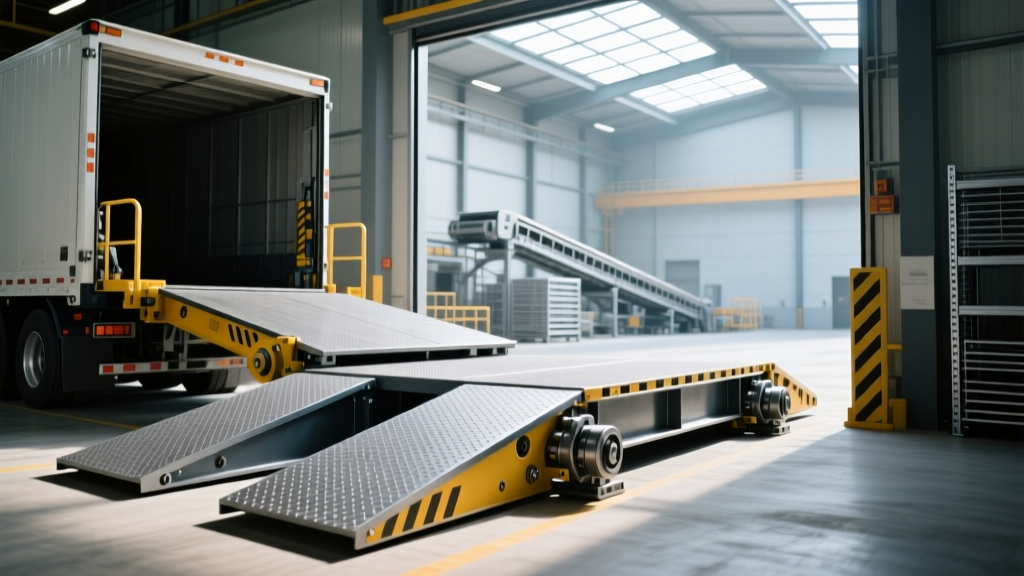
Dock levelers serve as the critical structural bridge between a warehouse floor and a truck bed, absorbing dynamic impacts and compensating for varying vehicle heights. Understanding the internal mechanics is essential for specifying the right unit for high-throughput facilities. The two dominant systems are hydraulic and mechanical (spring-tensioned).
Hydraulic dock levelers utilize a Hydraulic Power Unit (HPU), typically driven by a 1 HP or 1.5 HP motor operating on 115V/230V single-phase power. The HPU generates approximately 1,500 to 2,000 PSI of fluid pressure, which actuates two distinct cylinders: a main lift cylinder to raise the deck, and a smaller lip cylinder to deploy the ramp. Modern hydraulic systems incorporate a velocity fuse—a safety valve that instantly chokes hydraulic flow if a hose ruptures or a truck pulls away prematurely, preventing the deck from collapsing under load.
Mechanical levelers rely on high-tension steel springs housed in the rear chassis. When the operator pulls a release chain, the springs force the deck upward. A hold-down device keeps the deck tensioned against the truck bed, allowing it to float up and down as the trailer's suspension compresses and rebounds during loading. While mechanical units lack the precise push-button control of hydraulic models, they eliminate the risk of hydraulic fluid leaks in food-grade or pharmaceutical environments.
Technical Specifications Matrix
Selecting the correct leveler requires matching the equipment's structural capacity to the facility's operational profile. The following matrix outlines standard specifications for 8-foot by 10-foot pit-style levelers.
| Specification | Hydraulic Pit Leveler | Mechanical Pit Leveler | Edge-of-Dock (EOD) |
|---|---|---|---|
| Rollover Capacity | 25,000 - 50,000 lbs | 25,000 - 35,000 lbs | 15,000 - 20,000 lbs |
| Deck Steel Grade | A36 Tear-Tread (1/4") | A36 Tear-Tread (1/4") | A36 Smooth (5/16") |
| Lip Steel Grade | AR400 Abrasion-Resistant (5/8") | AR400 Abrasion-Resistant (5/8") | A36 Steel (1/2") |
| Working Range | 12" above to 12" below dock | 12" above to 12" below dock | 5" above to 5" below dock |
| Estimated 2026 Cost | $4,200 - $6,800 | $3,500 - $5,500 | $900 - $1,400 |
Calculating Point-Load Stresses and Dynamic Capacity
A common engineering failure in loading bay design is confusing rollover capacity with point-load capacity. Rollover capacity refers to the total weight of a forklift and its load passing over the leveler. However, forklifts transfer this weight through their front axle, creating a concentrated point load.
According to the ANSI MH30.1 standard established by the Material Handling Industry, dynamic loading creates an impact multiplier. A 10,000-pound forklift carrying a 5,000-pound load generates a front-axle point load that can exceed 12,000 pounds upon impact. Therefore, industry best practices dictate applying a 3x multiplier to the heaviest anticipated forklift weight. If your heaviest lift truck weighs 12,000 lbs, you must specify a dock leveler with a minimum 36,000 lb rollover capacity to prevent permanent deck deflection or hinge-tube shearing.
For facilities utilizing heavy clamp trucks or loaded container handlers, upgrading the deck from standard 1/4-inch A36 steel to 3/8-inch high-yield steel is mandatory. Additionally, the hinge tube—which connects the lip to the deck—must be specified as a heavy-wall structural tube (minimum 0.25-inch wall thickness) rather than standard schedule pipe to resist torsional twisting.
CRITICAL WARNING: Edge Case Failure ModesImproper weld penetration on the lip hinge is the leading cause of catastrophic leveler failure. If the continuous weld bead between the AR400 lip and the hinge tube lacks full joint penetration, repetitive impact loading will induce micro-fractures. Within 12 to 18 months, the lip can detach entirely under a loaded forklift. Always require magnetic particle inspection (MPI) on hinge welds during factory acceptance testing for heavy-duty units.
Integration with Bulk Material Handling Equipments
When configuring loading bays for various bulk material handling equipments, dock levelers must accommodate extreme and unconventional load profiles. Bulk operations frequently utilize continuous belt conveyors, heavy-duty automated guided vehicles (AGVs), and specialized pneumatic hoppers that differ vastly from standard palletized freight.
For example, when integrating dock levelers with bulk material handling equipments like motorized conveyor belts on wheels, the leveler lip must feature a beveled edge rather than a standard flat profile. A beveled lip prevents the small, hard casters of bulk conveyors from catching on the lip-to-truck transition, which can otherwise cause severe vibration and structural fatigue. Furthermore, AGVs operating in bulk transfer zones require exceptionally flat transitions; specifying a leveler with an automated hydraulic lip-return and a tapered lip extension ensures the AGV's LiDAR and suspension systems are not disrupted by a 2-inch drop-off.
Loading Bay Peripherals: Restraints and Seals
A dock leveler cannot function safely in isolation. It must be integrated with vehicle restraints and environmental seals to comply with OSHA Standard 1910.176 regarding material handling and secure clearances.
- Vehicle Restraints: Wheel chocks are largely obsolete in high-volume facilities due to reliance on human compliance. Hydraulic stabilizing restraints (such as the Kelley SHR series) hook onto the trailer's rear impact guard (ICC bar). These units apply up to 32,000 lbs of restraining force and feature a 1/2-inch steel hook that prevents both horizontal trailer creep and vertical trailer lift (upending) caused by heavy forklifts entering the rear of the trailer.
- Dock Seals vs. Shelters: Dock seals utilize high-density polyurethane foam (typically 3.5 to 4 lb density) wrapped in heavy-duty vinyl to compress against the trailer sides, offering superior thermal insulation for cold-storage bulk facilities. Dock shelters utilize rigid fiberglass stays and flexible curtains, providing a wider clearance for oversized bulk loads but sacrificing a tighter environmental seal.
Troubleshooting Common Leveler Failures
Maintenance teams can utilize this decision tree to diagnose operational faults rapidly without unnecessary part replacements.
- Symptom: Deck raises, but lip does not deploy.
- Cause: The lip sequence valve is stuck closed, or the lip cylinder is starved of fluid due to a clogged inline filter.
- Fix: Manually actuate the sequence valve spool. If movement is restricted, flush the HPU reservoir and replace the 10-micron hydraulic filter.
- Symptom: Leveler creeps downward while supporting a load.
- Cause: Internal bypassing in the lower control valve or a compromised O-ring on the main lift cylinder piston.
- Fix: Perform a drop-test. If the deck falls more than 1 inch per hour under load, rebuild the lower valve cartridge before replacing the cylinder seals.
- Symptom: HPU motor hums but fails to lift the deck.
- Cause: Hydraulic cavitation due to cold-temperature fluid thickening, or a sheared motor-to-gear pump coupling.
- Fix: Check the reservoir for aerated fluid. If the fluid is milky, replace it with an AW32 synthetic hydraulic fluid rated for sub-zero operations.
Installation Requirements and Concrete Pit Specifications
The longevity of a pit-style dock leveler is dictated entirely by the concrete foundation. A standard 8x10 foot pit requires a minimum 12-inch depth, but heavy-duty bulk applications demand an 18-inch deep pit to accommodate larger HPU tanks and reinforced substructures.
The concrete must achieve a minimum compressive strength of 3,000 PSI at 28 days. The pit perimeter must be formed using 3/8-inch thick steel embedment angles, anchored with #4 rebar tied directly into the facility's main structural slab. Failing to weld the leveler's rear frame to the steel embedment angle will result in the concrete spalling under repetitive dynamic loads, eventually causing the entire leveler to sink into the pit. For facilities utilizing washdown protocols, specifying a 304-grade stainless steel deck and lip is required to prevent the severe galvanic corrosion that destroys standard painted carbon steel within 24 months of exposure to caustic cleaning agents.
Expert Insight: Always verify the trailer bed height distribution for your specific supply chain. While standard over-the-road trailers have a bed height of 48 to 50 inches, specialized bulk agricultural and mining haulers frequently operate with bed heights ranging from 36 to 42 inches. Specifying an extended 16-inch lip rather than the standard 12-inch lip ensures safe ramp gradients for these lower-profile vehicles.