Repair Ergonomic Material Handling Equipment: Forklift Attachments
Repair ergonomic material handling equipment controls on specialized forklift attachments to eliminate operator fatigue, hydraulic lag, and MSD risks.
The Intersection of Forklift Attachments and Operator Ergonomics
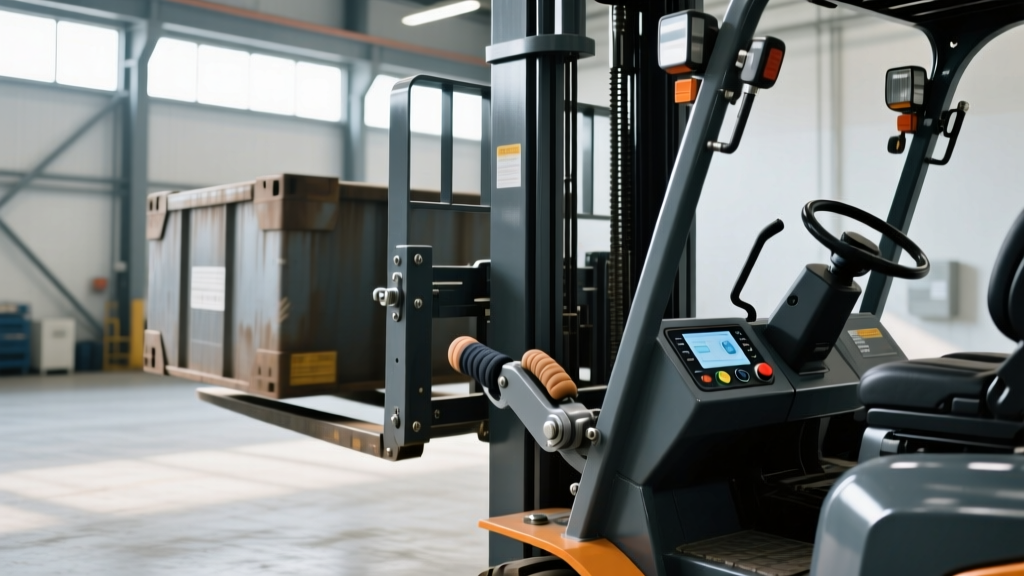
Specialized forklift attachments—such as rotating paper roll clamps, slip sheet handlers, and multi-pallet handlers—transform standard lift trucks into highly specialized ergonomic material handling equipment. By automating complex load manipulation, these attachments eliminate manual lifting and drastically reduce the risk of musculoskeletal disorders (MSDs). However, the ergonomic benefits are entirely dependent on the precision of the operator interface. When electrohydraulic joysticks, proportional control valves, and force-feedback sensors degrade, the equipment forces operators to compensate with awkward postures, excessive grip force, and repetitive micro-adjustments.
This guide provides advanced, component-level troubleshooting protocols for the control systems of specialized attachments. Restoring these systems to factory specifications is critical for maintaining their classification as effective ergonomic material handling equipment and preventing long-term operator injury.
⚠️ SAFETY PROTOCOL: Hydraulic Lockout & DepressurizationBefore troubleshooting any attachment control interface, you must eliminate stored hydraulic and electrical energy. Modern ergonomic attachments utilize accumulator circuits that retain pressure even when the forklift is off.
- Lower the attachment completely to the ground.
- Shut off the forklift engine and remove the key.
- Cycle the ergonomic joystick through all axes (forward, back, left, right, and auxiliary functions) for a minimum of 15 seconds to bleed residual pilot pressure.
- Disconnect the primary CANbus or wiring harness at the attachment junction box to prevent accidental solenoid actuation.
Diagnostic Matrix: Ergonomic Joystick and Valve Failures
Operator fatigue is rarely just a physical issue; it is often a symptom of failing control components. Use the following matrix to map operator complaints to specific mechanical or electrical faults within the attachment's control loop.
| Operator Symptom | Ergonomic Impact | Root Cause | Repair Action |
|---|---|---|---|
| Joystick requires excessive physical force to actuate | Wrist and forearm fatigue; increased grip strain | Mechanical binding in gimbal bearings or dried grease in detent mechanisms | Disassemble housing, clean with isopropyl alcohol, apply NLGI #2 lithium-complex grease |
| Delayed hydraulic response (lag) during clamping | Operator over-corrects, causing shoulder strain and cognitive load | PWM frequency mismatch or varnish buildup on proportional valve spool | Adjust PWM controller to 250Hz; flush and replace valve cartridge |
| Inconsistent or 'jerky' clamping pressure | Anxiety, visual strain from monitoring load stability | Failing pressure transducer or Hall-effect sensor drift in joystick | Replace transducer (e.g., Danfoss DST 460); recalibrate via CANbus diagnostic tool |
| Attachment drifts or creeps when joystick is neutral | Constant micro-adjustments required to hold load | Spool not returning to mechanical center due to weak centering spring | Replace centering spring kit; verify spool clearance is 3-5 microns |
| Loss of force-feedback in electronic joysticks | Loss of tactile awareness, leading to crushed loads | Blown haptic motor or corrupted CANbus J1939 profile | Check 120-ohm termination resistors; reflash joystick firmware |
Deep Dive: Resolving Proportional Valve Lag and Operator Fatigue
The core of any advanced ergonomic material handling equipment is its ability to translate minimal human input into precise, proportional hydraulic output. When a carton clamp (such as the Cascade 55F or 66F series) exhibits a 0.5-second lag between joystick movement and clamp pad engagement, the operator instinctively pushes the joystick further. This over-correction results in sudden, jerky movements that transmit shock loads through the operator's arm and spine.
Step 1: Inspect Spool Clearances and Fluid Viscosity
Proportional valves, like the Danfoss PVG 32 series commonly used in specialized attachments, rely on incredibly tight tolerances. The spool-to-bore clearance must remain between 3 and 5 microns. If the forklift's hydraulic fluid degrades and forms varnish, the spool will stick, causing the ergonomic lag.
- Test: Extract a fluid sample and test for ISO 4406 cleanliness. The target for proportional systems is 18/16/13 or better.
- Fix: If varnish is present, a simple fluid change is insufficient. Run a chemical flush using a solvency-based hydraulic cleaner for 4 hours at operating temperature (140°F - 160°F) before refilling with high-quality ISO VG 32 synthetic hydraulic fluid.
Step 2: Tune the PWM Controller
Proportional solenoids require a Pulse Width Modulation (PWM) signal with a specific dither (high-frequency vibration) to prevent the spool from sticking due to static friction. If the dither frequency drops, the joystick feels 'dead' in the center zone.
- Connect a digital multimeter with frequency measurement capabilities to the solenoid wiring harness.
- Actuate the joystick slightly past the deadband.
- Verify the PWM frequency. Most modern ergonomic attachment valves require a dither frequency between 50 Hz and 150 Hz.
- If the frequency is outside this range, access the forklift's proprietary diagnostic software (e.g., Cascade's eService or the OEM truck's CANbus interface) and recalibrate the PWM output to the attachment manufacturer's exact specification.
Many 2026-era forklifts allow operators to save custom ergonomic profiles via the dashboard touchscreen. If multiple operators share a truck, create distinct profiles. For example, an operator with a history of shoulder impingement may benefit from a profile that reduces the joystick's maximum throw angle by 20% while proportionally increasing the hydraulic flow gain, allowing full attachment function with significantly less physical arm movement.
Recalibrating Force-Feedback and Hall-Effect Joysticks
Advanced ergonomic material handling equipment utilizes non-contact Hall-effect sensors in joysticks (such as the Danfoss JS6000 series) to eliminate mechanical wear. However, these sensors can suffer from magnetic drift or wiring degradation, leading to 'phantom' movements where the attachment creeps without operator input.
Troubleshooting CANbus Communication Errors
When a Hall-effect joystick fails to register input, the issue is rarely the sensor itself; it is usually the CANbus J1939 network connecting the joystick to the attachment's ECU.
- Voltage Drop Test: Measure the voltage between the CAN High (CAN_H) and CAN Low (CAN_L) pins at the joystick connector. With the system active, you should see a differential voltage fluctuating around 2.0V to 3.0V. A flat 0V indicates a short, while a constant 5V indicates an open circuit.
- Termination Resistance: Power down the system and measure the resistance across CAN_H and CAN_L. The reading must be exactly 60 ohms (indicating two 120-ohm termination resistors in parallel). If you read 120 ohms, one terminator is missing or broken, causing signal reflection and erratic attachment behavior.
Maintenance Schedules for Ergonomic Attachment Interfaces
Preventative maintenance is the most cost-effective way to ensure forklift attachments continue to function as true ergonomic material handling equipment. Implement the following schedule based on operating hours.
| Interval | Component | Action Required | Estimated Cost (Parts) |
|---|---|---|---|
| 250 Hours | Joystick Gimbal & Boots | Inspect rubber boots for tears; clean gimbal with compressed air | $0 - $15 |
| 1,000 Hours | Proportional Valve Pilot Filters | Replace 10-micron pilot filters to protect spool clearances | $45 - $80 |
| 2,000 Hours | Hydraulic Fluid & Main Filters | Flush system, replace with ISO VG 32 synthetic, install new main filters | $250 - $400 |
| 5,000 Hours | Joystick Hall-Effect Module | Proactive replacement of joystick sensor module to prevent drift | $350 - $600 |
Cost-Benefit Analysis: Repair vs. Replace
When an ergonomic control interface fails, fleet managers must decide between rebuilding the component or replacing it outright. While replacing a complete ergonomic joystick assembly (e.g., a fully integrated Cascade or Bolzoni Auramo unit) can cost between $850 and $1,400, rebuilding the internal Hall-effect sensor and gimbal bearings typically costs under $400 in parts and 1.5 hours of labor. However, if the joystick housing is cracked or the CANbus pins are corroded beyond repair, immediate replacement is required to prevent moisture ingress, which will cause intermittent faults that are notoriously difficult to diagnose and severely impact operator morale.
References and Industry Standards
For further reading on the intersection of equipment design and operator health, consult the following resources:
- OSHA Ergonomics Guidelines for Manual Handling and Equipment Design - Provides foundational data on how equipment interface degradation contributes to workplace MSDs.
- NIOSH Research on Musculoskeletal Disorders in Material Handling - Details the biomechanical impact of delayed hydraulic responses on operator joints.
- Cascade Corporation Attachment Technical Manuals - Essential for sourcing exact PWM specifications and hydraulic flow schematics for specialized clamps and handlers.