Lift Assist Tech Specs Driving the Material Handling Equipment Market
Explore the technical specifications of ergonomic lift assists and IADs driving growth in the material handling equipment market. Compare servo vs pneumatic.
Musculoskeletal disorders (MSDs) account for over 30% of all warehouse and manufacturing lost-time injuries, costing facilities an average of $38,000 per incident in direct and indirect expenses. As facilities push for higher throughput, the material handling equipment market has pivoted aggressively from passive conveyance systems to active ergonomic assistance technologies. Modern lift assists are no longer simple mechanical counterweights; they are cyber-physical systems integrating closed-loop servo drives, fluid dynamics, and biomechanical feedback.
Market Shift: Ergonomics as a Technical Mandate
According to the CDC NIOSH Ergonomics Guidelines, the Recommended Weight Limit (RWL) for repetitive lifting under optimal conditions is 51 lbs. However, modern e-commerce fulfillment requires handling irregular loads up to 75 lbs at cycle times exceeding 400 picks per shift. This biomechanical deficit is the primary technical driver accelerating the adoption of Intelligent Assist Devices (IADs) and advanced vacuum lifters across the sector.
Servo-Driven Intelligent Assist Devices (IADs): Control Loop Mechanics
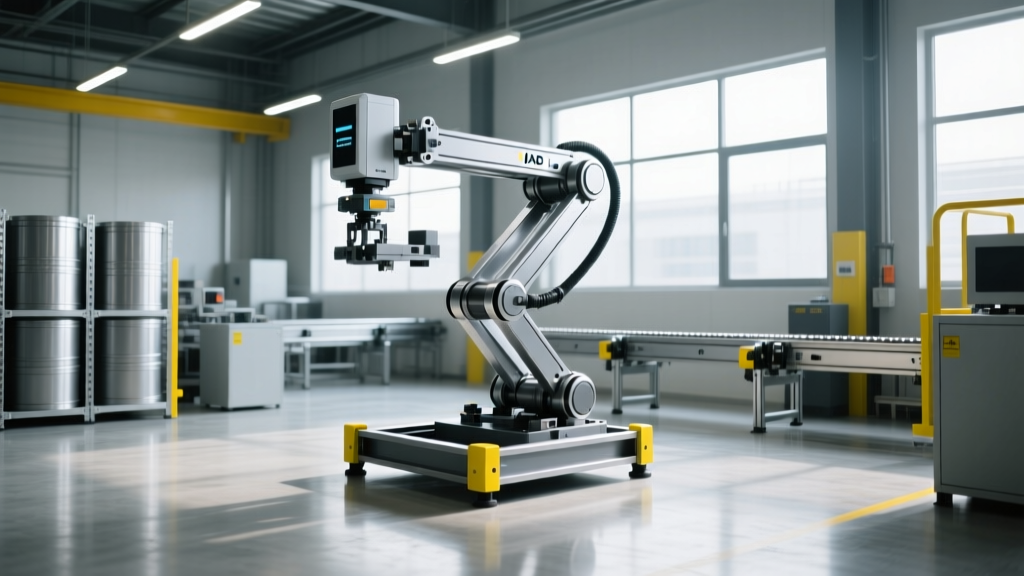
Intelligent Assist Devices, such as the Gorbel G-Force or Stanley Assembly Technologies' zero-gravity arms, utilize servo-motor technology to make heavy payloads feel virtually weightless. Unlike traditional air balancers that rely on fixed pneumatic pressure, IADs operate on a dynamic, software-defined control loop.
How the Sensor-to-Motor Pipeline Works
- Load Cell Sampling: A precision strain-gauge load cell situated at the end-effector continuously measures the downward force applied by the operator. High-end units sample at 1,000 Hz (1,000 times per second) with a resolution of 0.1 lbs.
- Algorithmic Interpretation: The onboard PLC interprets this force delta. If the operator pulls down with 2 lbs of force, the system calculates the required torque to move the specific payload mass at the requested acceleration.
- Servo Actuation: A brushless AC servo motor drives a ball screw or timing belt mechanism. The motor controller utilizes a 16-bit optical encoder to track position within 0.05mm, ensuring zero drift during suspended holds.
- Regenerative Braking: When the operator pushes the load upward or stops abruptly, the servo motor acts as a generator, feeding kinetic energy back into the system's capacitors while applying precise electromagnetic resistance to prevent load runaway.
Technical Specifications: IAD vs. Traditional Air Balancer
| Specification | Servo-Driven IAD (e.g., Gorbel G-Force) | Traditional Air Balancer |
|---|---|---|
| Payload Capacity | 35 lbs to 750 lbs (15 kg - 340 kg) | 10 lbs to 400 lbs (4.5 kg - 180 kg) |
| Lift Speed | Up to 150 ft/min (0.76 m/s) variable | Fixed, dependent on air volume |
| Positional Accuracy | ± 0.05 mm (Encoder feedback) | ± 15 mm (Pneumatic compressibility) |
| Power Requirement | 120V/240V AC, 15A dedicated circuit | 80-100 PSI clean, dry compressed air |
| Capital Cost Range | $18,000 - $34,000 per unit | $3,500 - $8,000 per unit |
Pneumatic Vacuum Lifters: Fluid Dynamics in Ergonomic Lifting
For facilities handling porous, fragile, or non-rigid goods (e.g., corrugated boxes, glass panes, rubber tires), servo-driven mechanical grippers are unviable. Here, the material handling equipment market relies on pneumatic vacuum tube lifters, such as the Schmalz Jumbo Ergo series. These devices merge lifting and gripping into a single continuous fluid-dynamic action.
The Venturi Effect and Vacuum Generation
Vacuum lifters do not use mechanical pumps. Instead, they utilize multi-stage Venturi ejectors. Compressed air (typically 80-100 PSI) is forced through a constricted nozzle, accelerating to supersonic speeds. This high-velocity air stream creates a low-pressure zone (vacuum) in the adjacent chamber, evacuating air from the suction cup and the connected lifting tube.
- Vacuum Thresholds: Safe lifting of standard corrugated cardboard requires maintaining a vacuum level of at least 600 mbar (approx. 17.7 inHg). Multi-stage ejectors achieve this threshold 30% faster than single-stage equivalents, reducing cycle drop-times.
- The Lifting Tube Mechanism: The lifting tube itself acts as a pneumatic cylinder. As vacuum increases, atmospheric pressure crushes the tube inward and upward, lifting the load. Releasing the vacuum via an exhaust valve allows the tube to expand and lower the load.
- Operator Ergonomics: The operator controls the vacuum level via a rotary paddle valve on the end-effector. This requires less than 2 lbs of finger force, completely eliminating wrist extension and grip strain associated with mechanical clamps.
When lifting recycled corrugated materials, micro-tears in the cardboard cause continuous vacuum leakage. If the facility's compressed air supply drops below 75 PSI, the multi-stage ejector cannot outpace the leak rate, resulting in a 'drop-on-fault'. Facilities must install inline vacuum switches set to trigger an acoustic alarm if vacuum levels fall below 550 mbar mid-cycle.
Passive Exoskeletons: Biomechanical Energy Storage
Where overhead gantries and floor-mounted lift arms restrict mobility, the market has introduced passive upper-body exoskeletons (e.g., SuitX ShoulderX or German Bionic Cray X). Unlike active exoskeletons that require battery-powered motors, passive units rely on mechanical potential energy storage.
These devices utilize elastomeric cords or gas springs routed across the shoulder joint. When the operator reaches upward (shoulder flexion past 60 degrees), the elastic elements stretch, storing kinetic energy. As the operator holds a 25 lb component overhead, the stored elastic potential energy exerts a counter-torque of up to 15 ft-lbs, effectively reducing the perceived weight of the object by 40-60% and shifting the load from the deltoid muscles to the device's waist belt and the operator's skeletal structure.
Decision Matrix: Selecting the Right Lift Assist by Application
Procurement teams must align technical specifications with specific operational constraints. Use this framework to specify the correct ergonomic technology:
| Application Scenario | Recommended Technology | Critical Technical Requirement |
|---|---|---|
| High-speed, repetitive loading of uniform 40 lb boxes onto pallets. | Pneumatic Vacuum Tube Lifter | Dual-circuit vacuum pads with check valves for instant release. |
| Precision mating of 150 lb machined engine blocks into assemblies. | Servo-Driven IAD (Float Mode) | Sub-millimeter positional accuracy and 'float' logic for zero-gravity maneuvering. |
| Overhead wiring harness installation in confined automotive bays. | Passive Shoulder Exoskeleton | Minimum 15 ft-lbs of assistive torque at 90-degree shoulder flexion; weight < 10 lbs. |
| Handling 50 lb bags of fine chemical powders (hazardous environment). | Explosion-Proof (ATEX) Air Balancer | Pneumatic-only actuation (no electrical sparks); stainless steel end-effectors. |
Regulatory Compliance and the NIOSH Lifting Equation
Integrating advanced lift assists directly impacts compliance with OSHA Ergonomics Guidelines. When engineering a material handling cell, safety teams must apply the NIOSH Lifting Equation to calculate the Lifting Index (LI).
If an operator lifts a 45 lb box from floor level (Vertical Multiplier = 0.78) with a 30-degree torso twist (Asymmetric Multiplier = 0.90), the NIOSH Recommended Weight Limit drops to approximately 28 lbs. The Lifting Index becomes 1.6 (45/28), indicating a high risk of lower back injury. By deploying a servo-driven IAD configured to support 80% of the static load, the operator's physical exertion drops to 9 lbs. The revised LI falls to 0.32, moving the task from the 'hazardous' red zone into the 'safe' green zone, thereby insulating the facility from regulatory citations and workers' compensation liabilities.
Specifying ergonomic material handling equipment requires moving beyond basic payload capacities. By evaluating sensor sampling rates, vacuum generation mechanics, and biomechanical torque profiles, facility engineers can deploy systems that not only protect the workforce but also eliminate the micro-delays inherent in manual load manipulation.