CPQ in Material Handling Equipment Manufacturing: Hoist Maintenance Schedules
Discover how CPQ in material handling equipment manufacturing automates custom hoist and winch maintenance schedules based on FEM/ISO duty classes.
When a manufacturer sells a highly customized overhead crane hoist or an industrial pulling winch, the aftermarket service contract is often an afterthought. Sales teams frequently attach generic, one-size-fits-all maintenance schedules to complex quotes, leading to over-servicing basic components and under-servicing critical load-bearing parts. Implementing advanced CPQ in material handling equipment manufacturing solves this disconnect by dynamically generating component-specific, usage-based maintenance schedules at the exact moment the equipment is configured and priced.
Modern Configure, Price, Quote (CPQ) platforms like Tacton, Salesforce CPQ, and Epicor are no longer just pricing calculators. They are rules-based engineering engines. For vertical material transport systems—where a failure can result in dropped loads and catastrophic facility damage—the ability to map specific hoist components, FEM/ISO duty classes, and environmental factors to precise service intervals is a massive competitive advantage. This guide details how manufacturers leverage CPQ logic to automate maintenance schedules for custom hoists and winches, ensuring compliance with OSHA 1910.179 standards while optimizing lifecycle service revenue.
The Disconnect Between Custom Sales and Aftermarket Service
Traditionally, a sales engineer configuring a 15-ton double-girder bridge crane hoist would select an H5-duty motor, a specific gearbox ratio, and 20mm wire rope. The CPQ would calculate the hardware price, but the service contract would default to a standard 'Annual Inspection' SKU.
This creates severe operational blind spots:
- Over-maintenance: Replacing gearbox oil on an H2 (light duty) hoist annually wastes capital and labor.
- Under-maintenance: An H5 (heavy duty) hoist operating in a steel mill requires wire rope magnetic particle inspections every 500 hours, not annually. Missing this interval violates ISO 4309:2017 discard criteria and risks catastrophic wire failure.
- Warranty Leakage: When customers follow generic schedules that do not match the actual configured duty class, manufacturers absorb the cost of premature component failures under warranty.
How CPQ Logic Maps Hoist Components to Service Intervals
To automate maintenance schedules, the CPQ engine must ingest the engineering rules governing hoist and winch lifecycles. This requires mapping the Bill of Materials (BOM) to a Service Bill of Materials (SBOM) using conditional logic tied to international standards like the FEM (Fédération Européenne de la Manutention) or CMAA (Crane Manufacturers Association of America) specifications.
FEM/ISO Duty Class Integration in CPQ
The CPQ system calculates the mechanism group (e.g., FEM 2m, 3m, or ISO M5, M6) based on the customer's stated load spectrum and operating hours. Once the CPQ assigns the duty class, it triggers specific maintenance rule sets:
- FEM 1Bm / 1Am (ISO M3/M4): Light duty. CPQ triggers standard 12-month visual inspections and 5-year gearbox oil sampling.
- FEM 2m / 3m (ISO M5/M6): Heavy/Continuous duty. CPQ triggers 3-month brake lining wear measurements, 6-month wire rope NDT (Non-Destructive Testing), and annual gearbox oil changes.
Component-Specific Maintenance Triggers in the CPQ Engine
A sophisticated CPQ implementation evaluates every selectable component on the hoist or winch and assigns a maintenance weight. Below is a matrix of how specific material handling components trigger automated service SKUs within the quoting engine.
| Configured Component | Engineering Parameter | CPQ Triggered Service Interval | Specific Maintenance Action |
|---|---|---|---|
| Wire Rope (6x36 WS Construction) | D/d Ratio < 20 | Every 500 Operating Hours | Magnetic Flux Leakage (MFL) testing for internal core degradation per ISO 4309. |
| Electromagnetic Disc Brakes | Holding Torque > 1500 Nm | Every 1,000 Cycles | Caliper air-gap measurement and friction lining thickness micrometry. |
| VFD (Variable Frequency Drive) | Enclosure Rating IP54 | Every 2,000 Hours | Cooling fan replacement, heat sink fin vacuuming, and DC bus capacitor ESR testing. |
| LeBus Grooved Winch Drum | Fleet Angle > 1.5° | Every 250 Hours | Drum groove wear profiling and wire rope scrubbing inspection. |
Environmental Overrides and Edge Cases
Hardware configuration is only half the equation. The environment in which the hoist or winch operates drastically alters maintenance requirements. Advanced CPQ systems utilize 'environmental multiplier' logic to adjust service intervals dynamically.
High-Heat Environments (Foundries and Forges)
If a sales engineer selects 'Foundry' as the operating environment in the CPQ, the system automatically applies a thermal degradation multiplier to the lubrication schedule. Standard synthetic polyurea grease degrades rapidly above 80°C (176°F). The CPQ logic overrides the standard 1,000-hour lubrication interval, replacing it with a 250-hour interval using high-temperature perfluoropolyether (PFPE) grease, and automatically adds the premium grease SKU to the service contract.
Corrosive Environments (Marine and Chemical Processing)
For winches deployed in offshore or chemical environments, the CPQ detects the selection of 316L stainless steel hardware or epoxy-coated components. It automatically schedules quarterly sacrificial anode inspections and adds bi-annual load cell recalibration to the service quote, as corrosive gases frequently degrade the strain gauges inside wireless load cells.
Differentiating Hoist vs. Winch Service Logic
While often grouped together, hoists (vertical lifting) and winches (horizontal/angled pulling) require entirely different maintenance philosophies. The CPQ must distinguish between the two to generate accurate schedules.
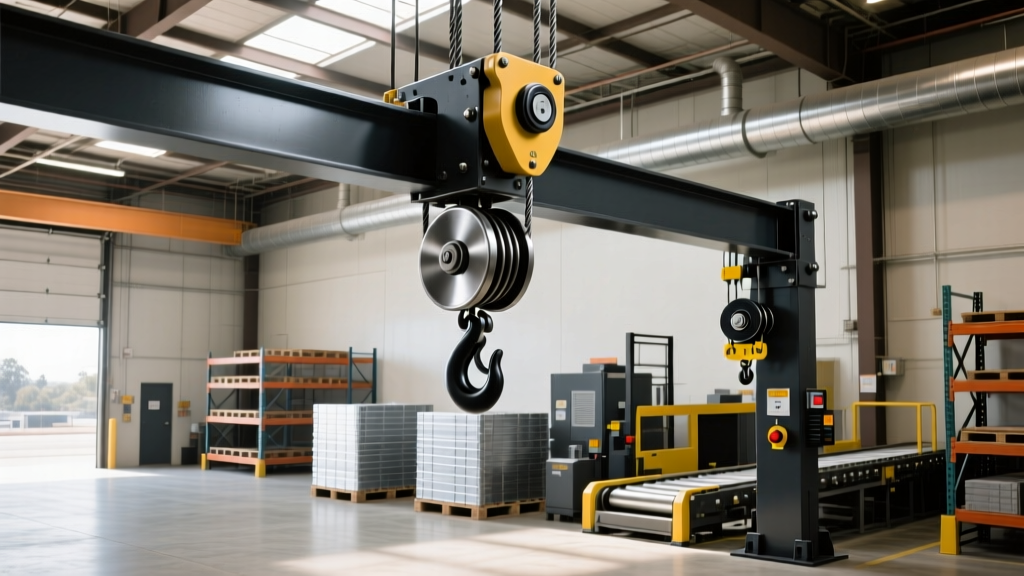
- Hoists (Suspended Loads): The primary failure mode is catastrophic brake failure or hook deformation. The CPQ prioritizes annual magnetic particle inspection (MPI) of the hook shank and weekly functional testing of the upper limit switch and secondary backup limit switch.
- Winches (Tension Pulling): The primary failure mode is drum crushing and wire rope bird-caging due to improper spooling under low-tension conditions. The CPQ logic for winches mandates the inclusion of a spooling assist device (like a cam follower) in the BOM and schedules bi-annual tension calibration of the level-wind mechanism.
The Financial Impact of Automated Service Schedules
Transitioning from generic service contracts to CPQ-generated, component-specific schedules yields measurable financial benefits for both the manufacturer and the end-user. By aligning CMAA specification requirements directly with the quoted service agreement, manufacturers eliminate scope creep and warranty disputes.
Cost Analysis: Generic vs. CPQ-Optimized Service Contracts
Scenario: 20-Ton H5-Duty Overhead Hoist in an Automotive Stamping Plant.
- Legacy Generic Contract: Priced at $14,500/year. Includes quarterly visual inspections and annual oil changes. Result: VFD cooling fans fail at month 8 due to stamping dust, causing $45,000 in unplanned line downtime. Manufacturer absorbs $6,000 in warranty dispute costs.
- CPQ-Optimized Contract: Priced at $11,200/year. CPQ logic detects the 'stamping/automotive' environment and H5 duty class. It removes unnecessary annual oil changes (sealed gearbox) but adds bi-monthly VFD filter replacements and 500-hour brake gap checks. Result: Zero unplanned downtime. Customer saves $3,300 in contract costs; manufacturer increases service margin by 18% due to precise labor routing.
Integrating CPQ with Enterprise CMMS Platforms
The ultimate value of generating maintenance schedules within the CPQ is realized when that data flows seamlessly into the customer's Computerized Maintenance Management System (CMMS) like IBM Maximo, Fiix, or UpKeep. Modern material handling CPQ architectures utilize REST APIs to push the configured Service BOM directly into the CMMS upon contract signature.
This means the moment the customer signs the quote for a custom 5-ton jib crane winch, the CMMS automatically generates the work orders for the first year of service, complete with the exact part numbers for the specific electromagnetic brake linings and the precise torque specifications for the drum mounting bolts. This eliminates manual data entry errors and ensures the maintenance team is executing the exact schedule engineered for that specific machine.
Summary of Implementation Requirements
To successfully deploy CPQ-driven maintenance scheduling for hoists and winches, material handling manufacturers must:
- Audit Engineering Rules: Map every configurable component to its specific FEM/ISO duty class and environmental degradation curve.
- Standardize Service SKUs: Break down monolithic 'Annual Service' SKUs into granular, modular service tasks (e.g., 'Wire Rope MFL Testing', 'VFD Filter Replacement').
- Implement API Integrations: Connect the CPQ output to ERP and CMMS platforms to automate work order generation.
By embedding maintenance logic directly into the sales configuration process, manufacturers transform aftermarket service from a reactive cost center into a proactive, highly engineered value proposition.