Best Bulk Material Handling Equipment for Wastewater Treatment: Ergonomic Lift Assists
Technical specifications and operating principles of ergonomic lift assists and vacuum hoists for handling bulk FIBC chemicals in wastewater treatment.
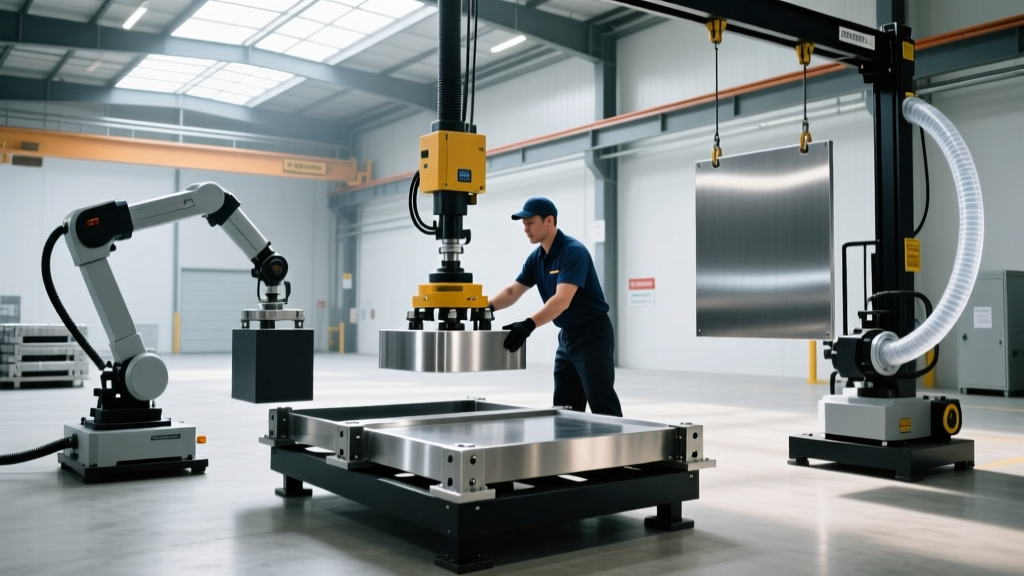
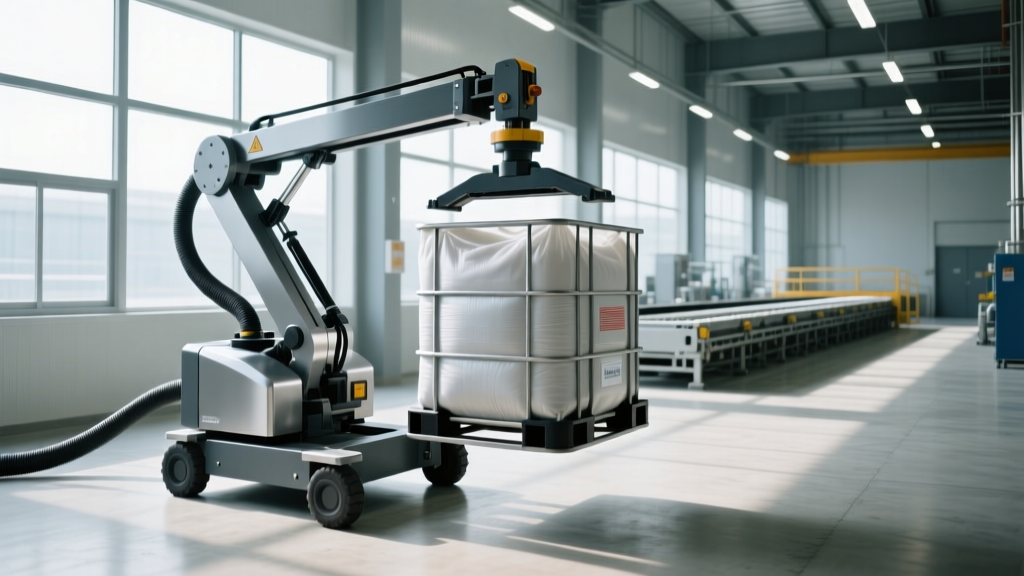
Wastewater treatment facilities process millions of gallons of influent daily, relying on precise chemical dosing to achieve effluent compliance. While massive screw conveyors and progressive cavity pumps dominate the sludge-handling side of the plant, the best bulk material handling equipment for wastewater treatment also encompasses the ergonomic lift assists required to safely load 2,000-lb Flexible Intermediate Bulk Containers (FIBCs) of flocculants, coagulants, and powdered activated carbon (PAC) into day hoppers. Manual handling of these bulk bags violates fundamental biomechanical limits and risks catastrophic musculoskeletal disorders (MSDs). This technical guide details the operating principles, specifications, and environmental hardening required for ergonomic lift assist devices in modern wastewater chemical handling applications.
The Biomechanical Reality of FIBC Chemical Handling
Dry polymers (polyacrylamide) and metallic salts (alum, ferric chloride) are frequently delivered to wastewater plants in FIBCs ranging from 1,000 to 3,000 lbs. According to the CDC/NIOSH Ergonomics Guidelines, the recommended weight limit for manual lifting under optimal conditions is 51 lbs. Attempting to manually guide a suspended 2,000-lb bulk bag into a discharge hopper spout generates immense shear force on the operator's lumbar spine and rotator cuffs. Furthermore, OSHA Standard 1910.176 mandates that mechanical handling equipment must be utilized to prevent injuries associated with manual material handling. Ergonomic lift assists bridge the gap between heavy overhead cranes (which lack precision) and manual labor, providing 'zero-gravity' float modes that allow a single operator to guide massive bulk bags with less than 5 lbs of lateral force.
Technical Breakdown: Pneumatic Balancers vs. Servo-Driven IADs
When specifying lift assists for bulk bag discharge stations, engineers typically choose between traditional pneumatic balancers and modern Intelligent Assist Devices (IADs). Both achieve weightlessness, but their underlying actuation and control logic differ drastically.
Core Operating Principle: Pneumatic balancers use a precision air regulator and a diaphragm cylinder to counteract gravity. IADs use a servo-motor driven winch paired with a high-frequency load cell to digitally calculate and apply the exact counter-torque required to neutralize the payload's mass.| Specification | Pneumatic Balancer (e.g., Zimmerman/Ingersoll Rand style) | Servo-Driven IAD (e.g., Gorbel G-Force style) |
|---|---|---|
| Max Capacity | Up to 600 lbs (Standard) / 2,200 lbs (Heavy Duty) | Up to 2,000 lbs per axis |
| Actuation Medium | Clean, Dry Air (CDA) at 80-100 PSI | 230V/460V 3-Phase Electrical |
| Control Logic | Analog mechanical valve & diaphragm | Digital servo-drive with 1000Hz load-cell polling |
| Vertical Speed | Up to 150 FPM (unloaded) | Up to 200 FPM (variable based on operator input) |
| Precision Docking | Moderate (requires operator feathering) | High (sub-millimeter stop accuracy) |
| Estimated 2026 Cost | $4,500 - $8,500 | $18,000 - $35,000 |
For high-volume polymer make-down systems where FIBCs are swapped every 45 minutes, the digital precision of an IAD reduces hopper-spout alignment time by up to 40%. However, for remote lift stations or grit handling buildings where electrical infrastructure is limited, pneumatic balancers remain the standard due to their intrinsic explosion-proof nature and reliance on plant air.
How Vacuum Tube Lifters Achieve Float Mode for Bulk Bags
Vacuum tube lifters operate on a fundamentally different principle than mechanical hoists. A central vacuum pump (typically a dry rotary vane or side-channel blower) generates a continuous vacuum of -600 to -800 mbar. The lifting tube itself acts as both the suspension member and the pneumatic cylinder. When the end-effector seals against the FIBC's surface or a dedicated lifting plate, the vacuum draws the internal piston upward, lifting the bag.
The 'float mode' is achieved via a manual or pneumatic control valve that bleeds ambient air into the tube, reducing the vacuum level just enough to lower the bag, or restricts airflow to raise it. Critical Edge Case: Standard FIBCs are woven from porous polypropylene. Vacuum lifters cannot seal directly to the fabric. Engineers must specify FIBCs with integrated, non-porous PVC lifting plates, or utilize a mechanical spreader-bar end-effector combined with a secondary vacuum cup for dust-containment docking.
Environmental Hardening: Combating H2S and Corrosive Aerosols
Wastewater environments are aggressively hostile to precision mechanical equipment. Hydrogen sulfide (H2S) gas, prevalent in headworks and sludge dewatering buildings, causes sulfide stress cracking in standard carbon steel and brass components. Simultaneously, aerosolized sodium hypochlorite and ferric chloride accelerate pitting corrosion.
WARNING: Never deploy standard powder-coated carbon steel lift assists in chemical storage rooms adjacent to sludge processing. The H2S will penetrate micro-fissures in the paint, leading to catastrophic structural failure of the lifting mast within 18 to 24 months.To ensure longevity, specify the following material and ingress protection (IP) standards for wastewater lift assists:
- Structural Components: 316L stainless steel masts and booms. The molybdenum content in 316L provides superior resistance to chloride pitting compared to 304 SS.
- Pneumatic Valves & Regulators: Anodized aluminum with Halar (ECTFE) or PTFE internal coatings to resist acidic off-gassing.
- Electrical Enclosures (for IADs): NEMA 4X rated enclosures with IP67 sealed servo motors to withstand high-pressure washdowns and corrosive humidity.
- Static Dissipation: When handling dry polymers, friction generates static electricity. Specify Type C (conductive) or Type D (dissipative) FIBCs, and ensure the lift assist features a continuous copper grounding braid from the end-effector to the facility ground bus to prevent electrostatic discharge (ESD) events.
End-Effector Engineering for FIBC Spout and Loop Handling
The interface between the lift assist and the bulk bag dictates the ergonomic success of the operation. Standard bag-loop hooks force the operator to reach high and stretch, negating the ergonomic benefits of the lifter. Instead, specify pneumatic bag-loop grippers. These devices feature four pneumatically actuated fingers that simultaneously engage all four FIBC loops at waist height. Once engaged, the operator uses a low-force toggle switch to tension the loops, lifting the bag and automatically deploying a spreader frame that keeps the bag's top open and taut for seamless docking into the bulk bag discharger's dust-tight containment ring.
Sizing the Air Supply and Preventing Pressure Drop
Pneumatic lift assists are highly sensitive to air supply quality and volume. A common failure mode in wastewater plants is 'load sag,' where the balancer slowly lowers a suspended FIBC. This is rarely a mechanical failure; it is almost always a pressure drop caused by undersized supply lines or saturated filters.
- Calculate CFM Requirements: A 2,000-lb capacity pneumatic balancer requires approximately 25 to 35 SCFM (Standard Cubic Feet per Minute) during active lifting. Ensure the plant air compressor and localized receiver tank can sustain this draw without dropping below 85 PSI.
- Line Sizing: Do not use standard 1/4-inch quick-connect fittings. The supply drop from the main header to the balancer must be a minimum of 1/2-inch inner diameter (ID) polyurethane or stainless steel tubing to prevent flow restriction.
- FRL Sizing: Install a dedicated Filter-Regulator-Lubricator (FRL) unit at the tool. Use a 5-micron coalescing filter to strip moisture and oil aerosols. Moisture in the air line will destroy the precision diaphragm inside the balancer's control valve, leading to erratic float-mode behavior.
'The true measure of bulk material handling equipment in a wastewater facility is not just its peak lifting capacity, but its ability to maintain precision and ergonomic neutrality after 10,000 cycles in a corrosive, high-humidity environment.' — Industrial Ergonomics Engineering Standard
By matching the exact actuation technology (pneumatic vs. servo) to the facility's utility infrastructure, and rigorously specifying 316L materials and static-dissipative end-effectors, plant engineers can eliminate MSD risks while ensuring decades of reliable chemical dosing operations.