How Smart Forklift Attachments Change the Way Material Handling Equipment Is Used
Discover how IoT sensors, automated quick-hitches, and RFID forks are transforming the material handling equipment used in modern warehouses.
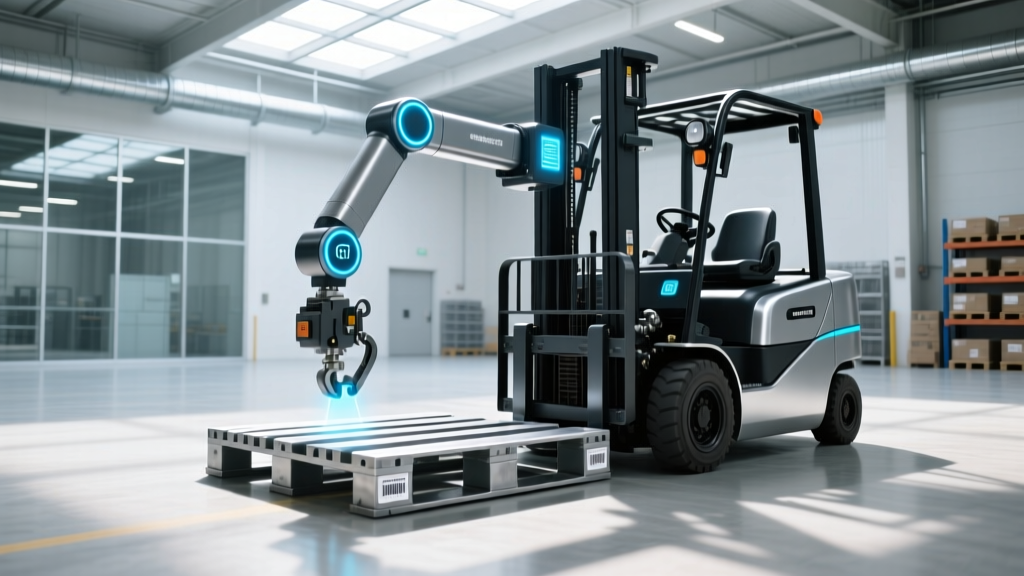
The modern forklift is no longer just a mechanical lifting device; it is a mobile data-gathering node and a highly adaptable robotic platform. When evaluating the material handling equipment used across global supply chains in 2026, the forklift attachment has emerged as the primary vector for technological innovation. Fleet managers are moving away from static, single-purpose iron and investing in mechatronic attachments that integrate directly with warehouse management systems (WMS) and vehicle telematics.
Key Industry Insight: Transitioning from standard mechanical forks to IoT-enabled smart attachments increases upfront capital expenditure by 35% to 50%. However, telemetry data from early adopters shows this investment reduces product damage claims by up to 62% and cuts attachment-swap downtime by 88%.Telematics-Enabled Clamps and Dynamic Force Sensing
Historically, carton clamps and paper roll clamps relied on manual hydraulic pressure adjustments. An operator handling fragile corrugated packaging had to manually dial down the hydraulic pressure to prevent crushing, often resulting in dropped loads if the pressure was set too low. Today, smart attachments utilize proportional pressure relief valves and integrated load-sensing technology.
The Mechanics of Smart Clamping
Advanced models, such as those developed by leading attachment manufacturers, feature built-in hydraulic pressure transducers. These sensors read the resistance of the load in real-time. When clamping a standard pallet of electronics, the system might automatically cap the clamping force at 1,200 PSI. If the operator switches to handling dense appliance boxes, the system dynamically scales the pressure up to 2,500 PSI. This dynamic force adjustment is transmitted via the forklift’s CAN bus to the central telematics dashboard, allowing fleet managers to audit clamping forces and identify operators who routinely override safety parameters.
- Standard Mechanical Clamps: Apply a blanket hydraulic pressure (typically 2,000 - 2,800 PSI), requiring manual gauge adjustments.
- Smart Sensor Clamps: Utilize closed-loop hydraulic feedback to maintain optimal grip force between 800 PSI and 2,800 PSI, adjusting in milliseconds.
Automated Quick-Hitch Systems: Eliminating the Downtime Bottleneck
One of the most significant inefficiencies in the material handling equipment used in multi-purpose yards is the time lost swapping attachments. Manually removing a pallet fork carriage and pinning on a bale clamp requires a second worker, a hammer, and 15 to 20 minutes of lost productivity. Automated hydraulic quick-hitch systems have entirely re-engineered this process.
Modern automated couplers utilize a hydraulic locking pin mechanism operated directly from the cab. The operator drives up to the new attachment, engages the hydraulic locking sequence via a dashboard toggle, and the system automatically secures the upper and lower carriage hooks. Simultaneously, a multi-coupler hydraulic block connects up to four auxiliary hydraulic lines and a 12-pin electrical connector in a single motion. The entire swap takes less than 45 seconds, and the forklift’s digital display automatically recognizes the new attachment via RFID tags embedded in the hitch, instantly updating the digital load chart.
RFID and Weigh-Scale Forks: Real-Time Inventory Tracking
Integrating weighing and identification directly into the forks eliminates the need for secondary floor scales and manual barcode scanning. Weigh-scale forks utilize high-precision strain-gauge load cells machined directly into the steel shank of the fork.
| Feature | Standard Mechanical Forks | RFID & Weigh-Scale Smart Forks |
|---|---|---|
| Weight Accuracy | N/A (Requires floor scale) | +/- 0.5% (Legal-for-trade options available) |
| Data Transmission | None | Bluetooth Low Energy (BLE) / Wi-Fi 6 |
| Environmental Rating | N/A | IP69K (High-pressure steam washdown) |
| Average Unit Cost | $600 - $1,200 | $4,500 - $8,200 |
| Maintenance Interval | Annual wear inspection | Bi-annual sensor calibration |
By pairing weigh-scale forks with an integrated RFID antenna in the carriage, a forklift can pick up a pallet, weigh it to verify the shipment against the bill of lading, and scan the pallet’s RFID tag simultaneously. This data is pushed via Wi-Fi 6 directly to the WMS, confirming the pick and updating inventory levels before the truck even reaches the loading dock.
OSHA Compliance and the Telematics Advantage
Safety regulations strictly govern how attachments alter a forklift's operational limits. According to OSHA's standard for powered industrial trucks (1910.178), any modification or addition that affects capacity and safe operation must be approved by the manufacturer, and the truck must be marked accordingly. In the past, this meant physically swapping out the metal data plate on the forklift mast every time an attachment was changed—a step frequently ignored in busy warehouses, leading to dangerous tip-over scenarios.
“The integration of attachment-recognition software via the J1939 CAN bus protocol ensures that the moment a smart attachment is locked onto the carriage, the forklift’s electronic control unit (ECU) automatically derates the maximum lift capacity and adjusts the center-of-gravity calculations on the operator’s digital display.”
This digital compliance ensures that the material handling equipment used on the floor is always operating within its engineered safety envelope, drastically reducing the risk of catastrophic tip-overs caused by unapproved or uncalculated attachment swaps.
Electrical and Hydraulic Compatibility Matrix
Retrofitting an existing fleet with smart attachments requires more than just sliding the forks onto the carriage. Facility engineers must verify the following baseline requirements before procuring IoT-enabled attachments:
- Hydraulic Flow and Spool Valves: Standard forklifts come with a 2-spool valve (lift and tilt). Smart attachments like rotating paper roll clamps or automated quick-hitches require a minimum 3-spool or 4-spool valve setup delivering at least 15 GPM (gallons per minute) at 3,000 PSI.
- Auxiliary Electrical Power: Sensors and RFID readers require dedicated 12V or 24V DC power. The forklift must have an auxiliary power take-off (PTO) or a dedicated step-down converter to prevent parasitic drain on the vehicle’s primary battery.
- CAN Bus Protocol: To transmit load data to the forklift’s dashboard, the attachment’s microcontroller must speak the same language as the forklift’s ECU. In 2026, the SAE J1939 protocol is the industry standard for internal combustion and heavy electric lifts, while smaller electric pallet jacks may rely on proprietary CANopen networks.
Cost vs. ROI Breakdown for Fleet Upgrades
While the initial capital outlay for smart attachments is substantial, the return on investment is highly measurable. Consider a 50-truck fleet operating in a beverage distribution center.
The Financial Impact
- Elimination of Floor Scales: Removing four in-ground floor scales saves approximately $45,000 in annual maintenance, calibration, and pit-cleaning costs.
- Labor Reallocation: Weigh-scale forks eliminate the need for a dedicated check-weigher stationed at the loading dock. Reallocating that labor saves roughly $52,000 annually in wages and benefits.
- Damage Reduction: Dynamic force-sensing clamps reduce crushed corrugated packaging incidents. For a mid-sized distributor, this translates to $20,000 to $35,000 in saved product loss and customer chargebacks per year.
According to data published by the Material Handling Industry (MHI), fleets that fully integrate telematics with their attachments see a complete ROI on the attachment premium within 9 to 14 months. The modern approach to specialized material handling dictates that the attachment is no longer an afterthought; it is the critical interface between the machine, the payload, and the digital supply chain.