Applying Material Handling Principles: Benefits & Equipment for Dock Levelers
Compare hydraulic, mechanical, and air dock levelers. See how applying material handling principles benefits equipment selection for loading bays.
The Loading Dock: High-Risk, High-Throughput Bottleneck
The loading dock is the highest-risk, highest-bottleneck zone in any distribution center. A single miscalculated dock leveler specification can result in forklift axle fatigue, product damage from severe impact gradients, or catastrophic trailer separation incidents. According to OSHA Warehouse Safety Guidelines, loading docks account for a disproportionate percentage of material handling injuries, often stemming from improper equipment alignment and degraded leveling infrastructure.
Selecting the right dock leveler is not merely a purchasing decision; it is an engineering imperative. Applying foundational material handling principles benefits equipment longevity, operator safety, and overall facility throughput. This analysis breaks down the technical specifications, cost structures, and operational limits of the four primary dock leveler alternatives available for modern loading bays.
Core Comparison Matrix: Dock Leveler Alternatives
Before examining specific mechanical designs, it is critical to understand the baseline performance metrics across the four dominant leveler categories. The table below outlines real-world capital expenditure (CapEx) and operational limits for standard 8x8 ft and 8x10 ft configurations.
| Leveler Type | Estimated CapEx (8x10 ft) | Max Dynamic Capacity | Maintenance Intensity | Optimal Application |
|---|---|---|---|---|
| Hydraulic | $4,500 - $7,200 | 50,000 - 80,000 lbs | Low (Annual fluid/seal checks) | High-volume, heavy forklift traffic |
| Mechanical (Spring) | $2,800 - $4,000 | 30,000 - 50,000 lbs | Medium (Spring tension adjustments) | Medium-volume, budget-constrained bays |
| Air-Powered | $3,200 - $4,800 | 30,000 - 50,000 lbs | Low-Medium (Airbag inspections) | Facilities avoiding hydraulic fluid risks |
| Edge-of-Dock (EODL) | $900 - $1,600 | 15,000 - 20,000 lbs | Low | Light-duty, strict 5-inch height variance |
Hydraulic Dock Levelers: The Heavy-Duty Standard
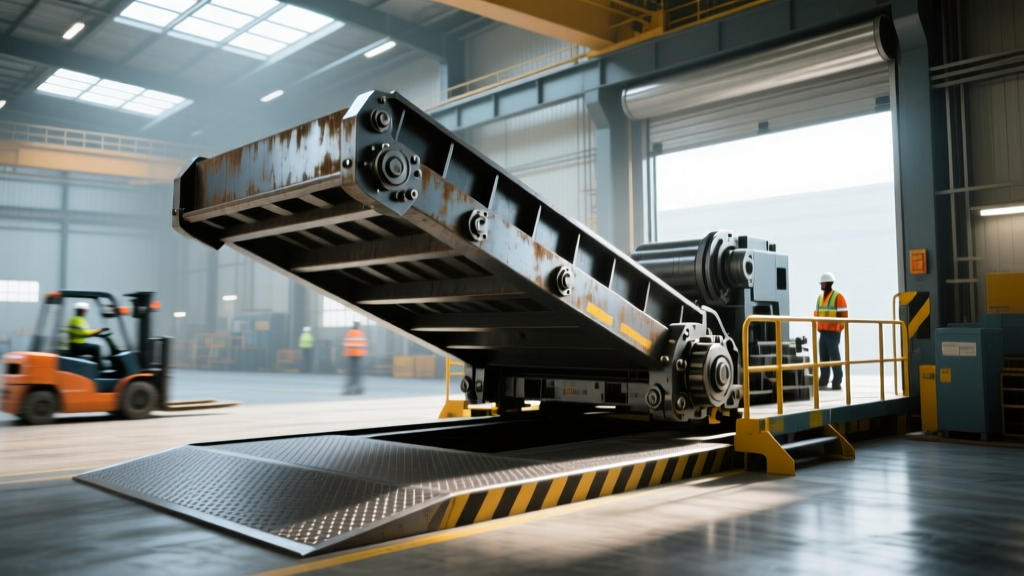
For facilities running multi-shift operations with 8,000 lb to 15,000 lb forklifts, hydraulic dock levelers remain the undisputed industry standard. Brands like Rite-Hite and Blue Giant engineer these units with high-yield steel decks and heavy-duty hydraulic cylinders that push the leveler lip outward and upward.
Technical Specifications & Edge Cases
- Deck Yield Strength: Premium models utilize steel with a minimum yield strength of 50,000 PSI, while heavy-duty variants (designed for 80,000 lb capacities) use 80,000 PSI steel to prevent permanent deck deflection under concentrated forklift axle loads.
- Lip Thickness: Standard lips are 5/8-inch thick. For facilities utilizing heavy clamp trucks or laden 15,000 lb forklifts, specifying a 3/4-inch or 1-inch thick lip is non-negotiable to prevent lip cracking at the hinge joint.
- Power Unit Placement: Remote power units mounted on the dock wall are vastly superior to integrated pit-mounted units. Pit-mounted units are exposed to moisture, debris, and snowmelt dripping from trailers, leading to premature electrical and hydraulic failures.
Mechanical and Air-Powered Alternatives
Not every loading bay justifies the electrical and hydraulic infrastructure required for a hydraulic leveler. Mechanical and air-powered alternatives offer distinct advantages for specific operational profiles.
Mechanical (Spring-Assisted) Levelers
Mechanical levelers rely on a heavy-duty torsion spring system to counterbalance the weight of the deck. The operator uses a pull-chain to release the hold-down mechanism, allowing the spring to push the deck upward. The Drawback: The operator must physically walk out onto the deck to push the lip down onto the trailer bed. This introduces a slip-and-fall hazard, particularly in icy or wet conditions. Furthermore, the torsion springs require bi-annual tension adjustments by a certified technician; failure to do so results in the deck slamming down violently when released.
Air-Powered Levelers
Air-powered levelers (such as those manufactured by Pentalift) replace the hydraulic cylinder with a high-pressure, reinforced fabric airbag connected to the facility's compressed air system or a dedicated low-pressure blower motor. The Advantage: They completely eliminate the risk of hydraulic fluid leaks contaminating food-grade or pharmaceutical loading bays. The Drawback: The airbags are susceptible to degradation from UV exposure, ozone, and physical punctures from debris trapped in the pit. They generally max out at 50,000 lbs dynamic capacity, making them unsuitable for extreme heavy-duty applications.
Edge-of-Dock Levelers (EODLs): The Budget Compromise
Edge-of-dock levelers are surface-mounted units that do not require a concrete pit. They are hinged directly to the exterior dock wall. While they drastically reduce initial construction costs, their operational limitations are severe.
EODLs are strictly limited to a maximum height differential of 5 inches above or below the dock height. If your facility receives a mix of standard 53-foot dry vans (bed height ~50 inches) and step-vans or box trucks (bed height ~36 inches), an EODL will physically fail to bridge the gap, rendering the bay useless for smaller vehicles.
Furthermore, EODLs lack the structural mass to absorb the repeated impact of heavy forklifts. According to the National Safety Council's material handling guidelines, repeated impact shocks on undersized leveling equipment accelerate forklift transmission wear and cause operator back injuries. EODLs should only be specified for light-duty applications utilizing manual pallet jacks or lightweight electric walkie-riders.
Critical Pit Sizing Warning: A common and costly construction error is pouring a concrete pit that exactly matches the leveler width (e.g., an 8-foot wide pit for an 8-foot wide leveler). Standard pit width should be 8 feet, but the actual steel leveler should be ordered at 7 feet 8 inches wide. This leaves a 2-inch concrete curb on either side to protect the leveler hinges and hydraulic lines from forklift tire shear.Decision Framework: Specifying the Right Equipment
Use the following diagnostic framework to align your facility's operational reality with the correct dock leveler alternative:
- IF your facility processes >50 trailers per day, utilizes forklifts >8,000 lbs, or operates in a cold-chain environment THEN specify a Hydraulic Leveler with a 3/4-inch lip, remote wall-mounted power unit, and integrated velocity guard valve.
- IF your facility handles food, pharmaceuticals, or clean-room products where hydraulic oil contamination is a critical risk THEN specify an Air-Powered Leveler with a dedicated, filtered blower motor.
- IF you are retrofitting an older warehouse with zero existing pit infrastructure and only receive uniform 53-foot dry vans THEN specify an Edge-of-Dock Leveler, but restrict bay usage to lightweight electric pallet jacks.
- IF capital expenditure is strictly capped and you have a dedicated maintenance team capable of bi-annual spring calibrations THEN specify a Mechanical Leveler, but mandate strict PPE and anti-slip protocols for operators deploying the lip.
Beyond the Leveler: Integrated Loading Bay Safety
A dock leveler does not operate in a vacuum. To fully realize the safety and throughput benefits of modern material handling equipment, the leveler must be integrated with a vehicle restraint system (dock lock). Relying solely on wheel chocks is a proven failure point; trailer creep and aggressive early departures cause hundreds of incidents annually. Specifying a hydraulic leveler with an integrated, interlocked vehicle restraint ensures the leveler cannot be operated until the trailer's rear impact guard (ICC bar) is securely captured, closing the loop on loading dock safety.