2026 Trends in Equipment for Material Handling in Semiconductor Fabs
Explore 2026 innovations in cleanroom equipment for material handling. Discover AMHS, OHT systems, and ISO-certified tech for semiconductor fabs.
The Physics of ISO Class 1: Why Standard Automation Fails
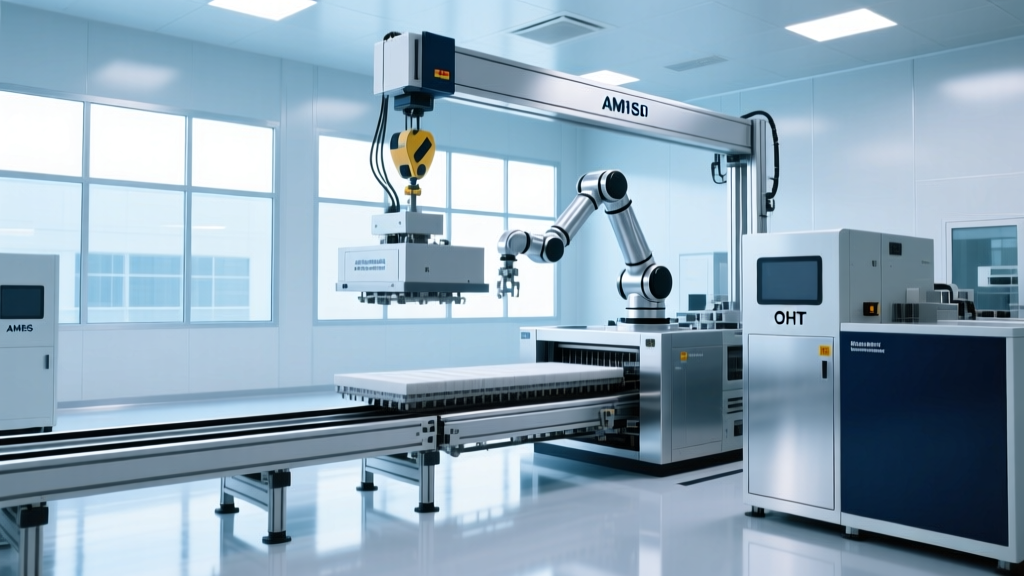
Sub-3nm semiconductor manufacturing demands absolute environmental control. A single 0.05-micron particle can destroy a multi-million-dollar EUV (Extreme Ultraviolet) reticle or ruin an entire 300mm wafer lot. Consequently, the equipment for material handling in semiconductor fabs has evolved from simple conveyance to highly integrated Automated Material Handling Systems (AMHS). In 2026, leading-edge fabs processing advanced nodes rely on AI-orchestrated Overhead Hoist Transport (OHT) networks and nitrogen-purged Front Opening Unified Pods (FOUPs) to maintain ISO Class 1 cleanliness while navigating up to 400,000 daily moves across a single facility.
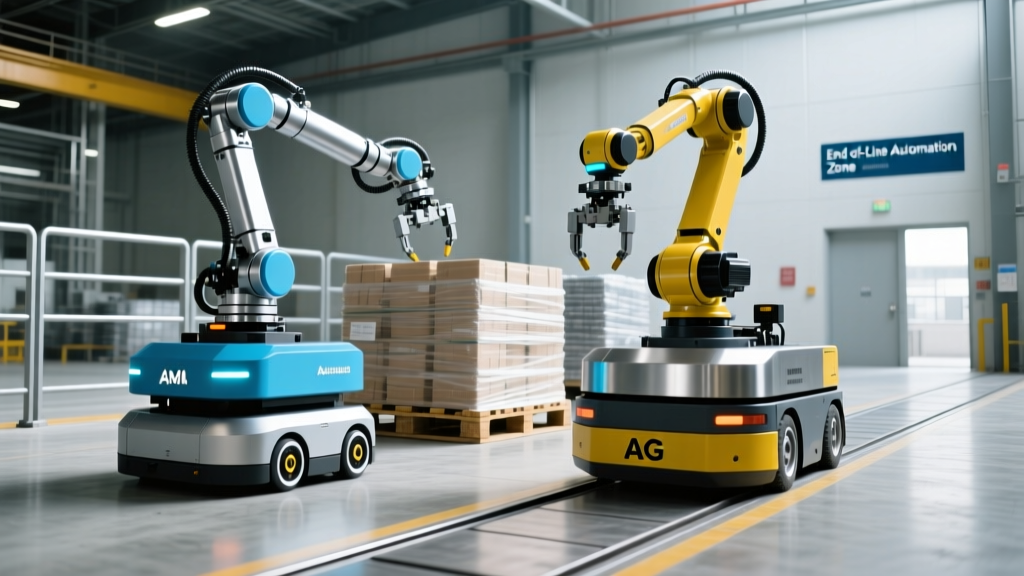
Standard warehouse automation relies on rubber-tired AGVs and exposed gear drives, which shed millions of micro-particles per minute. Cleanroom handling requires specialized tribology. Wheel compounds must utilize non-outgassing polyurethanes or PEEK (polyether ether ketone), and drive trains must be magnetically coupled or sealed to prevent lubricant vaporization. The baseline requirement for ISO Class 1 (per ISO 14644-1) permits a maximum of 10 particles per cubic meter at the 0.1-micron size threshold. Achieving this while moving 25-pound FOUPs at 3 meters per second requires engineering precision that pushes the boundaries of modern robotics.
2026 AMHS Key Metrics for 2nm Fabs:• Daily Moves: 350,000 - 500,000 per facility
• OHT Fleet Size: 1,800 - 2,500 vehicles per fab
• Track Length: 15 - 25 kilometers of overhead rail
• Capital Expenditure: $180M - $250M per AMHS deployment
Overhead Hoist Transport (OHT): The 2026 Standard for Advanced Nodes
While ground-based cleanroom AGVs are still utilized in legacy 200mm fabs and packaging/test areas, Overhead Hoist Transport (OHT) is the undisputed standard for 300mm and next-generation 450mm-ready front-end manufacturing. By moving payload traffic to the ceiling, OHT systems eliminate floor-space congestion, reduce human-vehicle interaction risks, and drastically minimize floor-level particle disturbance.
The primary technical battleground in 2026 OHT design is the drive mechanism. Traditional friction-drive OHTs use Kevlar-reinforced belts pressing against the aluminum rail. While reliable, the micro-abrasion generates trace particulate matter. The latest generation of OHTs from manufacturers like Daifuku and Muratec utilize Linear Induction Motors (LIM) or permanent magnet synchronous linear motors. These zero-contact drive systems eliminate friction-based particle generation entirely. However, they introduce a new challenge: electromagnetic interference (EMI). Advanced metrology tools and electron microscopes are highly sensitive to magnetic flux. Therefore, 2026 LIM-OHT vehicles require advanced mu-metal shielding and active flux-cancellation algorithms to ensure the magnetic field does not disrupt the lithography steppers below.
| System Type | Particle Generation | Vibration Profile | Spatial Footprint | Est. Cost per Vehicle |
|---|---|---|---|---|
| Friction-Drive OHT | Moderate (Belt wear) | Low-Medium | Overhead | $75,000 - $90,000 |
| Linear Motor OHT | Near Zero | Ultra-Low | Overhead | $110,000 - $140,000 |
| Cleanroom AGV | Low (Wheel shedding) | High (Floor coupling) | Floor-level | $150,000 - $200,000 |
| Rail-Guided Vehicle | Low | Medium | Floor-level (Fixed) | $90,000 - $120,000 |
FOUP Micro-Environments: Beyond Basic Particle Containment
The Front Opening Unified Pod (FOUP) is not merely a box; it is a mobile cleanroom. In 2026, managing Airborne Molecular Contamination (AMC) is just as critical as managing particulate matter. Acidic or basic airborne molecules can alter the chemical composition of photoresists or corrode copper interconnects. To combat this, modern equipment for material handling utilizes active purge technologies within the FOUPs themselves.
Leading suppliers like Entegris and Shin-Etsu Polymer now manufacture FOUPs equipped with integrated micro-valves and ultra-porous diffusion membranes. When an OHT vehicle picks up a FOUP, the Material Control System (MCS) can trigger a localized nitrogen (N2) or Extreme Clean Dry Air (XCDA) purge directly through the load port. This maintains a positive pressure environment inside the pod, ensuring that when the FOUP door opens at the equipment front-end module (EFEM), the outward rush of gas prevents ambient fab air from entering. Furthermore, the internal surfaces of these 2026-spec FOUPs are coated with advanced chemical filters, such as potassium-impregnated activated carbon, to adsorb volatile organic compounds (VOCs) during transit.
CRITICAL SPEC: Electrostatic Discharge (ESD) ControlStandard carbon-loaded plastics used for ESD protection shed black micro-particles. When specifying FOUPs and OHT grippers, mandate the use of static-dissipative PEEK or specialized polyetherimide (PEI) resins. The surface resistivity must be strictly maintained between 10^5 and 10^9 ohms/square to safely bleed off static charges generated by high-speed transit without compromising ISO Class 1 particulate limits.
Vibration Mitigation: Protecting EUV Reticles in Transit
Moving standard 300mm silicon wafers requires basic shock absorption, but transporting EUV reticles (masks) is an entirely different engineering challenge. An EUV reticle is a multi-layered masterpiece of molybdenum and silicon, costing upwards of $300,000, and is exceptionally fragile. High-frequency vibrations can cause microscopic pattern shifts or pellicle deformation, leading to catastrophic lithography defects.
According to SEMI standards governing fab environments, advanced lithography bays require vibration levels to meet the VC-F (3 µm/s RMS) or VC-G (1.5 µm/s RMS) criteria. Standard OHT hoists transmit rail-switching vibrations directly to the payload. To solve this, 2026 AMHS deployments utilize specialized Reticle Transport Vehicles (RTVs) equipped with active damping systems. These RTVs feature a secondary suspension stage utilizing piezoelectric actuators and voice-coil motors that sample vibration via accelerometers at 10,000 Hz and apply counter-forces in real-time. This active cancellation isolates the reticle pod from high-frequency transit vibrations, ensuring the payload experiences less than 1 µm/s RMS acceleration even during high-speed rail transitions.
AI-Driven Traffic Management and MCS Optimization
With over 2,000 OHT vehicles navigating 20 kilometers of single-lane and double-lane overhead tracks, traffic gridlock is a primary cause of fab yield loss. If a wafer lot waits too long between processing steps, chemical degradation or oxidation can occur. The Material Control System (MCS) is the brain of the AMHS.
Legacy MCS platforms relied on static routing tables and shortest-path algorithms (like Dijkstra’s). As highlighted in IEEE Spectrum’s semiconductor coverage, modern 2026 systems deploy deep reinforcement learning (DRL) models. These AI agents simulate millions of traffic scenarios, predicting bottlenecks before they form. If the AI detects a high volume of lots moving from the etch bay to the deposition bay, it will proactively reroute empty OHT vehicles to staging areas near the deposition tools, reducing empty-travel time and ensuring immediate pickup. This predictive orchestration increases overall equipment effectiveness (OEE) by 4% to 7%, translating to tens of millions of dollars in additional annual revenue per fab.
Procurement Framework: Specifying AMHS for Advanced Nodes
Facility engineers and procurement teams must look beyond basic payload capacity when sourcing cleanroom handling systems. The integration of the AMHS with the fab’s Manufacturing Execution System (MES) and the physical constraints of the cleanroom ceiling plenum require rigorous specification.
Mandatory RFP Technical Requirements
- SEMI E84 Handoff Compliance: Ensure all load ports and OHT grippers support the latest SEMI E84 optical/infrared handoff protocols with sub-millisecond latency to prevent timeout errors during tool-to-vehicle transfers.
- Non-Contact Power Delivery: Specify inductive power transfer (IPT) systems for the OHT vehicles. Slip-ring contacts generate carbon dust and require frequent maintenance. IPT provides continuous, particle-free power via magnetic induction along the rail.
- Hoist Belt Material: If utilizing belt-driven hoists, mandate the use of cleanroom-rated, low-outgassing aramid-fiber reinforced elastomers. Specify a minimum bend-radius tolerance that prevents micro-cracking after 5 million articulation cycles.
- Software API Openness: The MCS must provide a fully documented RESTful API and support OPC-UA protocols for seamless integration with third-party predictive maintenance dashboards and digital twin simulations.
- Seismic Braking Systems: In regions prone to seismic activity, OHT vehicles must feature mechanical fail-safe brakes that engage automatically upon detecting P-wave tremors, preventing 25-pound FOUPs from falling onto multi-million-dollar process tools during an earthquake.
Specifying the right equipment for material handling in semiconductor environments is no longer just about moving parts from point A to point B. It is about orchestrating a high-speed, ultra-clean, vibration-free ballet that directly dictates the yield and profitability of the world’s most advanced manufacturing facilities.