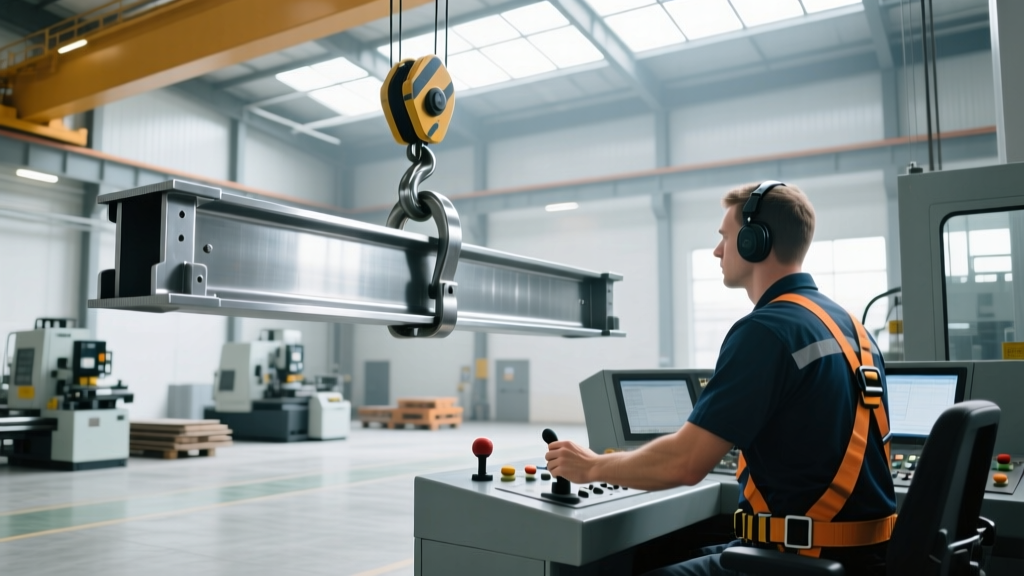
Handling Material Equipment: Overhead Bridge Crane Operator Training
Master overhead bridge crane operations with our expert guide on handling material equipment, covering load dynamics, rigging, and ASME B30.2 inspections.
The Anatomy of Bridge Crane Configurations
Operating an overhead crane requires a fundamental understanding of the machine's structural configuration and how it dictates load dynamics. When handling material equipment in heavy industrial environments, operators primarily interact with two bridge crane architectures: top-running and underhung systems. The choice between single-girder and double-girder designs directly impacts headroom, span capabilities, and the center of gravity during transit.
Top-running double-girder cranes, such as the Demag V-type series (capable of lifting up to 120 tons), utilize a tapered rotor motor design and a specialized V-shaped girder that reduces deadweight and oscillation. These systems are engineered for heavy-duty, high-cycle applications like steel service centers and foundries. Conversely, single-girder top-running models, like the Konecranes CXT (up to 80 tons), offer superior headroom in facilities with lower roof clearances but require stricter load path planning due to the trolley riding on the bottom flange of a single beam.
| Configuration | Max Span (Typical) | Capacity Range | Headroom | Primary Application |
|---|---|---|---|---|
| Single-Girder Top-Running | Up to 100 ft | 1 to 80 tons | Excellent (Hoist under girder) | General manufacturing, assembly |
| Double-Girder Top-Running | Over 150 ft | 10 to 500+ tons | Good (Hoist above girders) | Steel mills, heavy fabrication |
| Underhung (Under-Running) | Up to 80 ft | 1 to 25 tons | Poor (Requires clearance below) | Workstations, machine shops |
A fully installed 50-ton double-girder top-running system equipped with modern anti-sway variable frequency drives (VFDs) typically ranges from $180,000 to $320,000 in 2026, depending on runway length and structural reinforcements. Operators must understand that double-girder systems are inherently more resistant to skewing (bridge misalignment) due to the wider wheelbase, whereas single-girder systems demand smoother acceleration inputs to prevent lateral load pendulum effects.
Critical Pre-Shift Inspections: Beyond the Basics
Routine inspections are the first line of defense against catastrophic failure. While OSHA mandates daily visual checks, expert operators go beyond superficial glances, applying the strict discard criteria outlined in ASME B30.2 Safety Standards for Material Handling.
⚠️ WARNING: Hook Throat DegradationNever rely on visual estimation for hook wear. Use a calibrated caliper to measure the hook throat opening. If the throat opening has increased by more than 15% from the original manufacturer's baseline dimension, or if the hook exhibits any visible twist exceeding 10 degrees, it must be immediately removed from service. Hooks must never be welded or heat-straightened in the field; they require magnetic particle inspection by a certified metallurgist before any potential re-certification.
Wire Rope and Sheave Evaluation
For hoists utilizing Independent Wire Rope Core (IWRC) cables, operators must count wire breaks meticulously. The absolute discard threshold is six broken wires in one rope lay or three broken wires in a single strand. Furthermore, operators must inspect the sheave grooves. If a sheave groove is worn to the point that it no longer fully supports the rope's outer diameter, the rope will flatten under load, leading to accelerated internal friction and sudden core failure.
Rigging Geometry and Load Path Planning
Handling material equipment safely requires a rigorous understanding of rigging geometry. The angle of the sling legs directly dictates the tension placed on each leg and the horizontal crushing force exerted on the load. Many operators mistakenly believe that a 45-degree sling angle is universally safe, ignoring the exponential tension spike that occurs at lower angles.
- 60-Degree Angle (Vertical): Tension multiplier is 1.15x per leg. This is the ideal rigging configuration for maximizing hoist capacity.
- 45-Degree Angle: Tension multiplier increases to 1.41x per leg. Horizontal crushing forces become significant on fragile loads.
- 30-Degree Angle: Tension multiplier spikes to 2.0x per leg. This configuration effectively halves the safe working load of the sling assembly and should only be used with specialized spreader beams.
When maneuvering asymmetrical loads, operators must calculate the center of gravity (CoG) before the full lift. Perform a "test lift" by raising the load exactly two inches off the ground and holding for 10 seconds. If the load shifts or the hook is not perfectly plumb over the CoG, lower the load immediately and reconfigure the rigging. A hook that is even slightly off-plumb during a full lift will result in a violent lateral swing the moment the load seeks equilibrium.
Managing Load Swing and Skewing in Real-Time
Load swing (the pendulum effect) and bridge skewing are the primary causes of dropped loads and runway damage. Skewing occurs when one side of the bridge travels faster than the other, often due to rail misalignment, unequal motor torque, or dragging the load laterally.
"Modern crane operation has shifted from manual 'plugging' (reversing the motor to stop a swing) to predictive electronic damping. Operators using systems equipped with ABB ACS880 crane drives should rely on the software's anti-sway algorithms, which calculate the exact deceleration ramp needed to stop the trolley with zero residual load swing. Manual overriding of these VFD limits is a leading cause of mechanical brake burnout."
Operator Techniques for Manual Swing Control
When operating older, contactor-based cranes without VFD anti-sway technology, operators must use the "follow and catch" method. If the load swings to the right, the operator must jog the trolley to the right to catch up with the load's apex, then apply smooth braking as the load returns to the center. Never attempt to stop a swinging load by reversing the trolley direction abruptly; this induces compound pendulum forces that can snap wire ropes or derail the trolley from the girder flange.
Regulatory Compliance and Certification Standards
Proficiency in handling material equipment is legally governed by OSHA Standard 1910.179 for Overhead and Gantry Cranes. Employers must ensure that operators are not merely "trained" but formally evaluated and certified. The industry benchmark for this is the NCCCO Overhead Crane Operator Certification.
Recurrency training must address the specific failure modes of the facility's exact crane models. An operator certified on a 10-ton underhung workstation crane is not legally or practically qualified to operate a 75-ton double-girder ladle crane without extensive, documented supplemental training. Facilities must maintain digital logs of operator evaluations, daily inspection checklists, and load test certifications (requiring a 125% rated load test after any major mechanical repair or hoist replacement) to ensure total compliance and operational safety.
Related reading

Top ASRS Material Handling Equipment Companies for Robotic Palletizing
Budgeting Washdown Fleets: Reviews of Auction Platforms for Forklift and Material Handling Equipment in Food & Pharma