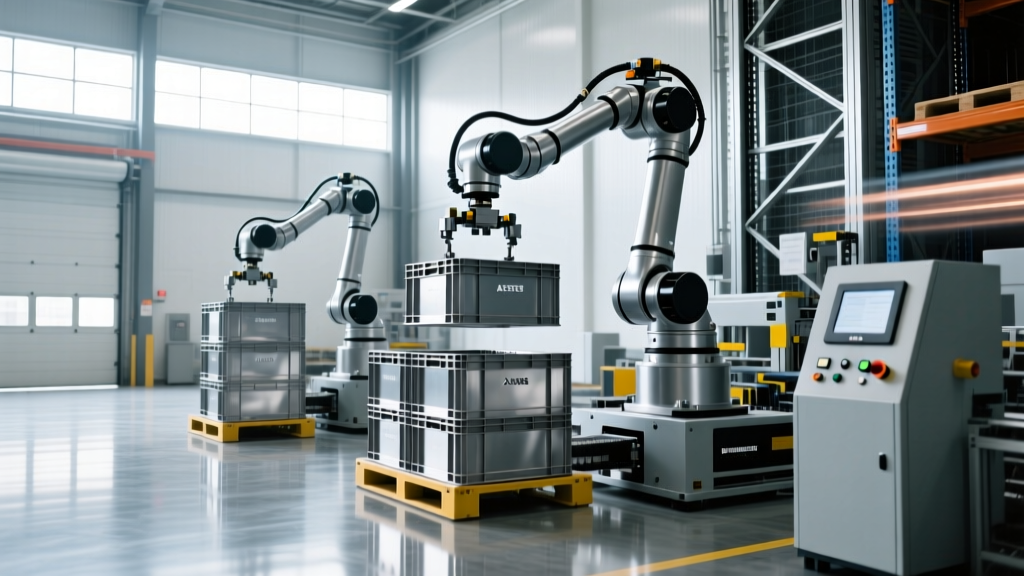
Top ASRS Material Handling Equipment Companies for Robotic Palletizing
Explore how top ASRS material handling equipment companies deploy robotic palletizing systems, featuring real-world case studies, costs, and ROI data.
The Synchronization Bottleneck: ASRS Meets End-of-Line
The transition from manual warehouse operations to high-density automated storage and retrieval systems (ASRS) frequently exposes a critical vulnerability: the end-of-line palletizing and depalletizing bottleneck. While modern shuttle-based ASRS can retrieve totes at rates exceeding 1,000 per hour, conventional manual palletizing stalls at roughly 40 to 60 cases per hour per worker. This throughput mismatch creates severe conveyor back-pressure, effectively throttling the ROI of a multi-million-dollar storage system.
To resolve this, leading facilities are integrating 6-axis robotic palletizers and AI-driven depalletizing cells directly into the ASRS warehouse control system (WCS). According to the Material Handling Industry (MHI), the synchronization between micro-fulfillment retrieval and robotic unit-load building is now the primary differentiator in modern distribution center design.
⚠️ Integration Warning: Never size a robotic palletizer based solely on the robot arm's maximum cycle speed. A FANUC M-410iC/185 can physically move at 20 cycles per minute, but if the ASRS infeed conveyor lacks adequate accumulation buffers (minimum 15 feet of zero-pressure accumulation), the robot will starve for product, dropping actual throughput to 12 cycles per minute.Case Study 1: High-Speed Beverage Mixed-SKU Palletizing
A mid-sized regional beverage distributor in the Midwest recently integrated a Dematic mini-load ASRS with a mixed-SKU robotic palletizing cell to handle highly variable grocery orders. The facility required the system to build rainbow pallets (mixed SKUs on a single layer) without crushing lower-tier corrugate.
Equipment & Architecture
- Robot: FANUC M-410iC/185 (185 kg payload, 3.1m reach). FANUC's palletizing lineup remains the industry standard for heavy, high-reach applications due to its robust gear reducers.
- End-of-Arm Tooling (EOAT): Piab Kenos KCSG modular vacuum grippers with integrated check valves. The zoned vacuum array allows the robot to pick 4 to 8 cases simultaneously while maintaining suction if one case has a porous surface.
- Software: HighJump (Körber) WMS communicating directly to the FANUC PalletTool PRO via a custom middleware layer.
Financials & Performance Metrics
The turnkey integration cost for this single cell—including safety fencing, SICK laser scanners, slip-sheet dispensers, and PLC programming—was $345,000. By eliminating three manual palletizers per shift (across two shifts) and reducing product damage claims by 18%, the facility achieved a verified ROI of 2.2 years. The sustained throughput operates at 16 cases per minute, perfectly matching the ASRS outfeed velocity.
Case Study 2: Sub-Zero Cold Storage Depalletizing
Depalletizing mixed inbound pallets in cold storage environments (-10°F) presents unique mechanical and human challenges. Human labor in these environments suffers from high turnover, mandatory 15-minute warm-up breaks every hour, and severe ergonomic risks, which the OSHA ergonomics guidelines explicitly highlight as high-risk for musculoskeletal disorders.
A major grocery fulfillment center in Pennsylvania deployed an AutoStore ASRS fed by a robotic depalletizing cell. The robot unloads mixed inbound pallets and places individual totes onto the AutoStore grid entry conveyors.
The Cold-Rated Hardware
The integrator selected the ABB IRB 460-110/2.4 equipped with the Arctic package. This package includes heated base joints, specialized low-temperature synthetic lubricants, and condensation-proof electronics housings. To handle the unpredictable stacking patterns of inbound vendor pallets, the cell utilizes a SICK Ranger3 3D laser profiler. This vision system identifies case edges, calculates the center of gravity, and directs the robotic EOAT to adjust its suction cups on the fly, preventing dropped loads.
| Metric | Manual Depalletizing (Cold) | Robotic Depalletizing (Cold) |
|---|---|---|
| Throughput (Cases/Hour) | 280 (per worker) | 850 (continuous) |
| Labor Cost (Fully Burdened) | $42/hr (includes cold premiums) | $14/hr (maintenance amortized) |
| Error/Drop Rate | 3.4% | 0.12% |
| Uptime in -10°F Environment | 65% (break mandated) | 98.5% |
Evaluating ASRS Material Handling Equipment Companies
When procurement teams evaluate asrs material handling equipment companies, the focus often drifts toward storage density metrics like cube utilization or shuttle G-force acceleration. However, the true value of an integrator lies in their software middleware and end-of-line orchestration.
The WCS Middleware Advantage
A robotic palletizer is only as intelligent as the Warehouse Control System (WCS) feeding it. Top-tier integrators do not simply pass PLC handshakes; they deploy predictive wave-planning algorithms. If the ASRS knows that a specific retail store's order requires 40 heavy cases on the bottom and 15 fragile cases on top, the WCS must sequence the tote deliveries to the robotic infeed in the exact reverse order. Companies that rely on basic FIFO (First-In-First-Out) conveyor logic will force the robot to execute complex, time-consuming restacking maneuvers, destroying cycle times.
💡 Procurement Tip: Require integrators to demonstrate their WCS 'pallet-building logic' during the vendor selection phase. Ask them to simulate a mixed-SKU wave where heavy items are retrieved from the ASRS *after* fragile items. If their software cannot dynamically re-sequence the conveyor induction to prioritize heavy items to the robot first, do not sign the contract.Hidden Failure Modes and Edge Cases
Robotic palletizing in an ASRS environment is not a 'set it and forget it' deployment. Facility engineers must proactively design for specific physical failure modes that occur when high-speed robotics interact with variable packaging materials.
Corrugate Delamination Under Acceleration
When a 6-axis robot accelerates a 40 lb case at 1.5G to meet a tight cycle time, poorly glued top flaps on recycled cardboard boxes can separate. This breaks the vacuum seal, resulting in a dropped load and a halted ASRS outfeed. The Fix: Do not rely solely on vacuum cups. Implement hybrid EOATs that combine peripheral vacuum arrays with mechanical side-clamps, or instruct the integrator to reduce the TCP (Tool Center Point) acceleration profile by 15% for known low-quality corrugate batches.
Slip Sheet Vision Blindness
Many ASRS operations require slip sheets between layers to stabilize mixed-SKU pallets. Standard 2D cameras often fail to detect the edge of a brown slip sheet against a brown wooden pallet or brown corrugate below it. The Fix: Mandate the use of 3D laser profilers (like the SICK Ranger3) or require the slip-sheet dispenser to use high-contrast (white or blue) slip sheets if 2D vision is the only budget-approved option.
Stretch Wrap Interference
If the ASRS delivers totes or cases that are lightly banded or wrapped in glossy stretch film, the glare from overhead LED warehouse lighting can blind the robot's vision system, causing mispicks. Integrators must install polarized lighting hoods over the vision inspection zone to eliminate specular reflection, ensuring the robot accurately calculates the grab points every cycle.