Robotic Palletizer Safety Rules for Material Handling Equipment Hire
Ensure OSHA and ISO 10218 compliance when renting automated systems. Learn critical safety checks for robotic palletizer material handling equipment hire.
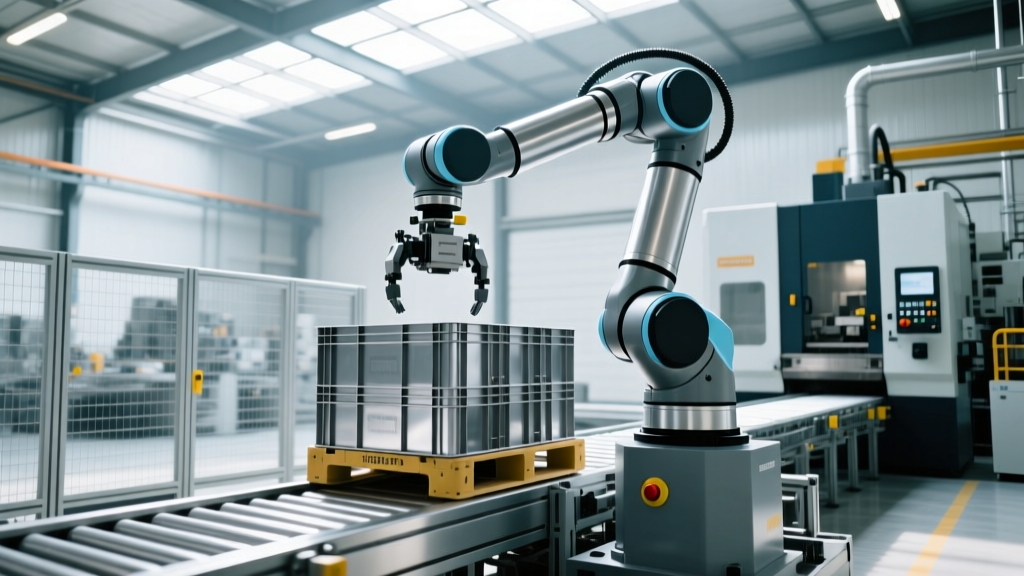
Integrating automated end-of-line systems into a warehouse or manufacturing facility is a high-stakes operational decision. When facilities opt for material handling equipment hire to deploy robotic palletizing and depalletizing systems—such as the FANUC M-410iC/110 or the ABB IRB 460—they often assume the rental provider has handled all safety compliance. This is a dangerous legal and operational fallacy. Under federal regulations, the entity controlling the workspace and directing the operators holds the ultimate liability for machine guarding and safety integration, regardless of equipment ownership.
The Liability Shift: Renter vs. Integrator
When you execute a material handling equipment hire contract for a robotic palletizer, the vendor typically delivers a pre-engineered cell or a standalone robot arm with an end-of-arm tool (EOAT). However, the physical integration into your specific facility layout, the routing of power, and the interaction with human workers fall under your jurisdiction. The Occupational Safety and Health Administration (OSHA) does not penalize the equipment lessor for a workplace injury; they penalize the employer. A single serious violation for inadequate machine guarding can result in fines exceeding $16,000 per instance, while willful or repeated violations can trigger penalties over $160,000.
⚠️ Compliance Warning: Never sign a rental acceptance certificate for a robotic palletizer until you have independently verified the safety PLC logic and physical guarding against ANSI/RIA R15.06 standards. The rental company's 'factory test' does not supersede your site-specific risk assessment.Mandatory Safety Standards for Hired Palletizers
Robotic palletizers operate at high speeds (often 8 to 12 cycles per minute) and handle massive payloads (up to 110 kg or more). The kinetic energy involved requires strict adherence to specialized robotics safety standards, which layer on top of general industry machine guarding rules.
| Standard | Focus Area | Verification Action for Hired Units |
|---|---|---|
| OSHA 1910.212 | General Machine Guarding | Verify physical barriers prevent reach-through to the robot's maximum envelope. |
| ISO 10218-1 | Robot and Robotic Devices | Confirm the robot controller has integrated safety functions (e.g., safe speed monitoring). |
| ANSI/RIA R15.06 | Robot System Integration | Ensure the rental agreement includes a site-specific Risk Assessment (RA) document. |
| ISO 13849-1 | Safety-Related Control Systems | Check that E-stops and light curtains are wired to a minimum Performance Level (PL) d, Category 3. |
Hardware Verification: Guarding and Presence Sensing
When evaluating a rented robotic palletizing cell, the physical hardware must be scrutinized for wear, correct specification, and proper placement. Rental equipment cycles through multiple facilities, meaning safety components may have been damaged or improperly reconfigured during the last teardown.
Physical Guarding Specifications
The perimeter of the palletizer must be enclosed. If the rental vendor provides welded wire mesh panels, verify that the mesh openings comply with ISO 13857 safety distance tables. For a standard 50mm x 50mm mesh, the guard must be positioned at least 850mm from the nearest robot hazard point. If the vendor uses polycarbonate shielding for visibility, it must be a minimum of 4mm thick to withstand impact from a dropped payload or a swinging EOAT.
Presence Sensing Devices
Modern depalletizing and palletizing cells rely on active optoelectronic protective devices (AOPDs). You must verify the specific models installed on the hired equipment:
- Light Curtains: Look for Type 4 safety light curtains (e.g., Omron F3SG-R or SICK deTec4). Type 2 curtains are insufficient for the high-risk environment of heavy payload palletizing. Verify the resolution is 14mm to 30mm to prevent finger or hand access.
- Laser Scanners: Area scanners like the SICK microScan3 Pro are common for pallet infeed zones. Check the scanner's configuration software to ensure the 'warning field' and 'protective field' boundaries have not been compressed to save floor space. The protective field must account for the robot's stopping distance plus the operator's approach speed (typically 1600 mm/s).
- Interlock Switches: All access gates must feature RFID-coded, non-contact safety switches (e.g., Euchner CTM or Schmersal AZM400) with guard locking capabilities to prevent operators from opening the gate until the robot has achieved a zero-energy state.
Software and Safety PLC Validation
The most critical failure point in material handling equipment hire occurs at the software logic level. A robot arm might be mechanically sound, but if the safety Programmable Logic Controller (PLC) is improperly mapped, the machine will not stop when a human breaches the perimeter.
"We frequently see rented palletizing cells where the E-stop circuit is wired to a standard I/O card rather than a dedicated safety controller. This violates dual-channel architecture requirements and can result in a failure to stop if a single wire shorts to ground." — Dr. Aris Thorne, Certified Automation Safety Professional
Ensure the rental unit utilizes a certified safety controller, such as the Allen-Bradley GuardLogix 5580 or Siemens SIMATIC S7-1500F. The safety logic must be configured for dual-channel monitoring. If one channel detects a fault (like a breached light curtain), it must trigger a Safe Torque Off (STO) or Safe Stop 1 (SS1) command directly to the robot's servo drives, bypassing the standard motion controller entirely.
Step-by-Step Safety Logic Test Before Deployment
- E-Stop Chain Verification: Depress every Emergency Stop button on the cell perimeter. Measure the time it takes for the robot to reach a complete halt. It must align with the calculated stopping time documented in the risk assessment (usually under 0.5 seconds).
- Gate Interlock Defeat Check: Attempt to reset the safety system while an access gate is open. The system must require a physical, deliberate reset action from outside the guarded space before the robot can resume operation.
- Muting Function Test: If the pallet outfeed uses muting sensors to allow full pallets to exit without tripping the light curtain, test the muting sequence with a partial or asymmetrical load. The system should fault and stop the robot if the muting sensor beam sequence is broken out of order.
- Safe Speed Monitoring: Put the robot in 'Teach' or 'Manual' mode. Force the robot to move at maximum speed. The safety controller must hard-stop the robot if it exceeds the 250 mm/s limit mandated for human-adjacent operations.
Operator Training and Documentation Requirements
Compliance does not end with hardware and software. Under OSHA's general duty clause and specific robotics guidelines, the hiring facility must ensure all operators and maintenance personnel are trained on the specific rented model. A FANUC M-410iC requires different recovery and jog procedures than a KUKA KR Quantec.
Demand the following documentation from the rental provider before the equipment is unloaded at your dock:
- Original Equipment Manufacturer (OEM) manuals in the local language.
- Electrical and pneumatic schematics with safety circuit highlights.
- A record of the last annual safety audit performed on the specific serial number you are renting.
- Lockout/Tagout (LOTO) procedures specific to the EOAT (e.g., vacuum generator bleed-down times or mechanical gripper spring tension release).
Frequently Asked Questions
Who is responsible if a rented robotic palletizer causes an injury due to a safety sensor failure?
While the equipment owner (lessor) may face civil liability for providing defective equipment, OSHA citations for workplace safety violations are almost exclusively directed at the employer (the hiring facility). You are responsible for daily safety checks and ensuring the equipment is maintained in a safe operating condition while on your premises.
Can we modify the safety guarding on a rented palletizer to fit our floor plan?
Any modification to physical guarding or safety PLC logic voids the rental provider's compliance warranties and shifts 100% of the integration liability to your facility. If the standard rental cell dimensions do not fit your layout, you must hire a certified robotics integrator to re-engineer and re-validate the safety system to ISO 13849 standards before operation.
Is a physical perimeter guard required if the robot has advanced vision-based safety sensors?
Yes. While advanced 3D vision systems and LiDAR can provide dynamic speed and separation monitoring, OSHA and ANSI/RIA R15.06 still require hard physical guarding to protect against mechanical failures, such as a payload dropping off the EOAT or a robot arm breaking loose from its base mount at high velocities. Vision systems supplement, but do not replace, physical perimeter guarding in heavy palletizing applications.
Related reading
Troubleshooting Forklift Attachments for Storeroom Bulk Material Handling Equipment Installations in California
Material Handling Equipment Costs: Pallet Racking vs AS/RS in 2026