Material Handling Equipment Costs: Pallet Racking vs AS/RS in 2026
Compare 2026 capital costs, ROI timelines, and operational expenses for selective pallet racking versus automated storage and retrieval systems.
The Capital Allocation Dilemma: Manual vs. Automated Storage
Allocating capital for warehouse expansion in 2026 requires navigating a stark financial divide. Facility planners must choose between the low-barrier, high-labor model of selective pallet racking and the capital-intensive, labor-lean model of Automated Storage and Retrieval Systems (AS/RS). According to the Material Handling Institute (MHI), the shift toward unit-load AS/RS is accelerating, driven not just by labor shortages, but by the compounding operational costs of manual forklift fleets. This analysis breaks down the exact capital expenditures (CapEx), hidden infrastructure taxes, and five-year total cost of ownership (TCO) for both systems to provide a concrete budgeting framework.
CapEx Breakdown: Selective Pallet Racking
Selective racking remains the baseline for industrial storage due to its modular scalability and immediate deployment timeline. However, 2026 steel market stabilizations and updated seismic building codes have shifted the pricing baseline.
Direct Material and Installation Costs
- Roll-Formed Selective Racking: Averages $85 to $115 per pallet position. This is suitable for standard consumer goods and environments with low seismic risk.
- Structural Steel Racking: Ranges from $135 to $175 per pallet position. Mandatory for cold storage, heavy industrial parts, or high-seismic zones (e.g., IBC Seismic Design Categories D, E, and F).
- Installation and Permitting: Professional installation adds $18 to $28 per position. Municipal permitting and stamped engineering drawings typically cost $8,000 to $15,000 per facility footprint.
Using mid-tier roll-formed racking at $100/position plus $22/position for installation, the direct CapEx is approximately $1,220,000. Add $12,000 for engineering and permitting, bringing the baseline CapEx to $1,232,000.
CapEx Breakdown: Unit-Load AS/RS
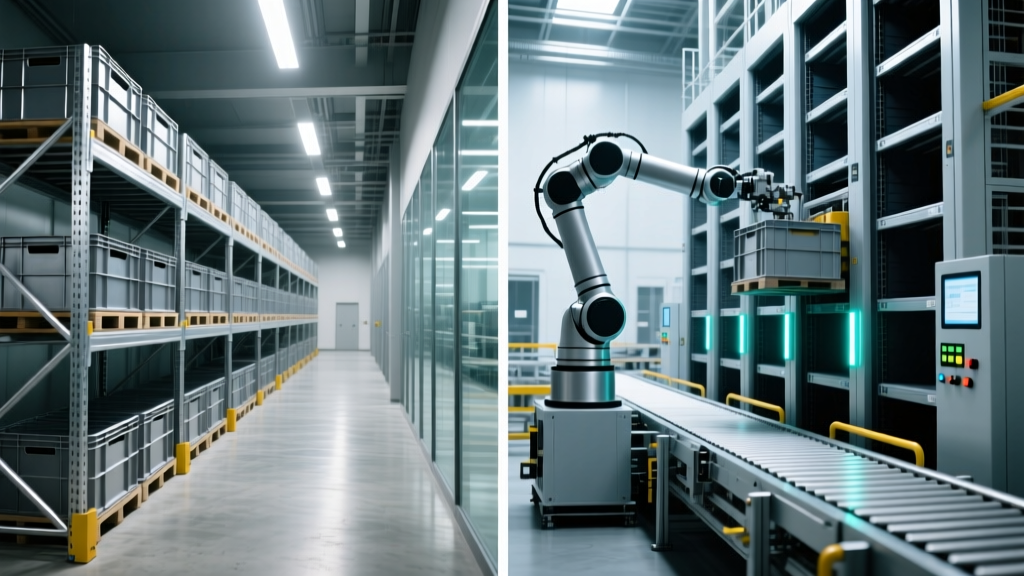
Unit-load AS/RS utilizes high-bay racking (typically 25 to 35 meters tall) integrated with computer-controlled storage and retrieval machines (SRMs). The financial barrier to entry is substantial, requiring a shift from viewing racking as 'furniture' to viewing it as 'machinery'.
Direct System Costs
A standard single-aisle unit-load AS/RS (including the SRM crane, high-bay structural racking, extractors, and aisle-end conveyors) costs between $1.8 million and $2.6 million per aisle in 2026. A 10,000-pallet facility typically requires 4 to 6 aisles, depending on building height and throughput velocity.
Software and Integration
Hardware is only half the equation. Integrating the Warehouse Control System (WCS) and tying it into your enterprise Warehouse Management System (WMS) requires specialized systems engineering. Expect to budget $250,000 to $450,000 for initial software licensing, custom API development, and site acceptance testing (SAT).
Hidden Infrastructure Taxes
Planners frequently underestimate the site-preparation costs associated with high-density material handling equipment. OSHA warehouse safety guidelines and local fire codes dictate stringent infrastructure requirements that scale with automation.
Floor Flatness and Superflat Requirements
Manual reach trucks operating in very narrow aisle (VNA) racking require a floor flatness rating of F-min 50 to 60. AS/RS cranes, however, demand superflat floors with an F-min 100 rating to prevent mast sway at 30-meter heights. Grinding and resurfacing a 50,000 sq. ft. slab to superflat specifications costs $4.50 to $7.00 per square foot, adding $225,000 to $350,000 to the AS/RS site prep budget.
Fire Suppression Upgrades
Standard selective racking up to 20 feet can often rely on ceiling-mounted ESFR (Early Suppression, Fast Response) sprinklers. AS/RS high-bay racking penetrates the ceiling smoke layer, mandating in-rack sprinkler systems. Integrating in-rack fire suppression adds $20 to $35 per pallet position, effectively adding $200,000 to $350,000 to a 10,000-position AS/RS project.
OpEx and Labor Economics
The true divergence in cost analysis occurs in years two through ten. Manual systems carry heavy, compounding labor and maintenance burdens, while automated systems shift costs to software, energy, and specialized technicians.
Manual Fleet OpEx
Servicing 10,000 pallet positions with selective racking requires a fleet of approximately 12 to 15 reach trucks and counterbalance forklifts. In 2026, a fully burdened warehouse operator costs between $52,000 and $68,000 annually (including benefits and payroll taxes). Assuming 15 operators at $60,000, the annual labor cost is $900,000. Add $180,000 for forklift maintenance, battery replacements, and facility damage repairs (upright guard replacements and rack repairs), pushing annual OpEx past $1.1 million.
AS/RS OpEx
An automated system reduces the manual forklift fleet to 2 or 3 units for dock-to-aisle transport. Labor drops to 4 system monitors and 2 specialized maintenance technicians (approx. $450,000 annually). However, you must factor in annual WCS/WMS SaaS support fees (typically 18% to 22% of the initial software cost, or ~$65,000/year) and preventive mechanical maintenance contracts (3% to 5% of hardware CapEx, or ~$300,000/year). Total AS/RS OpEx stabilizes around $850,000 annually, with the added benefit of regenerative braking on SRM cranes reducing facility energy consumption by 15% to 20% compared to manual lighting and HVAC needs in human-occupied aisles.
5-Year Total Cost of Ownership (TCO) Matrix
| Cost Category | Selective Racking (10k Pos) | Unit-Load AS/RS (10k Pos) |
|---|---|---|
| Initial CapEx (Hardware & Install) | $1,232,000 | $11,500,000 |
| Software & Integration | $0 | $350,000 |
| Site Prep (Floors & Fire) | $45,000 | $550,000 |
| Year 1-5 Labor Costs | $4,500,000 | $2,250,000 |
| Year 1-5 Maintenance & Support | $900,000 | $1,825,000 |
| 5-Year TCO | $6,677,000 | $16,475,000 |
Note: While the 5-year TCO heavily favors manual racking on paper, this matrix does not account for the real estate premium. AS/RS achieves the same 10,000-pallet density in 40% of the square footage. In markets where industrial real estate exceeds $12 per sq. ft. NNN, the land acquisition and building shell savings of AS/RS can offset $3M to $5M in CapEx.
Decision Framework: When to Pivot to Automation
Do not default to AS/RS simply to modernize. Use this diagnostic framework to determine if the capital outlay is justified for your specific operational profile.
Choose Selective Pallet Racking If:
- SKU Velocity is Highly Volatile: Your inventory profile shifts drastically quarter-to-quarter, requiring the flexibility to re-slot pallets manually without WCS reprogramming.
- Throughput is Below 40 Pallets/Hour: The mechanical cycle time of an SRM crane is wasted if dock doors and shipping schedules cannot absorb automated output.
- Capital Cost of Borrowing Exceeds 9%: In high-interest environments, financing an $11M AS/RS system destroys ROI compared to a $1.2M racking deployment.
Choose Unit-Load AS/RS If:
- Labor Markets are Constrained: Your facility is in a region with sub-3% unemployment and fully burdened warehouse labor costs exceed $65,000 annually.
- Cold Chain or Hazardous Materials: Operating in -20°C freezers or environments with toxic chemicals makes human retention nearly impossible and hazard pay exorbitant.
- Real Estate Density is Critical: You are retrofitting an existing urban-adjacent footprint where expanding the building shell is geographically or legally impossible, necessitating vertical density.
AS/RS systems require strict adherence to pallet dimensions and quality. Broken boards, protruding nails, or sagging stringers will trigger photo-eye faults and halt the crane. If your supply chain relies on low-grade, recycled GMA pallets, you must budget an additional $150,000 for an automated pallet inspection and re-stacking station at the AS/RS induction point.
Final Budgeting Directives
When presenting the budget to the CFO, separate the racking steel from the automation technology. Steel is a depreciating physical asset; the WCS/WMS software and SRM cranes are operational technology that requires continuous lifecycle management. By isolating the infrastructure taxes—specifically superflat floor grinding and in-rack fire suppression—you will prevent the 15% to 20% budget overruns that plague first-time AS/RS implementations. Consult the MHI Pallet Racking Solutions directory for certified structural engineers who can validate your local seismic load requirements before finalizing steel procurement.