Storeroom Semi-Automated Material Handling Equipment Ergonomic Solutions: AGVs
Explore technical specs, sensor fusion, and towing mechanisms of AGVs functioning as storeroom semi-automated material handling ergonomic solutions.
System Overview: AGVs in MRO Storerooms
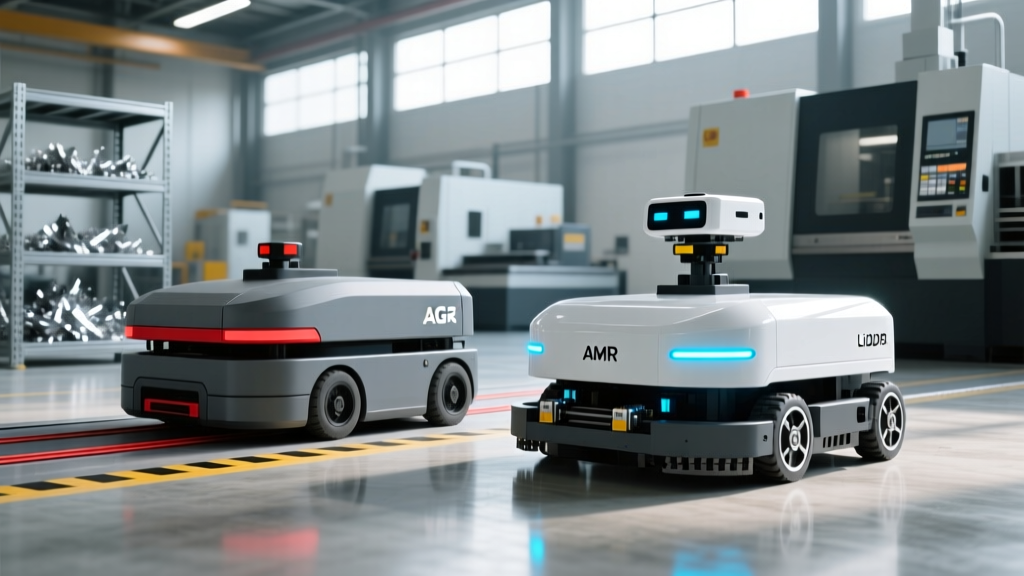
Deploying Autonomous Mobile Robots (AMRs) and Automated Guided Vehicles (AGVs) transforms manual cart-pushing into a streamlined, zero-strain workflow. By acting as the prime movers for existing rolling cages and picking carts, these units serve as premier storeroom semi-automated material handling equipment ergonomic solutions. They eliminate the 40–65 lbs of push-force typically required by warehouse personnel, directly mitigating musculoskeletal disorders (MSDs) in high-frequency Maintenance, Repair, and Operations (MRO) environments.
Navigation Architectures and Sensor Fusion Specs
Modern warehouse AGVs rely on multi-sensor fusion to navigate narrow storeroom aisles (often 60 to 72 inches wide) without requiring invasive floor modifications like magnetic tape or QR codes. The industry standard for 2026 deployments is vSLAM (Visual Simultaneous Localization and Mapping) paired with safety-rated LiDAR.
LiDAR and Optical Sensor Specifications
- Safety LiDAR: Units like the SICK microScan3 Pro offer a 275° scan angle with a 0.25° angular resolution. This provides a protective field range of up to 5.5 meters, ensuring the AGV stops well before intersecting with pedestrian traffic in blind aisles.
- 3D Vision Systems: Intel RealSense D435 depth cameras are frequently mounted at a 45-degree downward tilt. This allows the AGV to detect low-lying obstacles (like stray shrink wrap or dropped pallet bands) that fall below the 2D LiDAR scan plane.
- Mapping Tolerance: Advanced SLAM algorithms maintain localization accuracy within ±10 mm, even when the storeroom environment undergoes seasonal inventory shifts that alter the visual landscape.
Towing Mechanisms and Ergonomic Integration
The ergonomic value of an AGV is entirely dependent on how it interfaces with existing material handling carts. Forcing workers to manually align heavy carts with an AGV hitch defeats the purpose of the ergonomic intervention.
"True ergonomic integration requires the AGV to autonomously identify, approach, and secure the cart without manual physical intervention from the operator, reducing the ergonomic risk score to near-zero."
Automated Hitching Technologies
Top-tier AGVs utilize automated tow-bar systems or top-roller friction drives. The MiR Cart Connector, for example, uses a motorized hook mechanism that engages with a standardized 50mm tow ring on the cart. The AGV's front-facing LiDAR identifies the cart's base profile, autonomously aligns within a 2-inch tolerance, and engages the hitch in under 4 seconds.
AGV Fleet Comparison Matrix for Storeroom Operations
Selecting the right chassis depends on the specific payload dynamics and aisle widths of your facility. Below is a technical comparison of three leading platforms utilized in semi-automated storeroom environments.
| Specification | Mobile Industrial Robots (MiR250) | KUKA KMP 1500 | Omron LD-90 |
|---|---|---|---|
| Max Payload (Towing) | 250 kg (551 lbs) | 1,500 kg (3,306 lbs) | 900 kg (1,984 lbs) |
| Base Unit Pricing (2026) | $38,000 - $42,000 | $55,000 - $62,000 | $45,000 - $50,000 |
| Footprint (L x W) | 900 x 580 mm | 1,150 x 750 mm | 1,010 x 670 mm |
| Max Speed (Loaded) | 1.0 m/s (2.2 mph) | 1.5 m/s (3.3 mph) | 1.35 m/s (3.0 mph) |
| Ergonomic Hitch Type | Motorized Hook (MiR Cart Connector) | Automated Pin / Fork Lift | Top-Roller Friction Drive |
| Ideal Storeroom Use Case | Narrow MRO aisles, light kitting carts | Heavy die/mold transport, bulk staging | Standard picking cages, mixed-load totes |
Power Systems and Opportunity Charging Dynamics
Continuous operation in a 24/7 warehouse requires AGVs to utilize opportunity charging rather than returning to a dock for 8-hour shifts. Modern fleets utilize Lithium Iron Phosphate (LiFePO4) battery chemistries over traditional NMC (Nickel Manganese Cobalt) due to superior thermal stability and cycle life.
Battery Specifications and Charging Cycles
- Voltage Architecture: 48V DC systems are standard for towing AGVs, providing the necessary torque for initial cart breakaway without excessive current draw.
- Charge Rate: LiFePO4 cells accept a 1C charge rate safely. A 20-minute autonomous docking session during a worker's break can replenish 30% of the battery capacity.
- Cycle Life: Expect 3,000 to 5,000 full charge cycles before capacity degrades to 80%, translating to roughly 4–5 years of continuous 3-shift operation before battery replacement is required.
Edge Cases and Failure Modes in Storeroom Environments
While AGVs are highly reliable, specific storeroom environmental factors can trigger navigation faults. Understanding these failure modes is critical for facility planners.
Common Navigation Faults and Mitigation Strategies
- LiDAR Multipath Errors on Glossy Floors: High-gloss epoxy floors (common in clean-room storerooms) can reflect LiDAR laser pulses, creating "ghost" obstacles. Solution: Apply a matte polyurethane topcoat in AGV transit lanes or tune the LiDAR's remission filters to ignore high-reflectivity floor returns.
- Dynamic Obstacle Trapping: In dense MRO aisles, workers may temporarily block both ends of an aisle with pallets, trapping the AGV. Solution: Implement fleet management software with "time-out" protocols that automatically alert supervisors via SMS if an AGV remains stationary in a transit zone for more than 3 minutes.
- Wi-Fi Dead Zones in Metal Rack Aisles: Dense metal shelving creates Faraday cage effects, dropping 2.4GHz/5GHz Wi-Fi signals and disconnecting the AGV from the fleet manager. Solution: Deploy a private 5G network utilizing CBRS (Citizens Broadband Radio Service) frequencies, which penetrate metal racking structures significantly better than standard Wi-Fi.
Safety Standards and Regulatory Compliance
Any semi-automated material handling equipment deployed in a space shared with pedestrians must adhere to strict international safety frameworks. The governing standard for driverless industrial trucks is ISO 3691-4:2020.
Under ISO 3691-4, AGVs must utilize dual-channel, Performance Level d (PL-d) safety architectures. This means the safety LiDAR and the emergency stop (E-stop) circuits are redundantly monitored. If a single sensor fails or a wire breaks, the system defaults to a safe state (Category 3 architecture), immediately engaging the electromechanical brakes.
Furthermore, ergonomic compliance aligns with OSHA's general material handling guidelines, which mandate the minimization of manual lifting and pushing hazards. By replacing manual cart pushing with AGV towing, facilities routinely see a 100% reduction in push-force-related NIOSH-recordable ergonomic strain incidents. The transition from manual to semi-automated handling doesn't just improve throughput; it fundamentally redesigns the physical interaction between the worker and the load, ensuring long-term workforce health and operational continuity.