AMR vs AGV: Industrial Material Handling Equipment Solutions in 2026
Compare AMR and AGV systems for your warehouse. Discover which industrial material handling equipment solutions offer the best ROI, navigation, and flexibility.
The Core Divergence: Fixed Paths vs. Dynamic Navigation
When evaluating industrial material handling equipment solutions for modern fulfillment centers, the choice between Autonomous Mobile Robots (AMRs) and traditional Automated Guided Vehicles (AGVs) fundamentally dictates your facility's operational agility. While both automate point-to-point material transport, their underlying navigation architectures solve entirely different logistical problems.
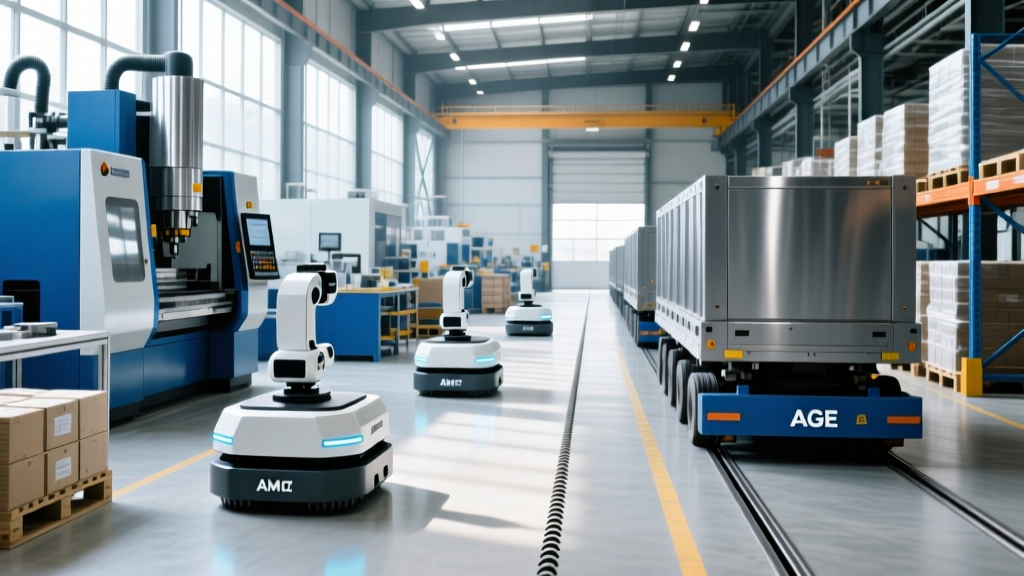
Traditional AGVs, such as the magnetic-wire systems deployed by JBT Corporation, rely on fixed physical infrastructure. They follow magnetic wires embedded in the concrete or optical magnetic tape applied to the floor. If an obstacle blocks the path, a traditional AGV halts and waits for human intervention. Conversely, AMRs like the Mobile Industrial Robots (MiR) MiR250 or Locus Robotics' LocusBot utilize Simultaneous Localization and Mapping (SLAM) combined with 2D/3D LiDAR. They map the environment dynamically, calculating alternative routes in milliseconds when encountering unexpected obstructions, such as a dropped pallet or a parked forklift.
Data Highlight: The Cost of Downtime
According to McKinsey & Company, warehouse automation can reduce operating costs by up to 40%. However, traditional AGVs experience an average of 12-15 minutes of downtime per shift due to path obstructions requiring manual resets. AMRs reduce obstruction-related downtime by 88%, dynamically rerouting without operator input.
Technical Architecture & Sensor Arrays
The hardware stack separating an AGV from an AMR is where the capital expenditure diverges. Understanding the sensor arrays is critical for facility managers assessing environmental compatibility.
| Feature | Traditional AGV (e.g., JBT, Seegrid) | SLAM-Based AMR (e.g., MiR250, Fetch Freight1500) |
|---|---|---|
| Primary Navigation | Magnetic wire, optical tape, or QR floor grids | 2D/3D LiDAR SLAM, V-SLAM (Visual SLAM) |
| Obstacle Handling | Stop and wait (e-stop trigger) | Dynamic path replanning (A* or D* Lite algorithms) |
| Sensor Hardware | Hall-effect sensors, basic ultrasonic bumpers | SICK TiM781 LiDAR, Intel RealSense depth cameras |
| Infrastructure Need | High (floor trenching, tape maintenance) | Near-zero (relies on existing structural features) |
Real-World Pricing & Infrastructure Costs
A common miscalculation in procurement is comparing the base unit price of an AGV against an AMR without factoring in facility preparation and software licensing. Here is a realistic 2026 CapEx and OpEx breakdown for a 10-vehicle fleet deployment.
Traditional AGV Fleet (10 Units)
- Vehicle CapEx: $22,000 - $28,000 per unit ($250,000 total).
- Infrastructure Installation: $14,000 - $18,000 per 1,000 feet of magnetic wire trenching and epoxy sealing. For a standard 50,000 sq. ft. facility, expect $45,000 - $60,000 in floor preparation.
- Maintenance OpEx: Optical tape degrades and requires replacement every 6-9 months in high-traffic forklift aisles, costing roughly $4,500 annually in materials and labor.
AMR Fleet (10 Units)
- Vehicle CapEx: $35,000 - $48,000 per unit (e.g., MiR250 base payload model) ($400,000 total).
- Infrastructure Installation: $0. Mapping is completed via manual joystick drive-through during commissioning.
- Software OpEx: Fleet management SaaS (e.g., MiR Fleet or Locus Orchestra) typically requires an annual license of $6,000 - $9,000 for a 10-bot cluster, including API integrations with your WMS (Warehouse Management System).
TCO Warning: The 3-Year Crossover
While AMRs require a 35-45% higher initial CapEx, the TCO (Total Cost of Ownership) crosses over in favor of AMRs at month 28. This is driven by the elimination of floor maintenance, zero downtime for path rerouting, and the ability to redeploy AMRs to a different facility without abandoning sunk infrastructure costs.
Failure Modes & Edge Cases: Where Systems Break
Vendor demonstrations occur in controlled environments. In live production, both technologies exhibit specific failure modes that engineers must design around.
AGV Failure Modes
The primary vulnerability of optical-tape AGVs is surface degradation. Heavy forklift traffic, particularly those with solid polyurethane tires, will scrub optical tape off the concrete within months. Furthermore, automated floor scrubbers using high-alkaline cleaning solutions can dissolve the adhesive backing. Magnetic wire AGVs avoid the tape issue but suffer from wire breaks when heavy loads cross the trench at sharp angles, severing the copper line and dead-ending the entire circuit until a technician splices the wire.
AMR Failure Modes
AMRs are not infallible. SLAM-based navigation relies on identifying fixed geometric features (pillars, walls, racking legs). In featureless corridors—such as a 60-meter aisle flanked by identical, flat white racking with no structural variations—an AMR can experience 'SLAM drift,' losing its X/Y coordinate confidence and triggering a safety stop.
Critical Edge Case: LiDAR Blindness
Standard 2D LiDAR sensors (operating at 905nm wavelength) struggle with light absorption and transparency. Black plastic totes absorb the laser light, rendering them invisible to the sensor. Similarly, highly reflective shrink wrap can scatter the beam, causing the AMR to perceive a solid wall where none exists. Facilities utilizing black plastics must specify AMRs equipped with 3D stereo-vision cameras or ultrasonic sensor fusion to detect these anomalies.
The Decision Framework: Matching Tech to Throughput
Selecting between these industrial material handling equipment solutions requires mapping the technology to your specific throughput profile. Use this decision matrix to guide your procurement strategy:
- Scenario A: High-Volume, Static Point-to-Point (e.g., Automotive Manufacturing)
Verdict: Traditional AGV. If the route from the receiving dock to the assembly line never changes, and the aisles are strictly segregated from human pedestrian traffic, the lower CapEx of a magnetic-wire AGV provides a faster ROI. The lack of dynamic rerouting is irrelevant in a static, controlled environment. - Scenario B: Dynamic E-Commerce Fulfillment (e.g., Goods-to-Person Picking)
Verdict: SLAM-Based AMR. If your facility shares aisles with manual forklifts, experiences shifting rack layouts, or requires seasonal scaling, AMRs are mandatory. The ability to upload a new facility map in minutes and redeploy bots to different zones during peak holiday shifts justifies the premium CapEx. - Scenario C: Heavy Payload / Outdoor Transitions
Verdict: Hybrid / Heavy-Duty AGV. For moving 5,000+ lb coils or aerospace components across outdoor aprons, traditional heavy-duty AGVs (often guided by GPS or embedded transponders) remain superior. Most standard warehouse AMRs max out at 1,500 kg (3,300 lbs) and struggle with LiDAR mapping in outdoor environments where weather and changing light conditions disrupt spatial mapping.
Safety Standards and Compliance
Deploying autonomous systems requires strict adherence to safety protocols. Historically, AGVs were governed by ANSI/ITSDF B56.5. However, the rapid evolution of AMRs necessitated a new framework. In 2020, the Association for Advancing Automation (A3) published the ANSI/RIA R15.08 standard, specifically addressing the safety requirements for industrial Mobile Robots (which includes AMRs). This standard dictates rigorous testing for dynamic obstacle avoidance, braking distances on varied floor friction coefficients, and emergency stop latency. When issuing an RFP, facility managers must explicitly require vendors to provide third-party certification of ANSI/RIA R15.08 compliance, as legacy AGV safety certifications do not cover the dynamic path-planning algorithms inherent to modern AMRs.