Storeroom Semi-Automated Material Handling Equipment Fulfillment Solutions: Sortation Training
Master operator training for storeroom semi-automated material handling equipment fulfillment solutions. Learn sortation induction, LOTO, and KPI tracking.
E-commerce fulfillment centers face a critical bottleneck at the sortation stage. Transitioning from manual push-carts to storeroom semi-automated material handling equipment fulfillment solutions requires more than just installing new hardware; it demands a fundamental shift in operator behavior. Semi-automated sortation loops—where human induction meets automated diversion and scanning—rely entirely on the precision of the operators feeding the system. A poorly trained induction team can reduce a 15,000-unit-per-hour cross-belt sorter to a jam-prone bottleneck operating at 40% Overall Equipment Effectiveness (OEE).
This guide details the exact training protocols, troubleshooting frameworks, and daily maintenance routines required to maximize throughput on semi-automated sortation systems in 2026.
Evaluating Sortation Technologies for Semi-Automated Storerooms
Before designing a training curriculum, operators must understand the mechanical realities of the specific sorter they are feeding. Semi-automated environments typically utilize three primary sortation technologies, each with distinct induction requirements and failure modes.
| Sorter Type | Leading 2026 Models | Max Throughput | Poly-Bag Compatibility | Primary Operator Focus |
|---|---|---|---|---|
| Sliding Shoe Sorter | Daifuku SSS, Honeywell Intelligrated AccuSort | 12,000 cartons/hr | Poor (bags catch on slats) | Carton spacing, rigid box orientation |
| Cross-Belt Sorter | Vanderlande Cross-Belt, Interroll MPS | 20,000 items/hr | Excellent (if centered) | Center-placement, avoiding overlap |
| Bomb Bay / Split Tray | Hytrol ProSort, Bastian Solutions | 8,000 items/hr | Good | Weight distribution, single-item drops |
Core Operator Training: Induction and Singulation
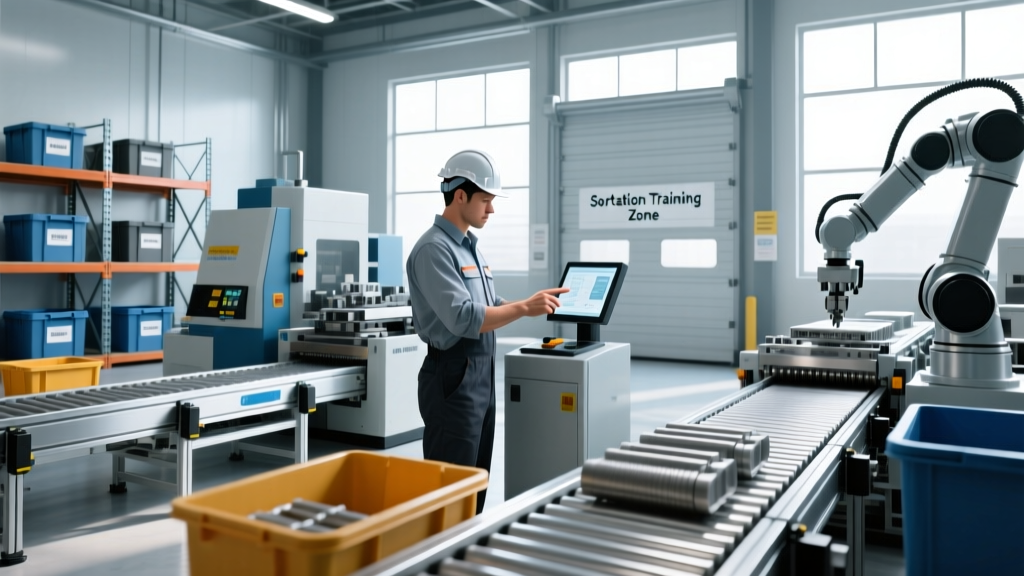
The induction station is where human error directly impacts automated downstream logic. Operators must be trained on the physics of the scanner tunnel and the mechanical timing of the diverters.
The 3-Second Spacing Rule
Automated scanner tunnels (such as the Cognex DataMan 580 5-sided scan arrays) require a minimum physical gap between items to resolve individual barcodes. Operators must be trained to maintain a strict 12-to-18-inch gap between cartons on the induction belt. Training should utilize laser-guided projection systems on the induction table that illuminate green only when the correct spacing is achieved. If operators 'shingle' or overlap cartons, the scanner reads the top barcode but misattributes it to the trailing carton, resulting in a mis-sort.
WARNING: Poly-Bag Shingling on Cross-Belt SortersPoly-bagged items (apparel, soft goods) are the leading cause of cross-belt sorter jams. Operators must never place poly-bags on the extreme edges of the carrier belt. If a bag overhangs the edge, it will slip into the 4mm gap between the carrier and the chassis, tearing the bag and triggering an immediate fault stop. Train operators to place soft goods dead-center and smooth out wrinkled barcodes to ensure a 99.2% first-pass read rate.
Barcode Orientation and Label Smoothing
While 5-sided scanners capture top, left, right, front, and rear barcodes, they cannot read through deep folds or heavy corrugated flaps. Operators must be trained to:
- Flatten 'dog-eared' shipping labels before induction.
- Orient boxes so that the largest barcode faces the top or primary side scan window.
- Reject severely damaged cartons to a manual rework station rather than forcing them onto the automated loop.
Jam Clearance and LOTO Protocols
When a jam occurs inside the sorter loop, the instinct of an untrained operator is to reach in and pull the stuck carton. This is a severe amputation hazard. Training must strictly enforce Lockout/Tagout (LOTO) procedures as mandated by OSHA Standard 1910.147.
Facility managers must implement a tiered response system for jam clearance:
- Tier 1 (Accessible Jams): Jams occurring at the induction or discharge chutes. Operators may clear these using the 'E-Stop and Hold' protocol, provided no body part crosses the light curtain plane.
- Tier 2 (Internal Loop Jams): Jams inside the enclosed sorter loop. Operators must press the local E-Stop, apply their personal padlock to the main disconnect, and verify zero energy state before opening the access panels.
- Tier 3 (Mechanical Faults): If a carton is wedged under a drive belt or a shoe is derailed, operators must not attempt removal. This requires a certified maintenance technician.
'According to the Conveyor Equipment Manufacturers Association (CEMA), over 60% of conveyor-related amputations occur during jam clearance when operators bypass safety interlocks to maintain production quotas. Training must emphasize that a 5-minute LOTO procedure is always faster than a 6-month OSHA investigation.'
Daily Preventative Maintenance (PM) for Operators
Operators are the first line of defense against mechanical degradation. While they do not replace parts, they must perform specific daily checks to ensure the semi-automated system operates within tolerance.
Pneumatic Diverter Air Pressure Checks
Sliding shoe and pop-up diverters rely on plant compressed air to actuate. If plant air pressure drops, diverters will fire too slowly, causing cartons to bounce off the shoe and jam the discharge chute. Operators must be trained to check the local FRL (Filter-Regulator-Lubricator) gauge at the start of every shift. The gauge must read between 85 and 95 PSI. If it reads below 80 PSI, the operator must notify maintenance immediately before starting the induction belt.
Photoelectric Sensor Lens Cleaning
Dust and cardboard particulate accumulate rapidly on the photoelectric sensors that track carton position on the induction belt. Operators must wipe the lenses of the induction zone sensors with a microfiber cloth and isopropyl alcohol at the beginning and middle of every shift. A dirty sensor will cause the PLC to miscalculate carton length, resulting in improper gap creation downstream.
Measuring Training Effectiveness: KPIs to Track
To validate the ROI of your training program, track these specific metrics on the warehouse management system (WMS) dashboard:
- Induction Rate (Units/Hour): Target 600-800 units per hour per operator. Rates above 900 usually indicate shingling and poor gap control.
- First-Pass Read Rate: Should exceed 98.5%. Drops in this metric indicate operators are failing to flatten labels or orient boxes correctly.
- Mis-Sort Percentage: Target less than 0.1%. High mis-sorts point to scanner tunnel calibration issues or operators feeding overlapping items.
- Unplanned Downtime (Minutes): Track downtime specifically coded to 'Induction Zone Jams' to identify operators who require retraining on spacing protocols.
Frequently Asked Questions
Can semi-automated sorters handle mixed cartons and poly-bags simultaneously?
Yes, but only on cross-belt or tilt-tray sorters. Sliding shoe sorters will tear poly-bags. If your fulfillment center processes a mixed media stream, you must train operators to separate soft goods from rigid corrugated boxes at the picking stage, or route them to different induction lines.
What is the average cost to retrofit a manual storeroom with a semi-automated sortation loop?
In 2026, a basic 50-discharge semi-automated sliding shoe sorter retrofit, including induction conveyors, 5-sided scanning, and PLC integration, typically costs between $180,000 and $320,000, depending on the facility's structural constraints and electrical upgrade requirements.
How often should operators be recertified on LOTO procedures?
OSHA requires periodic inspections of LOTO procedures at least annually. However, best-in-class fulfillment centers conduct hands-on LOTO recertification every six months, and immediately following any near-miss incident or equipment modification.